
Advanced Diploma in Technology, Subjectivity and Politics
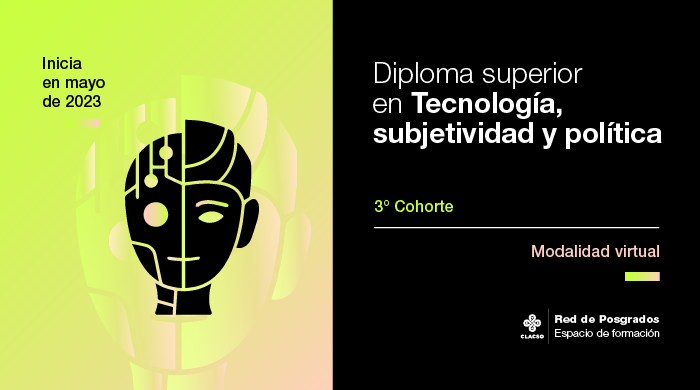
3rd cohort | Virtual modality
ACADEMIC COORDINATION
Paula Sibilia (Federal Fluminense University, Brazil), Fernanda Bruno (Federal University of Rio de Janeiro, Brazil) and Flavia Costa (University of Buenos Aires, Argentina)
PEDAGOGICAL COORDINATION
Christian Dodaro (University of Buenos Aires and National University of Avellaneda, Argentina)
PROFESSORS
Fernanda Bruno (Federal University of Rio de Janeiro, Brazil), Christian Ferrer (University of Buenos Aires, University of Cinema and Torcuato Di Tella University, Argentina), Claudio Celis Bueno (Academy of Christian Humanism University, Chile), Flavia Costa (University of Buenos Aires, Argentina), Paula Sibilia (Federal Fluminense University, Brazil), Claudia Kozak (University of Buenos Aires, Argentina) and Pablo M. Rodríguez (University of Buenos Aires, Argentina).
Virtual format | May to September 2023
In this diploma program, we aim to explore the magnitude and meaning of the changes occurring in our time—a time of increasing "technification." We will focus on the intersection between technical devices, the political rationalities and technologies that underlie them, and the modes of subjectivation that both promote or encourage.
We will seek to delve deeper into the processes, as well as the most innovative analyses, that have emerged in the last fifteen years: the validity of a new “algorithmic governmentality” associated with the availability of massive data or big data; the development of platforms whose business model is concentrated on the extraction and sale of data, both biometric and behavioral, and their repercussions on subjectivities.
Among the many diagnoses of our time, one of the most evident is that we inhabit an era of increasing "technification." One need only observe the speed at which the technology parks surrounding us rotate, in a manner as routine as it is ostentatious, to perceive the power and ubiquity of their network. This complex information and technology web has gone from being a set of means through which to achieve certain ends, to becoming our world environment, our environment in an ecological and environmental sense.
The “media” is, therefore, a relevant and paradoxical phenomenon in contemporary culture: it disrupts the hierarchy of the senses, organizes new ways of understanding existence, puts pressure on the forms of self-understanding of the living human being (are we our genes? are we our brain? are we our data?) and impacts art, architecture, and urban life. At the same time, the metamorphoses in work processes and a new order of relationships and intersections between “leisure time” and “work time” have substantially transformed our relationship with suffering and subjugation. And they compel us to ask ourselves again and again what a body is and what it can do, at a time when technology embodies and is incorporated into the human being through implants, transplants, surgical interventions, gene therapies, in a movement that opens up the questioning of the body itself as a kind of unfinished, operable project, which can and even should be shaped according to taste, convenience, social demands, or a mixture of the three.
In this diploma program, we aim to explore the magnitude and meaning of the changes that have occurred, moving beyond the overly simplistic dichotomy between "technophiles" and "technophobes." We will focus on the intersection between technical devices, the political rationalities and technologies that underlie them, and the modes of subjectivation that both promote or encourage.
To that end, we will outline a map of the different lines of thought on the technological phenomenon that have shaped the 20th and early 21st centuries. We will delve into the most innovative processes and analyses that have emerged in the last fifteen years: the rise of a new “algorithmic governance” associated with the availability of big data; the development of platforms whose business model focuses on the extraction and sale of data, both biometric and behavioral, and their repercussions on subjectivities. We will also address the transformations in work processes; the increasingly ubiquitous number of devices, surfaces, and immersive and “smart” environments with which we interact daily: screens, mobile devices, and information and communication networks. We will also attempt to discern the effects of the “virtual shock” brought about by the coronavirus pandemic: an accelerated and massive process of digitization of everyday experience that—it is claimed—is “here to stay.”
GENERAL PURPOSE:
To provide a historical-critical training on the relationships between technology, subjectivity and politics.
SPECIFIC OBJECTIVES:
- To present an overview of the classic approaches and the most recent arguments in the debate and literature on the relationships between technology, subjectivity, and politics.
- To foster a transdisciplinary and multifaceted perspective on the main problems of technologically mediated societies and experiences.
- To bring into dialogue the perspectives of the Global North and Latin America.
The Higher Diploma in Technology, Subjectivity and Politics is aimed at undergraduate and postgraduate students; teachers at all levels; activists and members of trade unions, social movements and political parties; public officials; members and managers of non-governmental organizations and professionals interested in the subject.
- Fernanda Bruno (UFRJ, Brazil)
- Claudio Celis Bueno (UACH, Chile)
- Flavia Costa (UBA, Argentina)
- Christian Ferrer (UBA, FUC and Di Tella, Argentina)
- Claudia Kozak (IIGG/CONICET, Argentina)
- Pablo M. Rodríguez (CONICET, Argentina)
- Paula Sibilia (UFF, Brazil)
The program consists of 5 modules of 3 weekly classes each, taught consecutively and linked together.
Total workload of 128 hours.
The modules that comprise the advanced diploma are:
PROFESSOR: FLAVIA COSTA
CLASS 1: Information Technology Lifestyles
Uted. Reflections on technology and subjectivity at the beginning of the 21st century. Between the “somatic individual” and the body-sign. Modes of subjectivation in the era of information-technological lifestyles.
This. Reflections on the experience of time. Between the 24/7 rhythm and sedentary multitasking.
Here. Reflections on spaces: personal ubiquity and cybergeographies. Archaeology of media and the digital world. Infrastructures of submarine cables, satellites, hubs, platforms: from the point of view of their materiality, “the cloud” is many things but not a “cloud”.
CLASS 2: From disciplinary societies to control-security societies
Foucault's notion of biopower, and contemporary studies on biopolitics and thanatopolitics. "Affirmative" and "negative" biopolitics. The problem of life in control societies. Societies of sovereignty, societies of discipline, control societies, or societies of "governmentality": risk, play, and security in the age of big data.
CLASS 3: Technocene, Anthropocene and “inhuman power”
Anthropocene, Technocene, Capitalocene: the expansion “from above” of the biopolitical battlefield. Technology as material infrastructure and as a historical force capable of affecting life: its relationship with the ecological, the sustainability of development, and the inequalities that are both a condition and a structural effect of the capitalist technical code. Anthropocene and Transhumanism: two narratives of the end—of humanity and the world as we know them. Is a “critical transhumanism” possible?
TEACHER: PAULA SIBILIA
CLASS 4: The digitized life and self-optimization
Although the most evident impact has occurred in the realm of communications and information, digital devices are replacing old analog tools in all areas. This transition from the mechanization to the digitization of life implies a far-reaching historical transformation with multiple consequences, suggesting significant changes in bodies and subjectivities.
CLASS 5: Between walls and networks: the discomfort of the unlimited
By becoming "compatible" with mobile communication and information devices, networks tend to penetrate all walls (and inhibitions), highlighting both the crisis of modern institutions and the profound historical transformations affecting subjectivities. The conversion of domestic space into a business, classroom, and vital hub in the home-based consumption network: visibility, connection, precarity, and multitasking on a 24/7 rhythm. From repression to stimulation: if overly rigid limitations caused suffering for modern citizens, the seemingly limitless horizon of possibilities and promises now opening up to consumers also provokes unease.
CLASS 6: Tensions between (self-)spectacle and (lack of) control
The spectacularization of the self on social media and the type of sociability these practices propagate: autofiction, performance, extimacy, likes, selfies, and algorithms. Advertising as a model, marketing, and corporate dynamics. The decline of psychological interiority in the age of always-online profiles: from "intro-directed character" to "alter-directed personalities." The difficult balance between the (self-)control required by "self-curation" and constant monitoring. The problem of otherness in the age of the "show of the self." The gaze of the other in the attention economy and generalized evaluation: bullying, cancel culture, trolls, haters, and virtual lynchings. The shift from guilt to shame as privileged mechanisms of social control.
TEACHER: FERNANDA BRUNO
CLASS 7: Culture of surveillance and algorithmic governmentality
The naturalization of the "culture of surveillance" and the production of subjectivities. Distributed surveillance and surveillance capitalism in the digital ecosystem. Algorithmic governmentality and profiling. Between digital (behavioral) footprints and fingerprints (biometric): are we our data?
CLASS 8: The psychic economy of algorithms
How do behavioral, psychological, and emotional data feed the algorithms of digital platforms? Business models, epistemological models: the value of psychic and emotional data. The platform laboratory and the algorithmic management of behavior: from prediction to capture. Pressures and incentives on the individual, the individual, and the transindividual.
CLASS 9: Decolonial perspectives on technopolitics and surveillance archives
How to situate the debate on technopolitics and surveillance in Latin America: colonial and feminist matrices. Policies decoloniais dos arquivos da vigilância. Reinscriptions of colonialism and extrativism given on digital platforms. Technopolitical feminism and human-machine relationships.
TEACHER: PABLO MANOLO RODRÍGUEZ
CLASS 10: Art and technique as regimes of experimentation of the sensible and powers
of creation
Art, technology, and society. Intermediality and/or transmediality in technological arts. Experimentalism, expanded arts, and technology. The Adorno/Benjamin debate. Technopoetics/technopolitics. Positions. Debates surrounding imaginaries of technological modernization and ideologies of progress. Anachronisms and deviations. Politics of error and randomness. The new versus novelty. Challenges of experimentation in contexts of mass flows.
CLASS 11: A Brief History of A+T
Historical avant-gardes and technological landscapes. Latin American avant-gardes and technology. Technological modernization and centers of condensation and radiation: the early 20th century, the 1960s, the 1990s to the 21st century. Technopoetics in bioinformatic domains. Performance, technology, and subjectivity. Technopoetics and algorithmic culture.
CLASS 12: Case study. (Techno)experimental drifts of literature at its intersection with visual, sound, body languages and digital codes
Expanded Literatures: On Books and Other Monstrosities in the Bioinformatic Domain. Digital Literature as Programmed Textual Art: History, Theory, Criticism. Materialities. How It Is Read. Hegemonic Politics of Languages in Global-Digital Contexts. On Deviations, Outrages, and Philosophies of the Event. Programs and “De-programs.” Determination and Chance. Contemporary Latin American Digital Literature and Migrant Translanguages.
INTEGRATION ACTIVITY
TEACHER: PABLO MANOLO RODRÍGUEZ
CLASS 13: The historical informational a priori and the divided
Information and cybernetics as new technological and epistemic strata of the contemporary world. Their translation into data, algorithms, and platforms: the DAP system. Digitization and protocolization of social life. Algorithmic governmentality: challenges of the Turing machine to modern humanism. Effects of information technologies on subjectivity and political bonds: the problem of the divided.
TEACHER: CLAUDIO CELIS BUENO
CLASS 14: Digital Technologies and Capitalist Valorization
The problem of continuity/discontinuity in modes of production. The transition from Fordism to Post-Fordism. Three interpretations of contemporary capitalism: i) critical theory of value; ii) post-operaism; iii) capital is dead.
CLASS 15: Cognitive Capitalism and New Forms of Valorization
Immaterial labor and the social factory: new forms of valorization and subsumption. Consequences: the crisis of the labor theory of value (Negri and Hardt); the becoming of capital as rent (Vercellone; Fumagalli). Platform capitalism (Srnicek).
INTEGRATION ACTIVITY
CLASS 16: INTERVIEW WITH CHRISTIAN FERRER
CLASS 17: Is capital dead? New perspectives for thinking about the future
The question of the outside to capital: a) the acceleration / deceleration debate; b) capitalism and algorithmic automation (the question of living labor); c) beyond capital (information, hackers, cyborgs and vectorialists).
| In one payment by 22/05 | In one payment after 22/05 | Payment in 3 installments | |
| CM Pleno | $175 | $230 | USD 315 (3 x USD 105) |
| CM Associate | $300 | $360 | USD 540 (3 x USD 180) |
| No link | $300 | $360 | USD 540 (3 x USD 180) |
To participate, you must register using the online form by clicking here. Registration will be open from March 6 to May 29, 2023.
Upon completion of the registration process, you will receive a confirmation in your email.
Classes will begin in May and conclude in September 2023.
All registered participants will receive the necessary instructions to access the classes, bibliography and discussion forums through the CLACSO Virtual Training Space.
Accessing and navigating the Virtual Learning Environment is very simple and user-friendly. In any case, a technical and academic support team will always be available to you.
Exceptional Criteria: In exceptional cases, and within the first month of the start of the Advanced Diploma program, students may request to withdraw from the cohort and rejoin the following year. In all cases, the reasons for the request must be submitted in writing. After this initial period, no requests will be accepted.
Money paid will only be refunded in cases where the organizing institutions decide to cancel the activity.
| In one payment by 22/05 | In one payment after 22/05 | Payment in 3 installments | |
| CM Pleno | $175 | $230 | USD 315 (3 x USD 105) |
| CM Associate | $300 | $360 | USD 540 (3 x USD 180) |
| No link | $300 | $360 | USD 540 (3 x USD 180) |
Payment can be made in one installment by credit card, bank deposit, or bank transfer. We also offer the option of paying in 3 installments.
Yes. There will be discounts for students belonging to CLACSO Member Centers and CLACSO Associated Centers, for CLACSO Associate Researchers, and for all those who pay within the discount period.
Inquiries: WhatsApp: +54 9 11 3880 – 1388
Email: [email protected]

