
Advanced Diploma in Sovereignty and Cultural Policies in Latin America
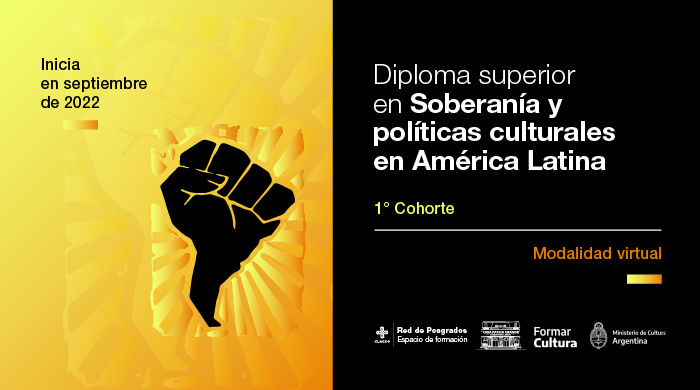
1th Cohort | Virtual Modality
INSTITUTIONAL COORDINATION: Juan Manuel Aranovich (National Directorate of Cultural Training – Ministry of Culture of the Nation, Argentina) and Alejandro Gambina (CLACSO)
ACADEMIC COORDINATION: Bruno Maccari (National Directorate of Cultural Training – Ministry of Culture of the Nation, Argentina)
PEDAGOGICAL COORDINATION: Paula Baró (National Directorate of Cultural Training – Ministry of Culture of the Nation, Argentina)
TEACHING TEAM: Martín Becerra | Juan Espinoza del Villar | Natalia Calcagno | Sabrina Cassini | Mercedes Gómez Chapman | Rodolfo Hamawi | María Pía López | Paola de la Vega | Nicolás Sticotti | Marcela País Andrade | Romina Solano | Ministers and Former Ministers of Culture of Latin America | Invited Specialists and Experts
Virtual format | September to December 2022
El Advanced Diploma in Sovereignty and Cultural Policies in Latin America It is a regional training program that aims to inaugurate a space for reflection, debate and specialization focused on the binomial of culture and politics, under the premise of collectively reflecting on the role and challenges of cultural policies in the new scenario of Latin America.
Organized jointly by the Latin American Council of Social Sciences (CLACSO) and the National Directorate of Cultural Training of the Secretariat of Cultural Management of the Ministry of Culture of the Nation, with the support of the Casa Patria Grande "President Néstor Carlos Kirchner". The program is specifically geared towards professionals, managers, researchers, students, officials and other agents in the cultural field interested in the topic of cultural policies from a regional, political and sovereign perspective.
Delivered virtually and structured around weekly classes, the first edition will be an intensive, three-month program, running from September 15 to December 10, 2022. The program is organized around a variety of learning resources, both synchronous and asynchronous: lectures, interviews with officials and experts, policy and program analyses, workshops and working groups, forums, and special activities. The program also includes special opening and closing events in a hybrid format with public access, as well as a free, open regional module accessible through the CLACSO and [other networks]. formar.cultura.gob.ar, learning platform of the Ministry of Culture of the Nation.
Designed and taught by a team of professionals specializing in the subject (officials, researchers, teachers, consultants, analysts), the program's meetings will not only be dedicated to explaining the main concepts and presenting the various approaches to cultural policies, but also to promoting the exchanges and debates necessary to reflect collectively on the regional challenges in terms of institutionality, policy, management and cultural sovereignty.
This Higher Diploma aims to contribute to the construction of new regional agendas that not only generate critical and constructive knowledge based on these historical experiences and models, but also provide the tools, concepts, and practices to decipher the new cultural ecosystem in the region, recover the cultural dimension of regional integration, and strengthen the priority of cultural policies from a perspective of commitment, participation, diversity, transformation, and cultural sovereignty for community development and the improvement of the quality of life of our peoples.
What is the current agenda shaping the regional cultural landscape? What are the emerging debates, movements, and experiences that characterize the new cultural map in Latin America? How can the cultural dimension be reintegrated into the debates and spaces of regional integration? What are the limitations and challenges when considering a model of regional cultural policies that is Latin American, sovereign, and transformative? In what direction could emblematic cultural policies and programs be rethought in light of the new dynamics and demands of society? What are the scope and challenges our states face when designing policies and programs within the framework of new sectoral dynamics? Can we identify a cultural policy model characteristic of Latin America? And if so, what features, components, and differentiating elements would define it? How can we envision a better shared future from a culturally responsible, sustainable, and inclusive perspective? What guidelines and characteristics should regional cultural policies consider for a common future? These are some of the questions that the Higher Diploma in Sovereignty and Cultural Policies in Latin America seeks to open, analyze, debate and deepen, in a collective and diverse way, and in a political, regional and sovereign key.
GENERAL PURPOSE
- To contribute to the processes of strengthening and professionalizing public cultural policies from a regional and sovereign perspective, with the purpose of recovering the centrality of the culture and politics binomial as a key dimension in the new agenda of challenges in Latin America.
OBJECTIVESPECIFIC
- To promote a collective space dedicated to thought and reflection on the current coordinates and challenges that the countries of the region are currently facing in terms of culture, public policies, sovereignty and cultural development.
- To provide notions, tools and methodologies aimed at the professionalization of management in the cultural sector, from a Latin American and contemporary perspective, which places culture at the center of debates and on the public agenda of the development processes —human, social, economic, sustainable— of our peoples.
- To consolidate a regional training and professional networking space aimed at promoting exchanges, debates and collective contributions in the area of cultural management and policies, taking into account their unique characteristics, perspectives and common processes.
- To share background information, experiences, materials, and case studies that allow for shared learning and reflection on the implementation, development, and continuity of public cultural management policies, programs, and initiatives implemented in the region.
The Higher Diploma in Sovereignty and Cultural Policies in Latin America is aimed at undergraduate and postgraduate students; cultural managers and practitioners; teachers and researchers; officials and agents of the public cultural sector; members and managers of non-governmental organizations and professionals; independent cultural producers, creators and promoters, especially interested in the subject of cultural policies from a regional, political and sovereign perspective.
- Martin Becerra
- Juan Espinoza del Villar
- Natalia Calcagno
- Sabrina Cassini
- Mercedes Gómez Chapman
- Rodolfo Hamawi
- Julia Houlle
- María Pía López
- Marcela País Andrade
- Paola de la Vega
- Nicolás Sticotti
- Romina Solano
- Ministers and Former Ministers of Culture of Latin America
- Invited specialists and experts
The first edition of Advanced Diploma in Sovereigntyíay polícultural practices in AmericaéLatin Rich It will be taught in an intensive format over a three-month period: from September 15 to December 10, 2022. The course format is virtual, with synchronous meetings on Tuesdays (every week) and Thursdays (every 15 days), from 18 to 20 pm (ARG).
The program is organized around a variety of training resources, both synchronous and asynchronous: lectures, interviews with officials and experts, policy and program analyses, workshops and working groups, forums, and special activities. The program also includes opening and closing events in a hybrid format with public access, as well as an open and free regional module, accessible through the CLACSO and [other networks]. formar.cultura.gob.ar, learning platform of the Ministry of Culture of the Nation.
Modules 1, 2, and 3 will be taught in synchronous virtual format and in continuous classes on Tuesdays; Module 4 will be taught in synchronous virtual format once a month (organized into 5 working groups; applicants must choose one of these groups at the time of registration); Module 5 will be taught in asynchronous virtual format and will be open access; the special opening and closing activities will be held, on dates to be confirmed, in a hybrid format (virtual and in-person; in-person participation in these activities is not required).
Modules:
-
The political dimension of cultural policies: cultural policies, the State and public cultural management
-
The social dimension of cultural policies: the conversation with civil society
-
The economic dimension of cultural policies: reflections on the economics of culture, the State and the cultural market
-
The technological dimension of cultural policies: keys to a cultural economy in times of digital convergence
-
(De)naturalizing the cultural aspects of policies for their management
-
Management as a political tool for cultural sovereignty
-
Cultural territories of collective management
-
Latin America in Network: Organizational Practices, Interaction Perspectives
-
Cultural policies: definitions, approaches, cycles and stages
-
Political agenda and implementation
- Coordinates, debates and challenges
This module of the Advanced Diploma program is dedicated to exploring five key areas of work in order to foster reflection, exchange, and specialized contributions within the field of public cultural policy. To this end, five regionally renowned professors and experts will initially present the content framework and working guidelines for each group's theme. Following this, the specialists will facilitate and moderate the exchanges and discussions necessary to delve deeper into each group's area of focus. Upon registration, applicants must select two options from the thematic alternatives offered for this edition.
The working groups, areas of focus, and those responsible will be:
- Working Group 1: Public Cultural Management
- Working Group 2: Policies for the cultural and creative industries
- Working Group 3: Cultural Rights, Inclusion and Citizenship
- Working Group 4: Publics, Audiences and Communities
- Working Group 5: Culture, communication and public space in the digital age
This module of the program consists of a series of interviews with four current and former Ministers of Culture from Latin America. The aim of the series is to discuss their management experiences, the political conception of their work, aspects of cultural institutions, and the challenges of sovereignty and cultural policies in Latin America. The interviews will be conducted by a team of researchers in the field of cultural management and policy and will be linked to the cross-cutting theme of Mundiacult 2022.
The four interviews form a comprehensive, publicly accessible series and will be broadcast through the CLACSO and other networks. formar.cultura.gob.ar, learning platform of the Ministry of Culture of the Nation (Argentina).
Among the Ministers and former Ministers to be interviewed will be:
Juliet Brodsky, Minister of Culture of Chile
Ticio Escobar, former Minister of Culture of Paraguay
Juca Ferreira, former Minister of Culture of Brazil
Coordination: Paola de la Vega y Nicolás Sticotti
CLACSO Scholarship Fund - Casa Patria Grande
To encourage the participation of students and researchers from the Associated Centers of the CLACSO network, 50 scholarships will be awarded to enroll in this Higher Diploma.The scholarships cover 100% of the tuition cost.
Participants will be selected by the evaluation team appointed by the convening organizations. Applications will be submitted through the CLACSO website.
Scholarship allocation method:
- Candidates must complete the scholarship application available at https://sistemas.clacso.org/inscripciones/becas/inscripciones/login.php?convocatoria=39
- The available scholarships (50) will be assigned to students in training respecting gender equity.
- An Academic Committee will analyze the applications and award the scholarships; it is not possible to appeal the result.
- This call for scholarship applications will remain open until the September 5
Scholarship Fund of the Ministry of Culture of the Argentine Nation
The call for applications to the scholarship fund of the Ministry of Culture of the Argentine Nation
To participate in the Higher Diploma in Sovereignty and Cultural Policies in Latin America, it is directed exclusively to those people of Argentine nationality who meet the registration requirements detailed below. The scholarships cover 100% of the tuition cost.
- Residing in one of the provinces of Argentina.
- Having prior experience and/or knowledge in the subject matter of the course.
- Attach a letter of reference (not a mandatory requirement).
- Submit a statement of intent to become a beneficiary of the scholarship.
- Since the Diploma will be delivered virtually, having internet connectivity is a mandatory requirement to participate.
- Complete the online pre-registration process during the application period; applications submitted after the deadline will not be accepted. https://forms.cultura.gob.ar/index.php/143119?lang=es
- No prior university or secondary school degree is required, although the Higher Diploma is specifically aimed at undergraduate and postgraduate students.
- The registration period is from August 16 to 29, 2022.
| In one payment by 04/09 | In one payment after 04/09 | Payment in 3 installments | |
| CM Pleno | $115 | $230 | USD 315 (3 x USD 105) |
| CM Associate | $240 | $360 | USD 540 (3 x USD 180) |
| No link | $240 | $360 | USD 540 (3 x USD 180) |
To participate, it is essential that you register using the online form.
Upon completion of the registration process, you will receive a confirmation in your email.
Classes will begin in September and will conclude in December 2022.
All registered participants will receive the necessary instructions to access the classes, bibliography and discussion forums through the CLACSO Virtual Training Space.
Accessing and navigating the Virtual Learning Environment is very simple and user-friendly. In any case, a technical and academic support team will always be available to you.
Exceptional criteria: In exceptional cases, and within the first month of the start of the Advanced Diploma program, students may request to withdraw from the cohort and rejoin the following year. In all cases, the reasons for the request must be submitted in writing. After that initial period of time has elapsed since the start of the course, no further requests will be accepted. Under no circumstances will refunds be issued.
Participants who meet the attendance and evaluation criteria will be accredited by the Latin American Council of Social Sciences (CLACSO) and the Ministry of Culture of the Argentine Nation with the Higher Diploma in Sovereignty and Cultural Policies in Latin America.
| In one payment by 04/09 | In one payment after 04/09 | Payment in 3 installments | |
| CM Pleno | $115 | $230 | USD 315 (3 x USD 105) |
| CM Associate | $240 | $360 | USD 540 (3 x USD 180) |
| No link | $240 | $360 | USD 540 (3 x USD 180) |
Payment can be made in one installment by credit card, bank deposit, or bank transfer. We also offer the option of paying in 3 installments.
Yes. There will be discounts for students belonging to CLACSO Member Centers and CLACSO Associated Centers, for CLACSO Associate Researchers, and for all those who pay within the discount period.
Queries: WhatsApp:+54 9 11 3880 – 1388
E-mail: [email protected]

