
Advanced Diploma in Historical Reparation and Afro-Diasporic Perspectives in the Digital Age
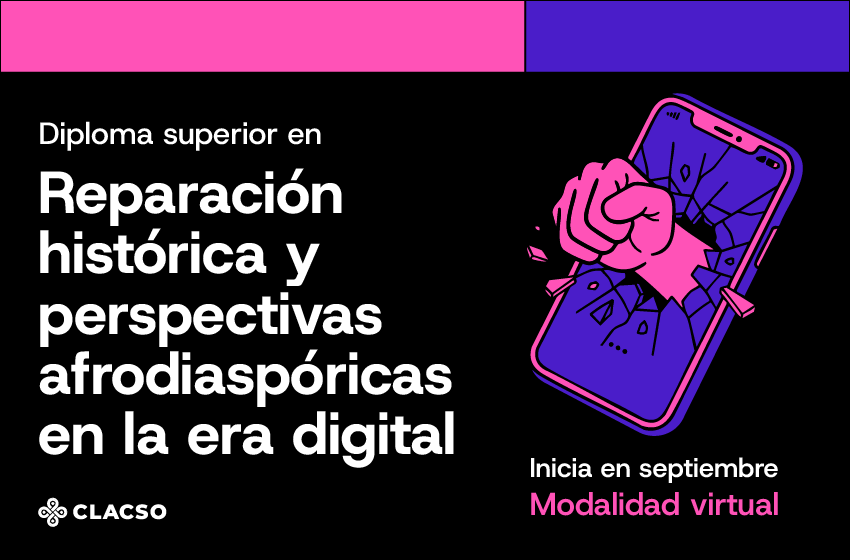
3th Cohort | Virtual Modality
ACADEMIC COORDINATION:
Rosa Campoalegre Septien (PUIC – National Autonomous University of Mexico) and Anny Ocoró Loango (Latin American Faculty of Social Sciences / CONICET, Argentina)
PROFESSORS
Rosa Campoalegre Septien (PUIC – National Autonomous University of Mexico) | Anny Ocoró Loango (Latin American Faculty of Social Sciences / CONICET, Argentina) | Karina Bidaseca (University of Buenos Aires, Argentina) | Pastor Elías Murillo (United Nations Permanent Forum for People of African Descent, Colombia) | Jorge Enrique García Rincón (Afro-Diasporic Research Association Descarimba, Colombia) | Santiago Arboleda Quiñonez (Andean University Simón Bolívar, Ecuador) | John Antón Sánchez (Institute of Higher National Studies, Ecuador) | Felicitas Regla López (Center for Psychological and Sociological Research, Cuba) | Nathalie Cook (AfroLeaders Research Institute on Technology, Artificial Intelligence and Racial Equity, Costa Rica) | Tarcizio Silva (Associação Desvelar, Brazil)
Virtual format | September to December 2026
Start date : 10/09/2026 | Registration : 15/05/2026 to 09/09/2026
The Higher Diploma “Historical Reparation and Afro-Diasporic Perspectives in the Digital Age” emerges in a context of profound technological, political, social, cultural, and environmental transformations that are redefining the world we live in and posing numerous challenges. These transformations do not eliminate the racism, classism, and dehumanization that have historically affected Afro-descendant peoples; on the contrary, “(…) they are situated within historical processes of exploitation, racialization, and dispossession that continue to this day” (Ocoró and Diallo (2026, p. 9).
Despite the progress made throughout the struggles of the Afro-descendant movement and the achievements attained in recent decades, ethnic-racial inequalities, as well as systemic and structural racism, continue to rise, unfolding the process of its “reconfiguration” (Campoalegre, 2022), based on the intensification of its most dangerous tendencies.
The first International Decade for People of African Descent (2015-2024) concluded with an unfinished agenda regarding its three main objectives: Recognition, Justice, and Development. Currently, the Second International Decade for People of African Descent is underway, coinciding with the 25th anniversary of the World Conference against Racism, Racial Discrimination, Xenophobia and Related Intolerance (2001), held in Durban, South Africa. However, outstanding rights and new challenges remain for building democratic and anti-racist societies.
In this direction, the Diploma promotes a central debate: What does it mean to think about the historical reparation of Afro-descendant and African peoples in the digital age in a context where systemic and structural racism is being reconfigured, especially through new technologies and inequalities and violence?
This Diploma contributes to postgraduate training in Afrocentric paradigms
Afro-feminists and critical Afro-diasporic thinkers collectively construct knowledge that challenges the racist colonial legacy and has been historically silenced. This also contributes to rewriting the histories of people of African descent and Africans, especially Black women, who have been victims of Afro-epistemological feminicide (Hall et al., 2016). From a decolonial perspective, it is recognized that the historical links between racism and colonialism underpin the foundations of the coloniality of power, knowledge, and gender, deepening intersecting oppressions. By promoting actions and opportunities aimed at achieving racial equity for historically exploited peoples such as Afro-descendant communities, Afro-reparations are urgently needed on the regional agenda as a mechanism to close the racial gap. The category of Afro-descendant people as a subject of international law assumes the political principle of community, organization and unity to fight for these rights, questioning the essentialist and racialized approach, which deepens colonial stereotypes and imaginaries.
In line with this Afro-diasporic perspective, the Diploma embraces Historical Reparation as an epistemological, political, and ethical horizon that acknowledges the historical and contemporary effects of colonialism, enslavement, and systemic and structural racism in the age of digital capitalism. In this sense, the Diploma recognizes that Historical Reparation is not limited to a material dimension, but rather entails a project of structural transformation of all types of social inequalities that prevail today. Thus, it highlights racial justice as a commitment of the Afro-descendant movement that expands and challenges democracy, equality, and rights.
At the same time, digital technologies, artificial intelligence, and algorithmic control are establishing new forms of global surveillance and racial discrimination, raising many questions about the possibilities of building racial justice in contemporary societies. Therefore, this Diploma program proposes a critical reflection on all these discussions centered on racial, educational, and environmental justice as part of the paradigm of historical reparations, from an intersectional and anti-racist perspective. The program seeks to contribute new debates that will help train academics, activists, policymakers, and other social actors committed to building more pluralistic and democratic societies from an Afro-diasporic perspective.
General Purpose
- To contribute to specialized training, the production of critical thinking and political advocacy for the fight against structural and systemic racism, from an Afro-diasporic perspective oriented towards the historical reparation of Afro-descendant and African peoples.
Specific objectives
- To characterize the historical roots and contemporary reconfigurations of systemic and structural racism, promoting a critical and integrative understanding of the historical reparation of Afro-descendant and African peoples
- To examine the progress, challenges and tensions surrounding the rights of Afro-descendant peoples within the framework of the second International Decade for People of African Descent, recovering the contributions and struggle experiences of the Afro-diasporic movement in Latin America and the Caribbean.
- To value the role of anti-racist education and Afro-diasporic and intersectional epistemologies for social transformation and the construction of epistemic justice.
- To analyze, from a critical and proactive approach, the risks, challenges and alternatives that Artificial Intelligence poses for the fight against systemic and structural racism.
- To analyze from a critical perspective the risks and challenges that artificial intelligence poses to environmental justice, racial justice, and the rights of Afro-descendant and African peoples.
This Higher Diploma is aimed at postgraduate students; teachers at all levels; activists and members of Afro-descendant movement organizations, trade unions, social movements and political parties; public officials; members and managers of non-governmental organizations and professionals interested in the subject.
- Rosa Campoalegre Septien (PUIC - National Autonomous University of Mexico)
- Anny Ocoró Loango (Latin American Faculty of Social Sciences / CONICET, Argentina)
- Karina Bidaseca (University of Buenos Aires, Argentina)
- Pastor Elias Murillo (United Nations Permanent Forum for People of African Descent, Colombia)
- Jorge Enrique García Rincón (Afro-Diasporic Research Association Descarimba, Colombia)
- Santiago Arboleda Quiñonez (Andean University Simón Bolívar, Ecuador)
- John Anton Sanchez (Institute of Higher National Studies, Ecuador)
- Felicitas Regla López (Center for Psychological and Sociological Research, Cuba)
- Nathalie Cook (AfroLeaders Research Institute on Technology, Artificial Intelligence and Racial Equity, Costa Rica)
- Tarcizio Silva (Associação Desvelar, Brazil)
The program consists of 5 modules of 3 weekly classes each, taught consecutively and linked together.
Total workload of 128 hours.
The modules that comprise the Higher Diploma are:
Class 1: Introduction to the Higher Diploma: “Historical Reparation and Afro-Diasporic Perspectives in the Digital Age”
Teachers in charge: Rosa Campoalegre Septien and Anny Ocoro.
Conceptual summary of the class:
This class offers a comprehensive overview of the academic program. It includes a dialogic presentation of the objectives, the program's structure highlighting its core themes, the teaching staff, and the student body. It outlines the organizational structure and dynamics of the Diploma program, as well as the final assessment. Finally, it characterizes the context in which this Advanced Diploma program is being offered, 25 years after the Durban Declaration and Transcendental Disasters and during the Second International Decade for People of African Descent.
Class 2: Historical Reparation as a Paradigm in Construction
Teacher in charge: Rosa Campoalegre Septien
Conceptual summary of the class:
This class analyzes the Historical Reparations of Afro-descendant and African peoples and how to understand them within the context of the current global polycrisis, in accordance with the legacy of the Durban Conference. Based on an assessment of its historical antecedents and the demands driven by the Afro movement, the class examines the foundations, principles, and dimensions of Historical Reparations, emphasizing its character as a comprehensive, intersectional, and emancipatory process, a paradigm under construction, and the epicenter of the anti-racist agenda. The class also reflects on the experiences, progress, and challenges faced by Historical Reparations processes in different contexts, highlighting the leading role of these Afro-descendant and African peoples in the construction of this emerging paradigm.
Class 3: Systemic and structural racism. Its reconfiguration today
Teacher in charge: Rosa Campoalegre Septien
Conceptual summary of the class:
This class presents the genealogies of racism, exploring the interrelationship between colonialism, coloniality, decoloniality, and racism. Based on this, it assesses the continued relevance of the position taken by the World Conference against Racism, Racial Discrimination, Xenophobia and Related Intolerance (2001), as well as the recognition of slavery as the most serious crime against humanity in history.
It also addresses racism as a polysemous and open category, examining the typologies of racism, its manifestations, and its connections to other systems of oppression, highlighting the methodological and political importance of differentiating between them, as well as the main consequences it produces in social life. Finally, it reflects on contemporary reconfigurations of racism, its current trends and challenges, emphasizing the need to de/construct the anti-racist agenda in the face of the reconfiguration of structural and systemic racism.Class 4: Afro-descendant Peoples and Afro-descendant International Law
Teacher in charge: Jhon Antón García
Conceptual summary of the class:
This course addresses the emergence and development of the category of “Afro-descendant peoples,” analyzing the historical, political, and legal contexts that have contributed to its legitimization at the regional and international levels. It will examine the debates surrounding the notions of Afro-descendant peoples, communities, and individuals, their main references, and their implications for collective rights. Furthermore, it will analyze the main national and international forums for debate on this category, including the United Nations Permanent Forum on People of African Descent, the Afro-descendant movement, national and international legal instruments on the subject, and the draft Declaration on the Rights of People of African Descent. International Law on Afro-descendants: Content and Challenges
Class 5: The generations of rights of Afro-descendant peoples and their current situation in digital capitalism
Teacher in charge: Pastor Elias Murillo
Conceptual summary of the class
The anti-racist struggle, as a complex process, reveals diverse generations that mark progress, shortcomings, and future prospects in the recognition, legal protection, guarantee, and promotion of these rights. This class comparatively analyzes these generations, placing them within their respective contexts and defining their purpose up to the present day.
In this regard, the class pays particular attention to the fact that, for the first time in history, the drafting and promulgation of an International Declaration for the promotion, guarantee, and full respect of the rights of people, communities, and peoples of African descent is being considered, underscoring the role of the Afro movement in this context. It analyzes which rights are currently under pressure, taking a proactive approach that assesses the progress, risks, and possibilities for the proclamation of the Declaration in question, as a legal instrument for the international community to combat racism in the face of the challenges of the digital age.
Class 6: Afro-descendant rights in tension: progress and challenges in their implementation
Teachers in charge: Felicitas Regla López Sotolongo
Conceptual summary of the class
This course examines the legal framework for the rights of Afro-descendant peoples, considering the main legal instruments and regulations at the national, regional, and international levels that promote these rights. It also explores the tension between the regulation of these rights and their practical implementation, as well as the erosion of the very notion of human rights in the context of the global polycrisis. This presents a historical challenge to guarantee full citizenship in the face of structural and systemic racism.
Class 7: Afro-reparations and epistemic justice in education
Teacher in charge: Anny Ocoró Loango
Currently, Afro-descendant populations continue to face significant obstacles to accessing, remaining in, and graduating from the various levels of the education system, as well as profound structural inequalities that shape their educational trajectories. Given this context, this class aims to reflect on historical reparations in the educational and epistemic fields, analyzing their implications for the recognition and valorization of Afro-diasporic epistemologies, and for problematizing and overcoming what Fricker (2017) calls epistemic injustice. Within this framework, the role of symbolic and material reparations will be discussed as part of an agenda committed to racial justice, the democratization, and decolonization of education systems.
Class 8: Political Cartographies and Contemporary Theoretical Debates on the Curriculum with an Intersectional Perspective
This course introduces students to the main contemporary theoretical debates surrounding educational inequalities, from an intersectional perspective of race, gender, and social class, with the aim of reflecting on the challenges posed by an anti-racist, egalitarian, and intercultural education. This approach will allow students to broaden their understanding of educational inequalities and enrich their training through an intersectional analysis and an examination of cultural diversity in the field of education.
Class 9: Afro-diasporic education: contributions to global racial justice
Teacher in charge: Jorge Enrique García Rincón
This course analyzes the inequalities in access to technology that affect the territories of the African diaspora, as well as the biases present in the images and representations of these populations generated by artificial intelligence. It also reflects on the potential of Afro-diasporic education to transform racial power relations, based on a political conception and practice of technology that recovers the contributions of Black and African peoples to the production of knowledge. Finally, it problematizes the forms of dehumanization inherent in necrotechnology (García, 2025), while advancing proposals and alternatives for a technological transformation committed to racial justice, equality, and the full recognition of the humanity of Afro-diasporic peoples.
Class 10: Data Colonialism and Algorithmic Racism
Teacher in charge: Nathalie Cook
This course examines the contemporary dynamics of data colonialism and its implications for the reproduction of racial inequalities in digital environments. From a critical perspective on technology, it will analyze how the extraction, classification, processing, and massive use of data can reproduce historical relations of power, exclusion, and subordination that disproportionately affect people of African descent and other historically marginalized groups. It will also explore the mechanisms by which algorithmic systems can generate, amplify, or perpetuate racial biases in areas such as security, employment, education, health, political participation, and access to services. The course will address key concepts such as algorithmic discrimination, data governance, automated bias, digital surveillance, and human rights in the age of artificial intelligence, providing tools to understand the ethical, legal, and political challenges associated with these technologies.
Class 11: Ethnocoding and algorithmic racial justice: towards an Afro-descendant architecture of technological governance
Teacher in charge: Nathalie Cook
This course presents ethnocoding as a technical, political, and epistemological approach aimed at building more equitable, culturally relevant, and respectful technological systems that acknowledge human diversity. From an interdisciplinary perspective that integrates information technology law, technology governance, critical technology theory, and artificial intelligence, the course will analyze how digital rights, the regulation of algorithmic systems, and the design of technological infrastructures require incorporating the knowledge, identities, experiences, and aspirations of historically excluded communities. Finally, it will reflect on the role of algorithmic racial justice as a fundamental component for building more inclusive, democratic, and socially responsible digital ecosystems.
Class 12: Generative AI as a revenge against the epistemology of ignorance
Teacher in charge: Tracizio Silva
This class will analyze the current offensive by large technology companies and financial capital to promote and normalize so-called generative AI as an inevitable and indispensable technology, as well as its relationship to the dynamics of racial capitalism. It will examine the repeated manifestations of algorithmic racism identified by researchers and journalists from around the world, drawing on the theoretical contributions of authors such as Charles Mills, Sueli Carneiro, and Syed Mustafa Ali.
Among the topics to be addressed are: epistemicide, its history and its transformations in the digital age; connectionist artificial intelligence and its technopolitical challenges; the damages, risks and forms of racial discrimination associated with algorithmic systems; and the processes of algorithmization, platformization and generative artificial intelligence in their relation to the reproduction of racism.
Class 13: Ecogenoethnocide and historical justice
Conceptual summary of the class
Teacher in charge: Santiago Arboleda Quiñones
This class argues for the need to holistically understand ecocide, genocide, and ethnocide as a necrophilic colonial and neocolonial pattern. It analyzes the relevance of concepts within the notion of ecogenoethnocide in order to move beyond the descriptive and interpretive fragmentation that has prevailed to date.
The class proposes a conceptual framework that seeks to address the ongoing tension between sociohistorical and legal truth, present in these types of phenomena subject to interpretive disputes, advocating for critical, biocentric, and decolonizing social, human, and intercultural sciences. The behavior of this problem in the region is examined, focusing on the case of the armed conflict in Colombia.
Class 14: Environmental Racism: Afro-feminist alternatives for the future
Teachers in charge: Karina Bidaseca
Conceptual summary of the class
The topic delves into environmental racism, its causes, and trends. Based on this, it emphasizes three interconnected lines of analysis: First, the category of “Ancestral Future” (Krenak, 2020), which expresses the synergy between the knowledge of historically racialized peoples. Second, the experience of Afro-descendant communities facing ecological losses in their territories; and third, the artivism of Afro-American and African women in the struggle against this type of racism, from an Afrofuturist perspective.
Class 15: Systematizing dialogues for the closing of the Higher Diploma
Teachers in charge: Rosa Campoalegre Septien, Anny Ocoró Loango
Conceptual summary of the class
The class offers a collective space for systematizing the learning, reflections, and debates developed throughout the Diploma program. Based on a review of the initial expectations for the program and a critical evaluation of the content covered, participants reflect on the challenges of the anti-racist agenda, focusing on historical reparations and social transformation in the region. They also identify emerging themes for future editions and provide methodological and organizational guidelines for preparing the final projects.
| Early registration (until 07/07) | General registration (May 6th to May 03st) | Registration without discount (04/09 to 09/09) | Payment in 3 installments | |
| Full or Associate Member Center | $190 | $260 | $340 | USD 420 (3 x USD 140) |
| No Link | $340 | USD 410 | $460 | USD 630 (3 x USD 210) |
You must be registered in the CLACSO Single Registration System (SUIC) and enter your username and password. If you are not registered, click here . To access the registration form, click the "Register" button on the webpage of the Diploma program you are interested in.
Upon completion of the registration process, you will receive a confirmation in your email.
Classes will begin in September and will conclude in December 2026.
All registered participants will receive on the first day of activities the necessary instructions to access the classes, bibliography and discussion forums through the CLACSO Virtual Training Space.
Accessing and navigating the Virtual Learning Environment is very simple and user-friendly. In any case, a technical and academic support team will always be available. For inquiries, you can write to [email protected]
You must send an email with the request to [email protected] and we will send you the requested certificate as soon as possible.
Exceptional Criteria: In exceptional cases, and within the first 20 days of the start of the Advanced Diploma program, students may write to [email protected] requesting to withdraw and stating the reasons. After evaluation of the case, a response will be sent to the request. If approved, the student may resume the Advanced Diploma program if a new cohort is offered the following year. After this period has elapsed since the start of the course, no requests will be accepted.
Money paid will only be refunded in cases where the organizing institutions decide to cancel the activity.
Yes, the advanced diploma is certified by CLACSO. The diploma will be sent digitally and is completely free of charge.
Payment can be made in one installment, by credit card or bank transfer. We also offer the option of paying in 3 installments.
Yes. There will be discounts for students belonging to CLACSO Member Centers and CLACSO Associated Centers, for CLACSO Associate Researchers, and for all those who pay within the discount period.
You can check if you belong to a member center here:
The Advanced Diploma program integrates a dynamic of asynchronous and synchronous classes. Classes are primarily asynchronous. The schedule for synchronous sessions will be communicated by the Diploma coordinator at the beginning of the program, and participation in these sessions is not a prerequisite for passing the program.
Inquiries: WhatsApp: +54 9 11 3880 – 1388
Email: [email protected]

