
Advanced Diploma in Reconfigurations of Work in the Contemporary World: Subjects, Processes, and Legal Frameworks. A Comparative Perspective
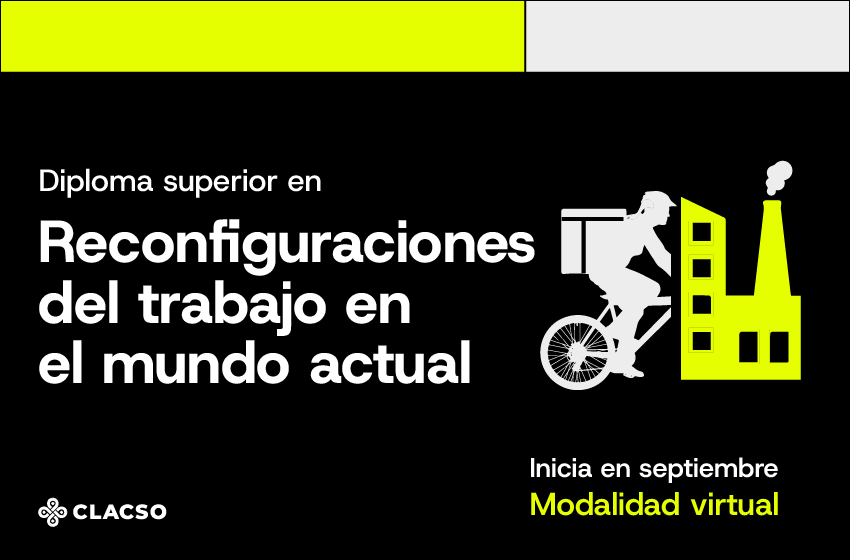
4th Cohort | Virtual Modality
ACADEMIC COORDINATION
Nora Judith Goren (National University of José C. Paz and National University of Buenos Aires, Argentina) and Adoración Guamán Hernández (University of Valencia, Spain)
ACADEMIC MANAGEMENT
Julia Sanchis (University of Valencia, Spain)
PROFESSORS
Antonio Baylos Grau (University of Castilla-La Mancha, Spain), Adoration Guaman Hernandez (University of Valencia, Spain), Nora Goren (National University of José C. Paz and National University of Buenos Aires, Argentina), Sayonara Grillo (Federal University of Rio de Janeiro, Brazil), Raúl Lorente Campos (University of Valencia, Spain), Johanna Maldovan Bonelli (National University of José C. Paz and CONICET, Argentina), Elisa Lanas Medina (Andean University Simón Bolívar, Ecuador), Guillermo Gianibelli (University of Buenos Aires, Argentina), Hugo Barretto Ghione (University of the Republic, Uruguay), Dasten Julián Vejar (Working Studies Group Foundation, Chile), Francisco Trillo (University of Castilla-La Mancha, Spain), Juan Manuel Ottaviano (CETyD, Argentina), José Dari Krein (State University of Campinas, Brazil), Nicholas Dzembrowski (UNPAZ/UBA/CONICET, Argentina) and Vicente Lopez (May 1st Foundation and University of Valencia, Spain)
Virtual format | September to December 2026
Start date : 10/09/2026 | Registration : 15/05/2026 to 09/09/2026
The Higher Diploma in Reconfigurations of Work in the Current World is a training program aimed at generating a space for study, reflection and debate on the world of work from a multidisciplinary perspective, with the fundamental objective of offering an analysis of the main transformations of work, the challenges they pose and the responses they elicit, with special attention to the frameworks of collective action and regulatory changes, combining sociological and economic analysis with legal analysis.
To this end, over 4 modules and with the help of 15 professors, normative models, subjects and processes of change that are taking place in various Latin American and European countries are compared.
The methodology is based on ongoing dialogue between professors from different fields of knowledge. The training structure facilitates participation by allowing for time planning tailored to each participant's needs.
We are at a moment of global risk, a situation of multiple crises that places the world of work before a growing and complex series of fundamental challenges, which overlap and intersect with one another. The current state of work worldwide presents a bleak picture. Globally, the International Labour Organization (ILO) has recently indicated that one in five workers lives in extreme poverty, that informal employment affects approximately three out of five, that the global employment deficit has reached 402 million people, that gender gaps and discrimination are widening, and that half of the employed population lacks adequate social security coverage, legal protection, or workplace safety measures.
Furthermore, there are currently more than fifty million people living in situations of slavery or similar conditions. Regarding Latin America, ILO data clearly states that: “the region has gone more than a decade without sufficient progress in labor terms, as neither the participation rate nor the employment rate has significantly surpassed the levels reached in 2012 […]”. The increase in working poverty, the employment deficit, the deterioration of working conditions, the expansion of the number of situations of unfree work, the increase in gender discrimination and workplace violence, and the other labor realities that deviate from the decent work paradigm demonstrate shortcomings—with a few exceptions at the national level—of the norms, policies, and institutions designed to regulate and balance the power dynamic between capital and labor. All of the above is combined and strained by the mutations that have taken place in the world of work as a result of technological changes, particularly digitization and automation, the global productive reconfiguration marked by processes of decentralization and offshoring, and an ever-increasing tendency towards the concentration of capital.
Capital's constant attempts to maximize exploitation manifest themselves in various strategies that circumvent legal frameworks, such as wage reductions, offshoring, attacks against the collective subject of labor, or even attempts at the direct expropriation of life itself, with the emergence of new forms of contemporary slavery. Faced with these strategies, traditional normative and institutional regulatory frameworks often prove ineffective, if not subservient to the will of capital, and traditional, regulated wage labor loses its relevance compared to other forms of exploitation of human labor.
Far from accepting defeat and embracing the fatalistic postulates of the "end of work," much less the great replacement resulting from robotization, critical and alternative science challenges the concept of work in the opposite direction, aiming to embrace its transformations as an opportunity to overcome the original burdens of wage labor and move towards social and ecological justice. Colonialism, heteropatriarchy, racism, dispossession, and a predatory relationship with nature are conditions highlighted by feminisms, environmentalisms, social movements, and unions, which are presented as paths for constructing a concept and regulation of work that is compatible with life, both human and natural. Even though the reality of work and its transformations is largely defined by national contexts, it is undeniable that the current moment of globalization demonstrates the existence of common problems and transformations. Therefore, it is necessary to propose both comparative analyses and solutions, and to a large extent labor regulations, that stem from the debate and understanding of the different realities present in Latin America and Europe and that propose common solutions.
Similarly, the analysis of social mobilization and the organization of the collective subject of labor beyond state borders is clearly necessary as a step towards a balance of power with a transnational antagonist that can lead to fruitful negotiation scenarios enabling the adequate protection of workers. Furthermore, there are both novel and common problems linked to the sustainability of life, the rights of the planet, the fight against gender inequalities, and against expanding phenomena such as modern slavery, which undoubtedly require joint analysis and action, not only among countries but, in particular, within the sphere of supranational organizations, both regional and international.
GENERAL PURPOSE
- To provide a situated critical analysis of the transformations of work in different countries of Latin America and the Caribbean and Europe, from the point of view of the different realities, the subjects, the collective actors involved, the comparative legal models and their evolution, in order to offer a theoretical framework that allows thinking and designing public policies aimed at achieving decent work
SPECIFIC OBJECTIVES
- To promote a space for analysis of the reality of work from a comparative, Latin American and European perspective.
- This analysis examines the realities of work within legal and labor frameworks, paying particular attention to the most relevant issues at present, such as platform work, informal work, gender discrimination, the relationship between the environmental crisis and work, and the impact of the rise of far-right movements on the workplace. It also considers fundamental, long-standing issues such as the regulation of employment contracts, dismissals, and collective bargaining.
- To offer a diachronic perspective on the evolution of labor markets in the aforementioned countries, in order to comparatively assess the points of convergence and divergence between them and to enable the formulation of common solutions.
- Study the labor reforms of the chosen countries from a historical perspective, assessing the political moment, the content, the responses of social actors and their effectiveness and impact on the well-being of working people.
- To equip students with the necessary tools for the design of socio-labor advocacy positions or legal-labor public policies, at the national and supranational levels.
- To analyze the performance of international and regional organizations with an impact on the world of work, to assess their performance from a critical perspective, and to propose initiatives that can be developed from a supranational point of view.
- To strengthen students' abilities to search for and use resources that allow for the analysis and study of the labor market.
The Advanced Diploma in Reconfigurations of Work in the Contemporary World: Subjects, Processes and Legal Frameworks. A Comparative Perspective is aimed at undergraduate and postgraduate students; teachers at all levels; activists and members of trade unions, social movements and political parties; public officials; members and managers of non-governmental organizations and professionals interested in the topic.
The program consists of 5 modules of 3 weekly classes each, taught consecutively and linked together.
Total workload of 128 hours.
The modules that comprise the Higher Diploma are:
CLASS 1: Work and its transformations
Teacher: Antonio Baylos Grau
CLASS 2: Feminisms and work. Transformative impetus and pending challenges
Teacher: Adoration Guaman Hernandez
CLASS 3: Work under scrutiny. The debate on the crisis of work
Teacher:Nicholas Dzembrowski
CLASS 4: Trade unions and freedom of association in the face of the reconfiguration of the world of work (technology, work culture, supply chains)
Teacher: Hugo Barretto Ghione
CLASS 5: Labor informality and its criticisms: a debate about the concept of informality and its reality between Europe and Latin America
Teacher: Raúl Lorente Campos
CLASS 6: Job insecurity
Teacher: Dasten Julian Vejar
CLASS 7: Work and Platforms: another twist on the appropriation and organization of work
Teacher: Guillermo Gianibelli
CLASS 8: The world of work in the face of the eco-social crisis
Teacher: Vicente Lopez
CLASS 9: Labor reforms in Latin America and job insecurity
Teacher: Sayonara Grillo
CLASS 10: Working time: the re-edition of the great debate on reducing the working day
Teacher: Francisco Trillo
CLASS 11: Challenges and opportunities for the regulation of self-employment
Teacher: Elisa Lanas Medina
CLASS 12: Work in the face of the far-right offensive: a necessary debate
Teacher: José Dari Krein
CLASS 13. Union organization on digital platforms
Teacher: Juan Manuel Ottaviano
CLASS 14: Feminisms and trade unionisms: trade union strategies and power struggles of genre
Teacher: Johanna Maldovan Bonelli
CLASS 15: Work from a feminist perspective. Current debates and agendas for the future
Teacher: Nora Goren
- Antonio Baylos Grau (University of Castilla-La Mancha, Spain)
- Adoration Guaman Hernandez (University of Valencia, Spain)
- Nora Goren (National University of José C. Paz and National University of Buenos Aires, Argentina)
- Sayonara Grillo (Federal University of Rio de Janeiro, Brazil)
- Raúl Lorente Campos (University of Valencia, Spain)
- Johanna Maldovan Bonelli (National University of José C. Paz and CONICET, Argentina)
- Elisa Lanas Medina (Andean University Simón Bolívar, Ecuador)
- Guillermo Gianibelli (University of Buenos Aires, Argentina)
- Hugo Barretto Ghione (University of the Republic, Uruguay)
- Dasten Julián Vejar (Labor Studies Group Foundation, Chile)
- Francisco Trillo (University of Castilla-La Mancha, Spain)
- Juan Manuel Ottaviano (CETyD, Argentina)
- José Dari Krein (State University of Campinas, Brazil)
- Nicholas Dzembrowski (UNPAZ/UBA/CONICET, Argentina)
- Vicente Lopez (May 1st Foundation and University of Valencia, Spain)
| Early registration (until 07/07) | General registration (May 6th to May 03st) | Registration without discount (04/09 to 09/09) | Payment in 3 installments | |
| Full or Associate Member Center | $190 | $260 | $340 | USD 420 (3 x USD 140) |
| No Link | $340 | USD 410 | $460 | USD 630 (3 x USD 210) |
You must be registered in the CLACSO Single Registration System (SUIC) and enter your username and password. If you are not registered, click here . To access the registration form, click the "Register" button on the webpage of the Diploma program you are interested in.
Upon completion of the registration process, you will receive a confirmation in your email.
Classes will begin in September and will conclude in December 2026.
All registered participants will receive on the first day of activities the necessary instructions to access the classes, bibliography and discussion forums through the CLACSO Virtual Training Space.
Accessing and navigating the Virtual Learning Environment is very simple and user-friendly. In any case, a technical and academic support team will always be available. For inquiries, you can write to [email protected]
You must send an email with the request to [email protected] and we will send you the requested certificate as soon as possible.
Exceptional Criteria: In exceptional cases, and within the first 20 days of the start of the Advanced Diploma program, students may write to [email protected] requesting to withdraw and stating the reasons. After evaluation of the case, a response will be sent to the request. If approved, the student may resume the Advanced Diploma program if a new cohort is offered the following year. After this period has elapsed since the start of the course, no requests will be accepted.
Money paid will only be refunded in cases where the organizing institutions decide to cancel the activity.
Yes, the advanced diploma is certified by CLACSO. The diploma will be sent digitally and is completely free of charge.
Payment can be made in one installment, by credit card or bank transfer. We also offer the option of paying in 3 installments.
Yes. There will be discounts for students belonging to CLACSO Member Centers and CLACSO Associated Centers, for CLACSO Associate Researchers, and for all those who pay within the discount period.
You can check if you belong to a member center here:
The Advanced Diploma program integrates a dynamic of asynchronous and synchronous classes. Classes are primarily asynchronous. The schedule for synchronous sessions will be communicated by the Diploma coordinator at the beginning of the program, and participation in these sessions is not a prerequisite for passing the program.
Inquiries: WhatsApp: +54 9 11 3880 – 1388
Email: [email protected]

