
Advanced Diploma in Education Policies for Young People and Adults
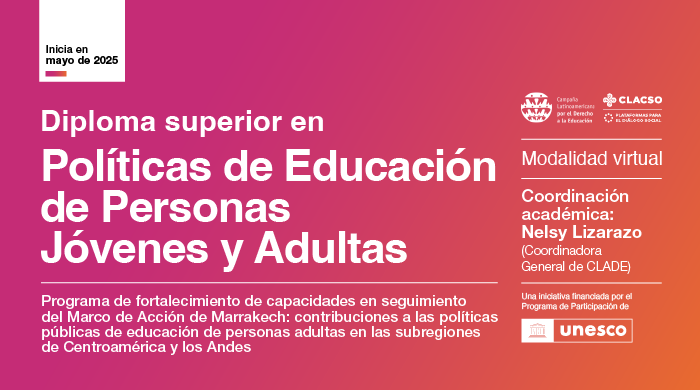
The Latin American Council of Social Sciences (CLACSO) and the Latin American Campaign for the Right to Education (CLADE), with the support of the United Nations Educational, Scientific and Cultural Organization (UNESCO), invite you to participate in the Higher Diploma in Education Policies for Young People and Adults.
*Capacity building program in follow-up of the Marrakech Framework for Action: contributions to adult education public policies in the subregions of Central America and the Andes.
*An initiative funded by the UNESCO Participation Programme / A workshop funded by the Participation Programme of UNESCO.
ACADEMIC COORDINATION: Nelsy Julieta Lizarazo Castro (CLADE, Regional NGO with administrative office in Sao Paulo, Brazil)
TEACHING TEAM: Raul Valdes (UIL – UNESCO) | Francisco Cantamutto (CONICET, Argentina) | Agostina Costantino (CONICET, Argentina) | María Eugenia Letelier (National Coordinator of the area of educational trajectories and lifelong learning of the Ministry of Education of Chile) | Rosy Zúñiga (CEAAL Coordinator) | María Cianci Bastidas (CLADE) | Nelsy Lizarazo Castro (CLADE)
Home: 05/05/2025 | Scholarship applications: 21/03/2025 al 21/04/2025
* CLACSO and CLADE, with the support of UNESCO, will award 70 full tuition scholarships to public officials from ministries of education and other ministries or institutions working in the field of youth and adult education, literacy, non-formal education, etc. Scholarships will also be awarded to civil society organizations, teachers, and researchers involved in the development and/or implementation of education policies for young people and adults.
The Diploma in Policies for Youth and Adult Education (EPJA) is the result of collaborative work between CLACSO and CLADE. It is presented as a space for critical, practical, and reflective training, designed to address the challenges and opportunities facing Youth and Adult Education (EPJA) in Latin America and the Caribbean. We seek to strengthen the capacities of public officials, specialists, researchers, activists, and decision-makers through the analysis of current public policies in different countries and the strengthening of these policies and their practices, with the aim of enhancing public offerings in EPJA in our region.
The academic program is structured around three modules that explore the theoretical and conceptual foundations of Adult and Youth Education (EPJA), as well as the experiences and challenges in implementing inclusive and equitable policies through case studies. Special attention will be given to the diversity of contexts and populations, promoting intercultural dialogue in the development of proposals within the socio-community sphere.
Through a participatory and collaborative pedagogical approach, participants will have the opportunity to exchange knowledge and experiences that contribute to strengthening EPJA in their respective contexts and areas of management.
This diploma program aims to strengthen the commitment to defending the human right to lifelong learning, empowering participants to promote public policies that guarantee social justice. We invite all those interested in building a more inclusive, democratic, and transformative adult education system to join this space for learning and collective reflection.
The Diploma in Policies for Youth and Adult Education (EPJA), offered by CLACSO and CLADE, is designed for public officials from ministries of education and other ministries or institutions working in the fields of youth and adult education, literacy, and non-formal education. It is also open to civil society organizations, teachers, and researchers involved in the development and/or implementation of education policies for young people and adults. The program is based on the need to strengthen the capacity of states to guarantee the right to lifelong learning, with an intersectional approach.
Key points of its rationale:
Recognition of Adult and Youth Education as a human right: The aim is to promote the understanding of Adult and Youth Education as a fundamental right, essential for individual and collective development. This implies moving beyond the traditional view of Adult and Youth Education as mere educational compensation, and recognizing its intrinsic value as a space for learning and social transformation.
Capacity building: strengthening capacities to analyze the context of adult education, identify convergences between the needs and demands of learners, and design and implement innovative and relevant adult education programs and projects, as well as evaluate the impact of adult education policies and programs.
Strengthening Public Policies: This diploma program aims to provide the necessary tools and knowledge to design, implement, and evaluate public policies for adult and youth education (EPJA). It emphasizes the importance of inclusive and equitable policies that respond to the needs and demands of the diverse stakeholders in adult and youth education.
Promoting inclusion and equity: Adult and Youth Education (EPJA) is conceived as a key instrument for combating inequality, asymmetries, and social exclusion. The diploma program seeks to promote policies that guarantee access to education for young people and adults in vulnerable situations, such as women, indigenous peoples, people with disabilities, and people deprived of their liberty.
Promoting citizen participation: The aim is to foster greater recognition of civil society in the definition and management of adult education policies. This involves strengthening mechanisms for dialogue and consultation between the State and social organizations.
General Purpose
To provide a professional development program for public officials from Ministries of Education and other ministries or institutions working in the field of Youth and Adult Education, Literacy, Non-Formal Education, etc. Additionally, to civil society organizations, teachers, and researchers involved in the development and/or implementation of education policies for young people and adults, especially in light of the Marrakech Framework for Action (MFA), an instrument that has guided work in this field since 1949.
Specific objectives
- Understanding the theoretical and conceptual frameworks that underpin EPJA policies, as well as the social, economic, and cultural factors that influence their formulation.
- Develop the ability to critically analyze existing EPJA policies by taking into account case studies, identifying their strengths, weaknesses and possibilities for improvement.
- Strengthening capacities to design innovative and relevant public policies that respond to the needs and demands of young people and adults, considering the diversity of contexts and populations, promoting the inclusion of vulnerable groups.
- To understand the processes of implementing EPJA policies, as well as the monitoring and evaluation mechanisms considering international frameworks such as MAM, Agenda 2030, among others.
The program consists of 10 weekly classes, each taught consecutively and linked to the others.
The modules that comprise the Higher Diploma are:
Module 1: Sustainability of EPJA: MAM, teacher training and financing
- Point zero. Marrakech Framework for Action (MFA), key to understanding public policies in EPJA.
- Eyes on the horizon. Challenges of teacher training for adult education that we need
- Commitment from the pocketbook. Financing Adult Education and its facets
- Polishing Violet Lenses. Gender and EPJA
Module 2: Case studies and experiences
- Looking at the practice. Opportunities in public management EPJA: The Chilean case (part 1)
- Looking at the practice. Opportunities in public management EPJA: The Chilean case (part 2)
- Looking at the practice. Opportunities for intercultural integration in public management EPJA: The case of Guatemala
- Looking at the practice. Opportunities in public management EPJA: The case of Brazil
Module 3: Intersectionality and Incidence
- Building bridges. Technical working groups for monitoring EPJA
- Regional convergences. Impact of regional spaces and the 2030 Agenda for monitoring SDG4 and MAM
- Raul Valdes (UIL – UNESCO)
- Francisco Cantamutto (CONICET, Argentina)
- Agostina Costantino (CONICET, Argentina)
- María Eugenia Letelier (National Coordinator of the area of educational trajectories and lifelong learning of the Ministry of Education of Chile)
- Rosy Zúñiga (CEAAL Coordinator)
- María Cianci Bastidas (CLADE)
- Nelsy Lizarazo Castro (CLADE)
Classes will be held synchronously on Tuesdays from 9 to 11 a.m. Ecuador time. The sessions will be recorded for those who cannot attend.
Each class will be accompanied by essential and supplementary readings, which will serve as the basis for discussions, reflections, and individual, group, and collective projects in forums and other resources and tools available in the virtual classroom. All activities will be supported by the tutoring team.
CLACSO and CLADE, with the support of UNESCO, will award 70 full tuition scholarships to public officials from ministries of education and other ministries or institutions working in the field of youth and adult education, literacy, non-formal education, etc. Scholarships will also be awarded to civil society organizations, teachers, and researchers involved in the development and/or implementation of education policies for young people and adults.
Requirements for the application:
- Participants will be selected by an evaluation committee appointed by the convening organizations. Applications will be submitted through the CLACSO website.
- The candidates must:
1- Complete your personal details.
2- Complete a letter of interest.
- The available scholarships will be allocated respecting regional diversity and gender equity.
- An Academic Committee will review the applications and award the scholarships; the decision cannot be appealed. The results will be announced by CLACSO.
- This call for applications will remain open. until April 21.
|
In one payment by 21/04 |
In one payment after 21/04 |
Payment in 3 installments |
|
|
Full or Associate Member Center |
$125 |
$240 |
USD 315 (3 x USD 105) |
|
No link |
$250 |
$370 |
USD 540 (3 x USD 180) |
* Residents of Argentina will pay the equivalent in Argentine pesos according to the official exchange rate of the Banco de la Nación Argentina (BNA) on the day of payment.
CLACSO and CLADE, with the support of UNESCO, awarded 70 full tuition scholarships to public officials from ministries of education and other ministries or institutions working in the field of youth and adult education, literacy, non-formal education, etc. Scholarships were also awarded to civil society organizations, teachers, and researchers involved in the development and/or implementation of education policies for young people and adults.
375 applications were received, which were evaluated by a committee and 70 students were selected, based on the relevance of the application, regional and gender balance.
| Name | Surnames | Nationality |
| Abel | Mendoza Guillen | Peru |
| Adriana Nicole | Gonzalez Ortiz | Ecuador |
| Aida Irene | Enriques | Argentina |
| Ale | Lopez Bemsch | Argentina |
| Analía Susana | Tolaba | Argentina |
| Andrés | Sarmiento | Ecuador |
| Angela | Della Flora | Brazil |
| Good | Rios | Peru |
| Camila | Eijo | Uruguay |
| Caesar Anthony | Mamani Orders | Chile |
| Cristina | Filloy | Panama |
| Deivys | flycatcher | Colombia |
| Denis Makarena | Diaz Diaz | Chile |
| Doris | Parra Salas | Colombia |
| Eduardo | OBourke | Cuba |
| Eduardo Alejandro | Hidalgo Niche | Peru |
| Edvin Jiovany | López Martínez | Guatemala |
| Eva Carola | Escobar Ari | Bolivia |
| Facundo Nicolás | Men | Argentina |
| Felipe | Quishpe | Ecuador |
| Fiorella | Hinostroza | Peru |
| Frankarlo | Núñez Bravo | Nicaragua |
| Guido Andrés | Durán Godoy | Chile |
| Hector Fabio | Carmona Cobo | Colombia |
| Javier | Diaz | Ecuador |
| Javier | monterroso | Guatemala |
| Jenny | Teran | Ecuador |
| Jimena Raquel | Rosero Torres | Ecuador |
| Jonnathan | Jaya Granda | Ecuador |
| José Carlos | Rocha Silva | Mexico |
| Jose Diego | Alonso García | Uruguay |
| Jose Ernesto | Montoya Martínez | El Salvador |
| Jose Rodolfo | Vargas Aramayo | Bolivia |
| Juan | Rosemary | Mexico |
| Juan Carlos | Callejas | Guatemala |
| Juan Pablo | Escobar Galo | Guatemala |
| Karina | Cabanillas Cárdenas | Peru |
| Kenya Mara | Gaedtke | Brazil |
| Kevin | Segura | Guatemala |
| Licelis Josefina | Ortiz Carrillo | Colombia |
| Lillian Daniela | Solano Morales | Costa Rica |
| Lizandra Tarsilla | Gallindo Lira Almeida | Brazil |
| Luis Sebastián | Calistro Neira | Uruguay |
| Madelin | Rodriguez Rensoli | Cuba |
| Marco Antonio | Rodriguez Galicia | Mexico |
| Maria Alejandra | Heel | Argentina |
| Maria Belen | Camarano de los Santos | Uruguay |
| Maribel Liliana | Taipe Guamanarca | Ecuador |
| Mario | de Sáa | Uruguay |
| Marlene | Iroa | Uruguay |
| Marta Lía | Greco | Argentina |
| Matilde | Thin | Uruguay |
| Mayra Deyanira | Navarro Manrique | Bolivia |
| Mayra Francisca Nathaly | Bonilla Portillo | El Salvador |
| Michelle | Arias | Ecuador |
| Osman Noel | Borjas Carrasco | Honduras |
| Pablo Giovanni | Mendoza Monzón | Guatemala |
| Paola | Gomez | Mexico |
| Roger | Hail | Ecuador |
| Rosana Elizabeth | Carema Fernández | Paraguay |
| Tatiana | Castelblanco Basin | Colombia |
| Tatiana | Beirut | Costa Rica |
| Teresa | Mayuri | Peru |
| Thiago | Souza Fixed | Brazil |
| Verônica Pessôa da Silva | Da Silva | Brazil |
| Verouschka | Vera | Venezuela |
| Vilma | Rodríguez | Peru |
| Wiselis | Sena | Dominican Republic |
| Yafreisy | Acevedo | Dominican Republic |
| Yalitza | Guillen | Venezuela |
Inquiries: [email protected]
WhatsApp: +549113880 – 1388

