
Advanced Diploma in Mutations of Domination in Contemporary Capitalism. Studies on the Far Right and the Crisis of Neoliberalism
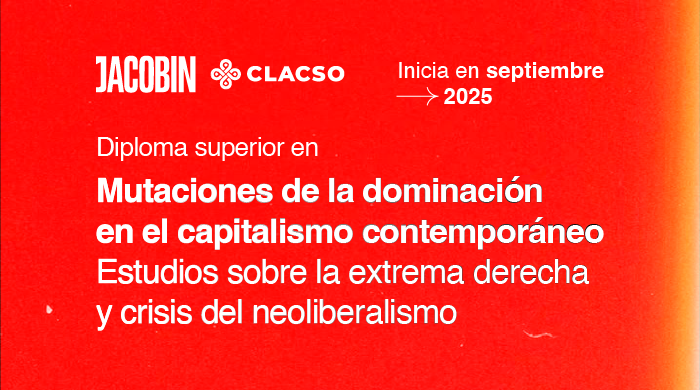
1th Cohort | Virtual Modality
ACADEMIC COORDINATION
Martín Mosquera (Argentina)
PROFESSORS
Michael Löwy (Brazil-France), Luciana Cadahia (Argentina), Massimo Modonesi (Mexico), Adrián Piva (Argentina), Nuria Alabao (Spain), Martín Arboleda (Chile), Claudio Katz (Argentina), Facundo Nahuel Martín (Argentina), Jorge Orovitz Sanmartino (Argentina), Henrique Canary (Brazil), Andrés Imperioso (Argentina) and Martín Mosquera (Argentina)
Organized by the Latin American Council of Social Sciences (CLACSO) and Jacobin Magazine
Virtual format | September to December 2025
Start: 29/09/2025 | Registration: 04/08/2025 to 28/09/2025
Over the past two decades, the rise of new authoritarian, nationalist, and ultra-identitarian right-wing movements has profoundly reshaped the global political landscape. This phenomenon is not simply an ideological regression or a temporary anomaly, but rather a structural mutation in the forms of domination and the mechanisms of reproduction of the contemporary capitalist order. The crisis of neoliberalism—economic, social, ecological, and legitimacy-related—has ushered in a cycle of disintegration of the liberal-democratic consensus, within which reactionary projects are emerging that are capable of appealing to broad sectors of the subordinate classes.
This Advanced Diploma offers a critical and multidimensional approach to the contemporary far right, as a historical and political phenomenon that embodies the crisis of neoliberal hegemony and experiments with new forms of social control, management of discontent, and authoritarian reconstitution of power. Through a theoretical perspective informed by Marxism, critical theory, and studies on fascism and populism, the program aims to equip students, activists, researchers, and communicators with conceptual and historical tools to understand the specific nature of these right-wing movements, their material roots, their ideological and cultural dimensions, and possible strategies for confronting them.
The modules address, among other topics: the genealogy of neo-fascism, the economic dimension of the crisis, the relationship between the far right and social networks, the transformations of the State and the repressive apparatus, the link between racism, patriarchy and authoritarianism, the role of the popular classes and the terrain of cultural dispute.
The tour combines global analyses with case studies in Latin America, Europe and the United States, integrating academic, activist and journalistic voices.
The Advanced Diploma aims to provide a critical and in-depth understanding of recent shifts in forms of capitalist domination, focusing its analysis on the rise of the far right within the context of the neoliberal crisis. Far from being a temporary phenomenon, these right-wing movements reflect structural transformations in the political, economic, and cultural order, capable of articulating reactionary discourses with popular demands, thereby eroding hard-won rights and freedoms. Understanding their emergence, their logic of action, and their social bases is essential for those seeking to build democratic and emancipatory alternatives.
OBJECTIVES
- Analyze the historical, economic, and cultural roots of the new authoritarian right.
- Identify their mechanisms of political construction, social interpellation, and ideological control
- Understanding the link between neoliberal crisis, authoritarian recomposition, and the struggle for hegemony
- To offer conceptual and comparative tools for interpreting experiences in Latin America, Europe, and the United States
- To discuss political, cultural, and communication strategies to confront these right-wing movements from a democratic and emancipatory perspective
The Advanced Diploma in Mutations of Domination in Contemporary Capitalism: Studies on the Far Right and the Crisis of Neoliberalism is aimed at undergraduate and postgraduate students; teachers at all levels; activists and members of trade unions, social movements and political parties; public officials; members and managers of non-governmental organizations and professionals interested in the subject.
The program consists of 4 modules of 3 weekly classes each, taught consecutively and linked together.
Total workload of 128 hours.
The modules that comprise the Higher Diploma are:
CLASS 1: Contemporary Polycrisis
Teacher: Facundo Nahuel Martín
Conceptual summary of the class
Multiple dimensions of the current crisis: economic, political, ecological and geopolitical
CLASS 2: Crisis of neoliberalism and changes in political domination
Teacher: Adrián Piva
Conceptual summary of the class
Reconfiguration of power structures and articulation of class interests
CLASS 3: Authoritarian Neoliberalism?
Teacher: Jorge Orovitz Sanmartino
Conceptual summary of the class
Authoritarian traits and neoliberal continuities in crisis management
CLASS 4: Global Geopolitics, Crisis and Hegemonic Transition
Teacher: Claudio Katz
Conceptual summary of the class
Relative decline of the US, multipolarity, and opportunities for the far right
CLASS 5: Fascism and international economic subordination
Teacher: Martín Arboleda
Conceptual summary of the class
Neofascism in peripheral economies and dynamics of dependency
CLASS 6: The extreme right in Latin America
Teacher: Luciana Cadahia
Conceptual summary of the class
Regional characteristics, cases and policy strategies
CLASS 7: Far Right, Culture Wars and Feminism
Teacher: Nuria Alabao
Conceptual summary of the class
Patriarchy, conservative backlash, and the struggle for common sense
CLASS 8: The ecocidal dynamics of contemporary capitalism
Teacher: Michael Löwy
Conceptual summary of the class
Ecological crisis, extractivism and climate authoritarianism
CLASS 9: Uprisings in Latin America in recent decades
Teacher: Massimo Modonesi
Conceptual summary of the class
Crisis of neoliberal legitimacy and crisis of alternatives on the left
CLASS 10: Classical Marxism in the face of fascism and the united front tactic
Teacher: Henrique Canary
Conceptual summary of the class
Marxist readings of fascism in the 20th century and its current relevance. The tactic of the united workers' front: history, contemporary reformulation, problems and potential.
CLASS 11: Republicanism, socialism and democracy: an anti-authoritarian strategy for the 21st century
Teacher: Andrés Imperioso
Conceptual summary of the class
Recovering democratic and republican traditions for a contemporary socialist strategy. Articulating rights, popular power, and structural transformation in the face of authoritarianism.
CLASS 12: Theory of the State: autonomy and authoritarian phenomena
Teacher: Martín Mosquera
Conceptual summary of the class
The State as a terrain of dispute and contemporary forms of authoritarianism
| Early registration (until 08/09) | General registration (May 6th to May 22st) | Registration without discount (August 23-29) | Payment in 3 installments | |
| Full or Associate Member Center | $125 | $185 | $240 | USD 315 (3 x USD 105) |
| No Link | $250 | $310 | $370 | USD 540 (3 x USD 180) |
* Residents of Argentina will pay the equivalent in Argentine pesos according to the official exchange rate of the Banco de la Nación Argentina (BNA) on the day of payment.
You must be registered in the CLACSO Single Registration System (SUIC) and enter your username and password. If you are not registered, click here . To access the registration form, click the "Register" button on the webpage of the Diploma program you are interested in.
Upon completion of the registration process, you will receive a confirmation in your email.
Classes will begin on September 29 and will conclude in December 2025.
All registered participants will receive on the first day of activities the necessary instructions to access the classes, bibliography and discussion forums through the CLACSO Virtual Training Space.
Accessing and navigating the Virtual Learning Environment is very simple and user-friendly. In any case, a technical and academic support team will always be available. For inquiries, you can write to [email protected]
You must send an email with the request to [email protected] and we will send you the requested certificate as soon as possible.
Exceptional Criteria: In exceptional cases, and within the first 20 days of the start of the Advanced Diploma program, students may write to [email protected] requesting to withdraw and stating the reasons. After evaluation of the case, a response will be sent to the request. If approved, the student may resume the Advanced Diploma program if a new cohort is offered the following year. After this period has elapsed since the start of the course, no requests will be accepted.
Money paid will only be refunded in cases where the organizing institutions decide to cancel the activity.
Yes, the advanced diploma is certified by CLACSO. The diploma will be sent digitally and is completely free of charge.
Payment can be made in one installment, by credit card or bank transfer. We also offer the option of paying in 3 installments.
Yes. There will be discounts for students belonging to CLACSO Member Centers and CLACSO Associated Centers, for CLACSO Associate Researchers, and for all those who pay within the discount period.
You can check if you belong to a member center here:
The Advanced Diploma program integrates a dynamic of asynchronous and synchronous classes. Classes are primarily asynchronous. The schedule for synchronous sessions will be communicated by the Diploma coordinator at the beginning of the program, and participation in these sessions is not a prerequisite for passing the program.
Inquiries: WhatsApp: +54 9 11 3880 – 1388
Email: [email protected]

