
Advanced Diploma in Memory, Recent History and Human Rights
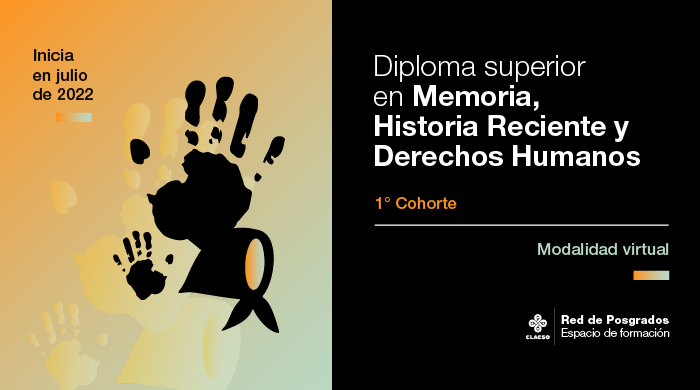
1th Cohort | Virtual Modality
ACADEMIC COORDINATION: Emmanuel Nicolás Kahan (National University of La Plata, Argentina) and Mónica Gatica (National University of Patagonia San Juan Bosco, Argentina)
TEACHING TEAM: Emmanuel Nicolás Kahan (National University of La Plata, Argentina), Mónica Gatica (National University of Patagonia San Juan Bosco, Argentina), Patricia Flier (National University of La Plata – CONICET, Argentina), Enrique Coraza de los Santos (El Colegio de la Frontera Sur, Mexico), Jimena Alonso (University of the Republic, Uruguay), Carla Peñaloza (University of Chile), Natalia Casola (University of Buenos Aires and National University of Tres de Febrero, Argentina), Victoria Álvarez (University of Buenos Aires, Argentina), Pilar Uriarte Bálsamo (University of the Republic, Uruguay), Magdalena Cubero Díaz (University of the Republic, Uruguay), Olga Vázquez Cruz (National University of Colombia), Denise Jardim (Federal University of Rio Grande do Sul, Brazil), Érica Sarmiento (Federal University of Rio de Janeiro, Brazil), Carmen Norambuena (University of Santiago, Chile), Nicolás Herrera (National University of La Plata, Argentina), Guillermo Bravo Acevedo (University of Chile), Joseph Handerson (Federal University of Rio Grande do Sul, Brazil), María de la Paz Escobar (National University of Patagonia San Juan Bosco, Argentina), Andrea Silva Domingues (Federal University of Pará, Brazil), Gonzalo Pérez Álvarez (National University of Patagonia San Juan Bosco, Argentina), Julieta Sahade (Archive of the Provincial Commission for Memory, Argentina), Magdalena Lanteri (Archive of the Provincial Commission for Memory, Argentina), Silvia Dutrénit Bielous (Dr. José María Luis Mora Research Institute, Mexico), Octavio Rafael Nadal Améndola (Museum of Memory, Uruguay), Roxana Enríquez Farías (Mexican Forensic Anthropology Team, Mexico), Ricardo Sáenz de Tejada (University of San Carlos, Guatemala)
Virtual format | July to December 2022
For several years, Latin American countries have been experiencing, in diverse ways, a process of consolidating social movements and public policies dedicated to commemorating mass violence and human rights violations. While this is a regional experience, one of its distinctive features has been the disparity in who promoted these movements—social collectives and/or state agencies—and, in turn, what forms of violence they sought to remember and redress. Although we recognize a series of shared characteristics within the Latin American dimension, the political, social, and cultural processes have revealed the particular ways in which the countries of the region addressed the incorporation and expansion of the human rights agenda and the redress of recent past injustices.
An approach that allows us to understand the specific contexts in which initiatives and policies aimed at redressing past violence, as well as the current expansion of demands surrounding human rights, are developed is relevant for the development of intervention strategies and for the involvement of those connected to professional and academic training. Recognizing how, under what conceptualizations or normative frameworks, and in what national and global contexts those involved in the struggles to consolidate these issues on the public agenda operate, is a decisive factor in strengthening and supporting the interventions of diverse actors in civil society.
This last point is a central theme in our time. While the issue of human rights and the recognition of past violence has been expanding in Latin America, albeit in uneven ways, the emergence of conservative political movements and leaders is straining the gains achieved, as well as the debates about the new horizons proposed by the expanded human rights agenda. Both the past and the future are being viewed with suspicion by the conservative backlash, which not only calls into question the achievements obtained but also re-victimizes those affected by past violence, as well as new populations.
In this sense, the Diploma Program on Memory, Recent History, and Human Rights is not merely an exploration of the ways and debates surrounding how the past remains alive in the present, but rather an invitation to collectively and regionally reflect on the challenges posed by our current historical context. The variety of topics to be addressed constitutes sensitive issues in public life and political engagement, which, examined through Latin American case studies, will allow participants to recognize a broad range of experiences and identify the challenges we face and those that lie ahead.
General Purpose
- To understand and update the debates on the approach to memories and the recent past in Latin America.
- To investigate and reveal how the international human rights agenda was recognized in the region and what the current debates are about its horizons of expansion.
Specific objectives
- To carry out canonical as well as updated readings on perspectives on memory and recent past studies, paying attention to specific dimensions such as Recent History, memory and public uses of the past; forced mobilities and border migrations; archives of sensitive topics and identities, forensic anthropology and the commitment of sciences to human rights agendas.
- To recognize, through case studies, the shared and unique dimensions of memory and human rights policies in Latin America, especially with the materiality/immateriality provided by forensic anthropology.
- To investigate the universe of actors involved in its development - whether from civil society or state agencies - as well as those who are its detractors.
- To highlight the various areas in which activism, as well as public policies, consolidated its demands, strategies, reparations and recognition of the violence perpetrated against populations affected by human rights violations.
- Reflecting on the role of intellectuals, academics, and professionals in supporting, making visible, and legitimizing agendas and strategies around these issues.
The Higher Diploma in Memory, Recent History and Human Rights is aimed at undergraduate and postgraduate students; teachers at all levels; activists and members of trade unions, social movements and political parties; public officials; members and managers of non-governmental organizations and professionals interested in the subject.
- Emmanuel Nicolás Kahan (National University of La Plata, Argentina)
- Mónica Gatica (National University of Patagonia San Juan Bosco, Argentina)
- Silvia Dutrénit Bielous (Doctor José María Luis Mora Research Institute, Mexico)
- Patricia Flier (National University of La Plata - CONICET, Argentina)
- Enrique Coraza de los Santos (El Colegio de la Frontera Sur, Mexico)
- Patricia Flier (National University of La Plata, Argentina),
- Jimena Alonso (University of the Republic, Uruguay)
- Carla Peñaloza (University of Chile)
- Natalia Casola (University of Buenos Aires and National University of Tres de Febrero, Argentina)
- Victoria Álvarez (University of Buenos Aires, Argentina)
- Pilar Uriarte Bálsamo (University of the Republic, Uruguay)
- Magdalena Cubero Díaz (University of the Republic, Uruguay)
- Olga Vázquez Cruz (National University of Colombia)
- Denise Jardim (Federal University of Rio Grande do Sul, Brazil)
- Erica Sarmiento (Federal University of Rio de Janeiro, Brazil)
- Carmen Norambuena (University of Santiago, Chile)
- Nicolás Herrera (National University of La Plata, Argentina)
- Guillermo Bravo Acevedo (University of Chile)
- Joseph Handerson (Federal University of Rio Grande do Sul, Brazil)
- María de la Paz Escobar (National University of Patagonia San Juan Bosco, Argentina)
- Andrea Silva Domingues (Federal University of Pará, Brazil)
- Gonzalo Pérez Álvarez (National University of Patagonia San Juan Bosco, Argentina)
- Julieta Sahade (Archive of the Provincial Commission for Memory, Argentina)
- Magdalena Lanteri (Archive of the Provincial Commission for Memory, Argentina)
- Octavio Rafael Nadal Améndola (Museum of Memory, Uruguay)
- Roxana Enríquez Farías (Mexican Forensic Anthropology Team, Mexico)
- Ricardo Sáenz de Tejada (University of San Carlos, Guatemala)
The program consists of 5 modules of 4 weekly classes each, taught consecutively and linked together.
Total workload of 128 hours.
The modules that comprise the advanced diploma are:
- 1 Module: Recent history, memory and public uses of the past
- 2 Module: Migration, exile and refuge
- 3 Module: Mobilities, spaces, territories and borders
- 4 Module: Sensitive Archives, Documentation Centers and Research Institutes
- 5 Module: Forensic anthropology, citizen search and human rights
| In one payment by 10/07 | In one payment after 10/07 | Payment in 3 installments | |
| CM Pleno | $115 | $230 | USD 315 (3 x USD 105) |
| CM Associate | $240 | $360 | USD 540 (3 x USD 180) |
| No link | $240 | $360 | USD 540 (3 x USD 180) |
To participate, it is essential that you register using the online form.
Upon completion of the registration process, you will receive a confirmation in your email.
Classes will begin in July and will conclude in December 2022.
All registered participants will receive the necessary instructions to access the classes, bibliography and discussion forums through the CLACSO Virtual Training Space.
Accessing and navigating the Virtual Learning Environment is very simple and user-friendly. In any case, a technical and academic support team will always be available to you.
Exceptional Criteria: In exceptional cases, and within the first month of the start of the Advanced Diploma program, students may request to withdraw from the cohort and resume it the following year. In all cases, the reasons for the request must be submitted in writing. After this period has elapsed since the start of the course, no requests will be accepted. Under no circumstances will the money paid be refunded.
| In one payment by 10/07 | In one payment after 10/07 | Payment in 3 installments | |
| CM Pleno | $115 | $230 | USD 315 (3 x USD 105) |
| CM Associate | $240 | $360 | USD 540 (3 x USD 180) |
| No link | $240 | $360 | USD 540 (3 x USD 180) |
Payment can be made in one installment by credit card, bank deposit, or bank transfer. We also offer the option of paying in 3 installments.
Yes. There will be discounts for students belonging to CLACSO Member Centers and CLACSO Associated Centers, for CLACSO Associate Researchers, and for all those who pay within the discount period.
Inquiries: WhatsApp: +54 9 11 3880 – 1388
Email: [email protected]

