
Advanced Diploma in Measuring Gender-Based Violence Against Women and Femicide-Feminicide
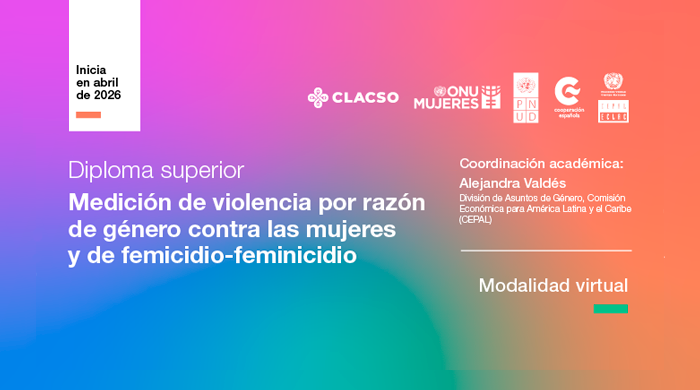
The Latin American Council of Social Sciences (CLACSO) and the Gender Affairs Division of the Economic Commission for Latin America and the Caribbean (ECLAC), with the support of the United Nations Development Programme (UNDP) and the United Nations Entity for Gender Equality and the Empowerment of Women (UN Women), invite you to participate in the Higher Diploma in Measuring Gender-Based Violence Against Women and Femicide-Feminicide.
ACADEMIC COORDINATION: Alejandra Valdés (Consultant, Gender Affairs Division, Economic Commission for Latin America and the Caribbean, ECLAC)
TEACHING TEAM: Alejandra Valdés (ECLAC) | Alejandra Negrete (UNAM, Mexico/UA, Spain) | Karen García (Statistics Officer at ECLAC) | Andrea Llerenas (UN-Women) | Manuel Contreras Urbina (World Bank) | Maite Albagly (Eurosocial) | Luz Patricia Mejía (MESECVI) | Tere Guerra Favela (UN-Women) | Adriana Oropeza (UNODC-INEGI, Mexico) | Diana Arango (World Bank) | Teresa Inchaustegui (UNAM, FLACSO-Mexico) | Helena Suárez (Data Against Femicide)| Vivian Souza (UNDP Brazil) | Marcela Smutt (UNDP)
TUTORING TEAM: Laura García (Chile) | Patricia Vera Traslaviña (Chile-Netherlands) | Andrea Pequeño Bueno (Chile-Spain) | Valentina Pineda (Chile)
Start date : 04/15/2026 | Scholarship applications: 01/15/2026 to 02/17/2026
* CLACSO and UN Women will award 40 full tuition scholarships aimed at public officials from state institutions and members of civil society organizations, responsible for the production of socio-statistical information on violence against women and femicide-feminicide.
RESULTS
We appreciate the overwhelming response to this call for applications. We received over 1000 applications , all of which were carefully evaluated. Following this process, the following individuals have been selected to participate in the Advanced Diploma program:
| Name | Surnames | Country of residence |
| Silvia | Lescano | Argentina |
| Yanina | Torruella | Argentina |
| Alejandra Silvia | Benaglia | Argentina |
| Zulema | Lopez Ayza | Bolivia |
| Mireya Virginia | Pacosillo Quinta | Bolivia |
| Maria Clara Teresa | Fernandes Silveira | Brazil |
| Francisca Evangelista da SIlva Neta | Francisca | Brazil |
| Maria Patricia | Baeza heads | Chile |
| Karla Francisca | Espinoza Jiménez | Chile |
| Viviana del Tránsito | Sepúlveda Villegas | Chile |
| Angie Carolina | Beltran Urbina | Colombia |
| Laura Carolina | Díaz Parra | Colombia |
| Mayra | Brown Vargas | Costa Rica |
| Maria Laura | Zamora Esquivel | Costa Rica |
| The | Alonso | Cuba |
| Rachel | Lambert Correoso | Cuba |
| Edierkys | Ramos Concepción | Cuba |
| Daysi | Reasco | Ecuador |
| Diana | Simbaña | Ecuador |
| Ruth | Argueta | El Salvador |
| Yara Elizama | Benitez Aldana | El Salvador |
| Samara Estefania | Castro | Guatemala |
| Eugenia Maria | Vielman Ramos de Rodríguez | Guatemala |
| Victor Manuel | Morales Rodas | Honduras |
| Danny Gabriela | Hernandez Sanchez | Honduras |
| Mariana | Matus Ruiz | Mexico |
| Karem | Breton Saint Cross | Mexico |
| Arlen | Navas | Nicaragua |
| Henry Antonio | Rodríguez Avilés | Nicaragua |
| Margien Jeanine | Atoche Gonzalez | Panama |
| Maria Gloria Yolanda | Rodríguez Duarte | Paraguay |
| Aurora Sofia | Rojas Peralta | Paraguay |
| Kelly Decire | Gonzales Barrientos | Peru |
| rosmery | Juyo Juyo | Peru |
| Mileyka | De la Rosa Cabrera | Dominican Republic |
| Anmy Gabriela | Guzmán Núñez | Dominican Republic |
| Elisa Andrea | Di Giovanni Zabaleta | Uruguay |
| Jenny Anabella | Segovia Bustos | Uruguay |
| Ana Carolina | Santiago Roldán | Venezuela |
| Monica | Villarreal Gómez | Venezuela |
Gender-based violence against women and girls, as well as its most extreme expression, femicide/feminicide, in Latin America and the Caribbean, demonstrates the persistence of one of the most complex structural knots of gender inequality to dismantle: discriminatory and violent cultural patterns that impede women's autonomy. As one of the most normalized violations of human rights, it constitutes a significant obstacle to development in the countries of Latin America and the Caribbean. Furthermore, it violates and restricts women's enjoyment of their fundamental rights and freedoms, with serious consequences for their health, economic opportunities, rights, and well-being. According to surveys in the region, it affects between 30% and 77% of women. Its consequences not only profoundly affect the lives of the women victims, but also threaten the stability, security, and well-being of their families and communities, as well as the development of their countries. For more than three decades, this scourge has been one of the most relevant issues on the international and regional agenda for gender equality and human rights.
The States of Latin America and the Caribbean have increasingly incorporated into their legislation the need to generate statistics on gender-based violence against women, and many have established regulations for collecting periodic information and creating systems for registering violence against women. These regulations employ a comprehensive conceptual framework that broadens the understanding of gender-based violence against women and girls, the different contexts in which it occurs, and the perpetrators, while also specifying the areas of intervention and the actions of various state institutions at the intersectoral and subnational levels. This is further complemented by the broad scope of comprehensive protection laws and national action plans, which establish roles and responsibilities for sectoral statistical operators, as well as for national statistical institutes or offices, in the prevention, care, punishment, and redress of violence against women.
The institutional, cultural, and methodological challenges facing the measurement of violence against women and the monitoring of indicators for the Sustainable Development Goals related to violence against women are reflected in the diverse instruments and methodologies used to collect prevalence data. This complicates comparability between countries and within countries over time, thus hindering the generation of regional estimates. Similarly, a lack of regulations and funding persists for the institutionalization and periodic implementation of surveys to measure the magnitude of violence. However, significant progress has been made in data production, incorporating gender and intersectional analyses to improve diagnoses and account for the diversity of violence against women. Increasingly, national efforts are being made to include territorial dimensions, ethnic and racial background, gender identity, and age, in addition to income level, and to account for the heterogeneity of experiences with gender inequality in different contexts.
Furthermore, States are making progress in generating Administrative Records Systems that account for violence against women in all its manifestations and, especially, in cases of extreme violence, such as femicide or feminicide or violent deaths of women for gender-related reasons.
Measuring the prevalence and incidence of gender-based violence against women has been included within the framework of international and regional human rights standards globally. In Latin America and the Caribbean, the Declaration on the Elimination of Violence against Women (1993), the Beijing Declaration and Platform for Action (1995), the Convention on the Elimination of All Forms of Discrimination against Women (CEDAW), the Belém do Pará Convention (1994), the Regional Gender Agenda, and the 2030 Agenda have established that efforts to end violence against women must be accompanied by rigorous and reliable statistics.
The duty of due diligence of States enshrined in CEDAW and the Belem do Pará Convention obliges them to adopt all appropriate measures to prevent, investigate, prosecute, punish and provide reparation for the acts or omissions of state and non-state agents that give rise to gender-based violence against women, which obliges states to investigate and record the response in prevention, care, reparation, protection of victims, access to justice and monitoring of judicial processes.
To end gender-based violence against women, the design and implementation of public policies, their budgetary allocation and the monitoring of their management must be accompanied by reliable statistics on the different manifestations, characteristics, causes and consequences of gender-based violence experienced by women and girls in their diversity in all contexts and situations, in order to have information on the effectiveness of public policy and the evolution of the processes of eradicating this scourge.
The accumulated analysis of the processes of measuring and investigating gender-based violence against women has been built thanks to the consensus of international, state, academic and civil society actors, which has allowed progress in strengthening a socio-statistical analytical field of great importance for the social sciences and its implications in different areas of knowledge.
- To understand the international and regional regulatory framework on gender-based violence against women and girls, in particular the mandates and recommendations on measuring its prevalence and incidence.
- To describe the analytical framework for the production of information on gender-based violence against women and the necessary ethical parameters for the collection and dissemination of information from a gender equality and intersectionality perspective.
- Identify the main sources and procedures for measuring gender-based violence against women.
- To know the results of the national surveys on violence against women and the modules in specific surveys on violence against women developed in health and demographic surveys.
- Identify the methodological and quantitative challenges of the indicators for monitoring the Sustainable Development Goals, prioritized in violence against women in the 2030 Agenda.
- Develop capacities to generate statistics from administrative records and their usefulness in accounting for state and civil responses to femicidal violence and manifestations of gender-based violence towards women and girls in contexts of extreme violence.
- Analyze the availability and quality of data on trafficking in women and report on the challenges for improving disaggregated, coherent, up-to-date and public data, which optimize the recording and analysis of these problems.
- To report on the progress in the quality of femicide/feminicide measurement in the countries of the region, as well as the tools for international comparability of femicide/feminicide data in the region.
- Exchange knowledge and practices on proposals and mechanisms for monitoring and producing data on gender-based violence against women generated by civil society organizations.
- To analyze the impact of economic, political, social and health crises on the production of information on extreme violence against women, especially femicides.
- Methodological challenges of the procedures used and the sources for measuring gender-based violence against women and girls
- National surveys measuring the prevalence of violence against women.
- Monitoring of the SDG indicators prioritized in the region to eradicate all forms of violence against all women and girls (Goal 5: indicator 5.2.1; 5.2.2 and C-5.2) and indicator of child marriage and early unions (indicator 5.3.1).
- Monitoring the Belem do Pará Convention and its compliance process indicators.
- Administrative records on violence against women, standardization for the generation of statistics on violence against women in general, and on femicide in particular.
- Progress towards standardization and a single registry of femicide for Latin America and the Caribbean.
- The global statistical framework for measuring gender-based killings of women and girls.
- Findings and results on the quality of the measurement of femicide/feminicide and violent deaths of women for gender reasons.
- Analysis of measurement practices for violence against women and femicide/feminicide.
- Violence Against Women Registry Systems: The Mexico City Experience.
- New dimensions of analysis in violence against women: disappearances, trafficking and femicide. Challenges in information gathering.
- The challenges of intersectionality for measuring extreme violence against women.
- Measuring violence against women and girls in crisis contexts: Old measurement problems versus new and urgent responses.
- The challenges of measuring violence against women in organized crime contexts: The experience of data production and comparability in Central America.
- Femicide, data and activism: making data from civil society and feminist organizations.
- Lessons learned and challenges in measuring gender-based violence against women.
We are grateful for the contributions of UN Women, the UNDP Regional Office, the Follow-up Mechanism to the Belem do Pará Convention (MESECVI), UNODC and the World Bank.
- Alejandra Valdés (Social Planner. Researcher. Specialist in monitoring public policies on gender equality and in measuring violence against women. Consultant, Gender Affairs Division, Economic Commission for Latin America and the Caribbean, ECLAC)
- Alejandra Negrete (Lawyer, UNAM-Mexico. Master's Degree in Legal Argumentation, University of Alicante, Spain)
- Marisa Weinstein, Researcher, Gender Affairs Division of ECLAC and Andrea Llerenas, Data and Statistics Advisor at the Regional Office for the Americas and the Caribbean of UN Women
- Manuel Contreras Urbina (Global Leader on Gender-Based Violence for Latin America and the Caribbean - World Bank)
- Maite Albagly (Specialist in surveys on violence against women and girls, Eurosocial Consultant)
- Andrea Llerenas (Data and Statistics Advisor at the Regional Office for the Americas and the Caribbean of UN Women)
- Luz Patricia Mejía (Technical Secretariat of the Follow-up Mechanism to the Belem do Pará Convention (MESECVI))
- Tere Guerra Favela (Coordinator of the Global Centre of Excellence in Gender Statistics of UN Women Mexico, UN Women)
- Adriana Oropeza (Coordinator of the UNODC-INEGI Centre of Excellence for Statistical Information on Government, Public Security, Victimization and Justice, Mexico)
- Diana Arango (World Bank)
- Teresa Inchaustegui (Sociologist-UNAM, PhD in Political Science with specialization in social policy FLACSO-Mexico)
- Vivian Souza (Sociologist, Master in Social Sciences and Bachelor in International Relations. Consultant UNDP Brazil)
- Marcela Smutt (Coordinator of the Infosegura Regional Project of the United Nations Development Programme for Latin America and the Caribbean (UNDP))
- Helena Suárez (Social communicator and feminist researcher. Co-leads the participatory action research project Data Against Femicide)
TUTORING TEAM:
- Laura Garcia (Sociologist and demographer. Expert in indicators and analysis of information on gender and indigenous and Afro-descendant peoples; systematization of surveys on the prevalence of violence against women)
- Patricia Vera Traslaviña (Sociologist and cultural anthropologist from the University of Amsterdam, UvA. Researcher and activist in the field of migrant women)
- Andrea Pequeño Bueno (Doctor of Social and Cultural Anthropology, Master of Social Sciences, specializing in Gender and Development, Social Communicator and Bachelor of Humanities)
- Valentina Pineda (Geographer from the Pontifical Catholic University of Chile, Master in Urban Planning from the University of Chile)
The Higher Diploma will be developed in 16 sessions led by the teaching team.
Each class will be accompanied by essential and supplementary readings, which will serve as the basis for discussions, reflections, and individual and group projects in forums and other resources and tools available in the virtual classroom. All activities will be supported by the team of tutors.
At the beginning of each week, participants will have access in the virtual classroom to the materials for the week's topics, as well as the required and optional reading materials. Participants can review the materials and participate in the proposed activities. Subsequently, the instructor for each class will develop the topics for each session and engage in dialogue with the participants in a weekly synchronous meeting, held every Wednesday at 6:00 PM (ARG).
Two online discussion forums will be held in the virtual classroom to foster dialogue among students. These forums will be led by the tutoring team. Participation in the forums will allow students to review topics covered in class, share experiences and measurement methodologies, explore inter-institutional partnerships, and more.
The evaluation process is based on continuous and graded assessment throughout the academic period, using questionnaires linked to the content developed in the sessions and implemented at specific times (90%), and the evaluation of participation in synchronous and asynchronous workshops (10%). These components determine the final grade for passing the Diploma.
CLACSO, ECLAC, UNDP and UN Women will award 40 full scholarships aimed at public officials from state institutions and civil society organizations, responsible for the production of socio-statistical information on violence against women and femicide-feminicide.
Requirements for the application:
- The participants will be selected by an evaluation committee appointed by the convening organizations.
- Applications will be submitted through the CLACSO website.
- The candidates must:
1- Complete your personal details.
2- Accredit your institutional affiliation as public officials and/or professionals dedicated to the subject.
- The available scholarships will be allocated respecting regional diversity and gender equity.
- An Academic Committee will review the applications and award the scholarships; the decision cannot be appealed. The results will be announced by CLACSO.
- This call for applications will remain open. until February 17.
| Early registration (until 04/03) | General registration (May 6th to May 15st) | Registration without discount (16/04) | Payment in 3 installments | |
| Full or Associate Member Center | $150 | $220 | $300 | USD 360 (3 x USD 120) |
| No Link | $300 | $370 | $420 | USD 600 (3 x USD 200) |
* Residents of Argentina will pay the equivalent in Argentine pesos according to the official exchange rate of the Banco de la Nación Argentina (BNA) on the day of payment.
Inquiries: [email protected]
WhatsApp: +549113880 – 1388

