
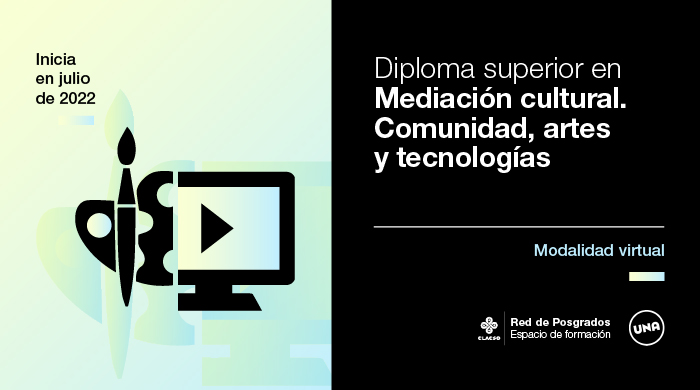
Advanced Diploma in Cultural Mediation: Community, Arts and Technologies
GENERAL COORDINATION: Damián Del Valle (UNA, Argentina)
ACADEMIC COORDINATION: Rosario Lucesole (UNA, Argentina)
ARTISTIC COORDINATION: Marcela Rapallo (UNA, Argentina)
TEACHING TEAM: João Luiz “Juca” Silva Ferreira – Former Minister of Culture (2008 – 2010 / 2014 – 2016) (Brazil), Sandra Torlucci (National University of the Arts, Argentina), Víctor Miguel Vich Florez (Pontifical Catholic University of Peru), Yamila Volnovich (National University of the Arts, Argentina), Damián Del Valle (National University of the Arts, Argentina), Feda Baeza (National University of the Arts, Argentina), François Mairesse (Université Sorbonne Nouvelle Paris 3, France), Bruno Nassim Aboudrar (Université Sorbonne Nouvelle Paris 3, France), Rosario Lucesole (National University of the Arts, Argentina), Marcela Rapallo (National University of the Arts, Argentina), María Araceli Soto (National University of the Arts, Argentina), Bianca Racioppe (National University of La Plata, Argentina), Gabriela Augustowsky (National University of the Arts, Argentina)
Virtual format | July to December 2022
Originating in Europe and widely developed in countries like Canada, cultural mediation has acquired its status and function in major cultural institutions worldwide. A common definition in Europe describes it as “a set of actions that, through an intermediary (the mediator, who may be a professional, an artist, a facilitator, or a peer), aim to connect an individual or group with a cultural or artistic offering (an original work of art, an exhibition, a concert, a performance, etc.) with the objective of fostering its understanding, knowledge, and appreciation” (Aboudrar and Mairesse 2018, 15). This definition is conceived around processes embedded in traditional cultural spheres, such as museums and major cultural institutions.
This Diploma program takes the premise that many actions and projects could fit the definition of cultural mediation, but that we generally know them under different concepts, depending on the country and academic or intellectual traditions. For example, in our region, the model of the cultural or sociocultural facilitator or the cultural promoter is widespread at different times and with different approaches. Even within the very idea of university outreach or engagement, we could find multiple projects that would fit some ideas of cultural mediation. A common element in all these actions is the idea of connection; that is, thinking of these actions as a way of forging bonds with others, based on cultural and artistic productions, to produce new meanings, deconstruct existing ones, and enable new ways of living in community.
We therefore begin by considering cultural mediation as a practice and as an emerging discipline that has not yet formed a clearly defined field of problems, with the exception of the French case and some Canadian experiences. Although some aspects of the topic have recently been developed in Latin America, for example in Chile (Peters 2019), it is not yet possible to approach it from an international perspective.
Given this scenario, the need arose to initiate a process of systematizing the diverse trajectories associated with cultural mediation in the region, while simultaneously developing specific training that brings together the knowledge that forms a conceptual framework unique to these latitudes. Therefore, in 2019, the National University of the Arts (UNA) of Argentina launched an initial training program for cultural mediators, which served as the starting point for the implementation of this online Diploma in 2020, in conjunction with the Latin American Council of Social Sciences (CLACSO). This program facilitates dialogue between trainees and cultural producers in Latin America and the Caribbean.
SPECIFIC OBJECTIVES
● Promote professionalization and improvement strategies that elevate the role of the mediator in the field of arts and cultures.
● To address various theoretical and practical aspects that enable the design, management, execution, coordination and supervision of the different aspects involved in cultural mediation.
The Higher Diploma in Cultural Mediation: Community, Arts and Technologies is aimed at undergraduate and postgraduate students; teachers at all levels; activists and members of trade unions, social movements and political parties; public officials; members and managers of non-governmental organizations and professionals interested in the subject.
- João Luiz “Juca” Silva Ferreira - Former Minister of Culture (2008 - 2010 / 2014 - 2016) (Brazil)
- Sandra Torlucci (National University of the Arts, Argentina)
- Victor Miguel Vich Florez (Pontifical Catholic University of Peru)
- Yamila Volnovich (National University of the Arts, Argentina)
- Damián Del Valle (National University of the Arts, Argentina)
- Feda Baeza (National University of the Arts, Argentina)
- François Mairesse (Université Sorbonne Nouvelle Paris 3, France)
- Bruno Nassim Aboudrar (Université Sorbonne Nouvelle Paris 3, France)
- Rosario Lucesole (National University of the Arts, Argentina)
- Marcela Rapallo (National University of the Arts, Argentina)
- María Araceli Soto (National University of the Arts, Argentina)
- Bianca Racioppe (National University of La Plata, Argentina)
- Gabriela Augustowsky (National University of the Arts, Argentina)
The program consists of 5 modules of 3-4 weekly classes, each taught consecutively and linked to the others.
The modules that comprise the advanced diploma are:
Prevailing paradigms surrounding the concept of culture, the origin of cultural mediation as a discipline, and the scope of cultural mediation. The role of the cultural mediator, and the trajectories and particularities that our region contributes to this practice. Strategies for performing a task situated in the territory we inhabit. Community culture and interculturality.
The artist as mediator. Experiences that articulate art, technology, and social transformation. The role of new technologies in these forms of knowledge and understanding. New paths of collaborative creation and building connections within territorial and virtual communities. Relational art and innovative pedagogical practices in dialogue with new ways of inhabiting the world. Free culture and free software. Creative Commons and licenses.
Cultural mediation as an educational strategy. Culture and the arts as arenas for contested meanings in educational spaces. Latin American educational experiences related to cultural mediation. Cultural policies and education in museums. The "educational turn" and didactic curatorship. The role of play in mediation, playfulness and aesthetics as forms of knowledge, learning, and knowledge exchange. Group work strategies for cultural mediators.
Project design, development of sustainability strategies and financing. Cultural communication. Measurement and evaluation of cultural projects.
New roles in the cultural and artistic field. Experiences focused on strategies for building connections and exchanges between cultural and artistic productions and audiences. The mediator as disseminator, facilitator, activist, and technician in the field of arts and culture. Documentation and collaboration with agents currently developing mediation strategies in Argentina and the region. Support in the development of the final project.
| In one payment by 10/07 | In one payment after 10/07 | Payment in 3 installments | |
| CM Pleno | $115 | $230 | USD 315 (3 x USD 105) |
| CM Associate | $240 | $360 | USD 540 (3 x USD 180) |
| No link | $240 | $360 | USD 540 (3 x USD 180) |
To participate, it is essential that you register using the online form.
Upon completion of the registration process, you will receive a confirmation in your email.
Classes will begin in July and will conclude in December 2022.
All registered participants will receive the necessary instructions to access the classes, bibliography and discussion forums through the CLACSO Virtual Training Space.
Accessing and navigating the Virtual Learning Environment is very simple and user-friendly. In any case, a technical and academic support team will always be available to you.
Exceptional Criteria: In exceptional cases, and within the first month of the start of the Advanced Diploma program, students may request to withdraw from the cohort and resume it the following year. In all cases, the reasons for the request must be submitted in writing. After this period has elapsed since the start of the course, no requests will be accepted. Under no circumstances will the money paid be refunded.
| In one payment by 10/07 | In one payment after 10/07 | Payment in 3 installments | |
| CM Pleno | $115 | $230 | USD 315 (3 x USD 105) |
| CM Associate | $240 | $360 | USD 540 (3 x USD 180) |
| No link | $240 | $360 | USD 540 (3 x USD 180) |
Payment can be made in one installment by credit card, bank deposit, or bank transfer. We also offer the option of paying in 3 installments.
Yes. There will be discounts for students belonging to CLACSO Member Centers and CLACSO Associated Centers, for CLACSO Associate Researchers, and for all those who pay within the discount period.
Inquiries: WhatsApp : +54 9 11 3880 – 1388
Email : [email protected]

