
Advanced Diploma in War Maps: Territories, Crises, and the Reproduction of Life
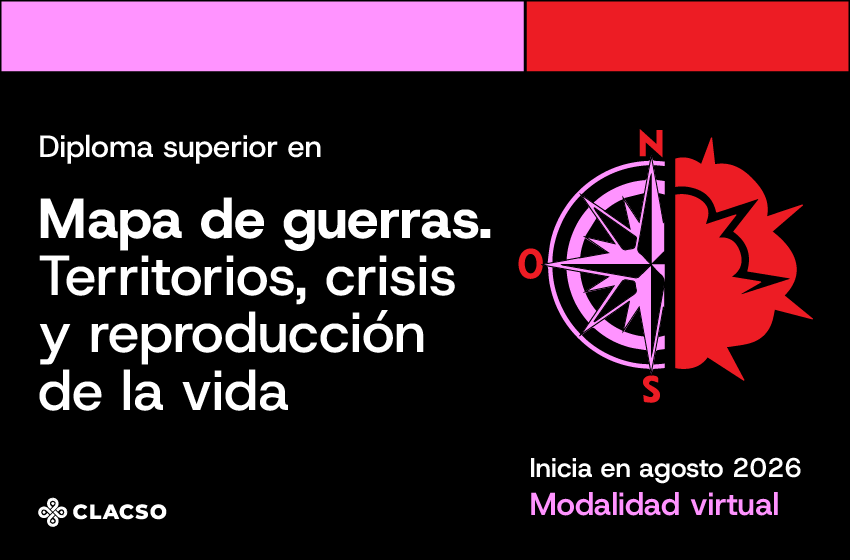
5th Cohort | Virtual Modality
COORDINATION : Tinta Limón Publishing Cooperative
Ignacio Gago (University of Buenos Aires, Argentina) | Diego Picotto (University of Buenos Aires, Argentina) | Andrés Bracony (University of Buenos Aires, Argentina) | Verónica Gago (National University of San Martín-CONICET, Argentina) | Ezequiel Gatto (National University of San Martín, Argentina).
TEACHING TEAM: Silvia Federici (Hofstra University, United States) | Maurizio Lazzarato (University of Paris, France) | Jérémy Rubenstein (Panthéon-Sorbonne University, Argentina-France) | Raquel Gutiérrez Aguilar (Autonomous University of Puebla, Mexico) | Fabio Luis Barbosa Dos Santos (Federal University of São Paulo, Brazil) | Ignacio Gago (University of Buenos Aires, Argentina) | Leandro Barttolotta (University of Buenos Aires, Argentina) | John Gibler (United States, Mexico) | Verónica Gago (National University of San Martín-CONICET, Argentina) | Rodrigo Nunes (Pontifical Catholic University of Rio de Janeiro, Brazil) | Emanuela Borzacchiello (National Autonomous University of Mexico) | Bruno Fornillo (CONICET, Argentina) | Melisa Argento (CONICET, Argentina) | Eduardo Gudynas (Latin American Center for Social Ecology, Uruguay) | Franco Bifo Berardi (University of Bologna, Italy) | Diego Picotto (University of Buenos Aires, Argentina).
Virtual format | August to December 2026
Start: 20/08/2026 | Registration: 18/05/2026 to 18/08/2026
This course proposes a fundamental shift: to read the present not from the perspective of peace, stability, or order, but from the perspective of war as the key to understanding it. Over 15 classes, we will address war not only as armed conflict, but also as a structuring principle of capitalist accumulation, the production of subjectivity, the reconfiguration of territories, and the crisis of social reproduction. This is not a course about war as an exception, but about war as a permanent feature of the contemporary world.
We propose practicing cartography to share experiences: to understand the world, to fight against it, and to make room within it for new ways of life. The publication of political essays here becomes explicit intervention. We are not interested in promoting canned discussions, but rather in inviting collective reflection on the wars that permeate us, surround us, and explode in our hands in the form of multiplied crises.
The journey traverses specific territories and regions—from Central America as a laboratory of empire to the strategic Amazon, passing through the crossroads of Brazil 2026, Gaza, Ayotzinapa and the Andean region—led by a teaching staff made up of leading figures in critical thought such as Silvia Federici, Verónica Gago, Maurizio Lazzarato, Raquel Gutiérrez Aguilar, Bifo Berardi, Rodrigo Nunes, among others.
The categories inherited from liberalism, and even those from traditional critical theory, are now insufficient to explain a world traversed by war at all scales: from the offensive against bodies and territories, to the siege of the commons and the reproduction of life.
Instead of treating war as an exceptional outbreak or a developmental anomaly, we propose it as a key to structural understanding. This perspective allows us to connect seemingly disparate phenomena: extractivism in the Andean region and counterinsurgency as a technology of power; the financialization of everyday life and the resurgence of the radical right; and, in response, the reconfiguration of feminisms as networks of resistance.
The goal is to forge the conceptual tools necessary to analyze the wars of the present —including those we do not yet name as such— and, simultaneously, to identify the fissures and bets on the common that emerge in the folds of a damaged world.
The Advanced Diploma in War Maps: Territories, Crises and the Reproduction of Life is aimed at undergraduate and postgraduate students; teachers at all levels; activists and members of trade unions, social movements and political parties; public officials; members and managers of non-governmental organizations and professionals interested in the subject.
- Silvia Federici (Hofstra University, United States)
- Maurizio Lazzarato (University of Paris, France)
- Jérémy Rubenstein (Panthéon-Sorbonne University, Argentina-France)
- Raquel Gutiérrez Aguilar (Autonomous University of Puebla, Mexico)
- Fabio Luis Barbosa Dos Santos (Federal University of São Paulo, Brazil)
- Ignacio Gago (University of Buenos Aires, Argentina)
- Leandro Barttolotta (University of Buenos Aires, Argentina)
- John Gibler (United States, Mexico)
- Veronica Gago (National University of San Martín-CONICET, Argentina)
- Rodrigo Nunes (Pontifical Catholic University of Rio de Janeiro, Brazil)
- Emanuela Borzacchiello (National Autonomous University of Mexico)
- Bruno Fornillo (CONICET, Argentina)
- Melisa Argento (CONICET, Argentina)
- Edward Gudynas (Latin American Center for Social Ecology, Uruguay)
- Franco Bifo Berardi (University of Bologna, Italy)
- Diego Picotto (University of Buenos Aires, Argentina)
The program consists of 15 weekly classes, divided into two modules. The modules that comprise the advanced diploma are:
- CLASS 1: War as a key to reading I
Teacher: Lemon Ink - CLASS 2: Who are today's new conquerors? War and accumulation
Teacher: Silvia Federici - CLASS 3: Why war and not revolution? From the economic and political failure of the United States to the “strategic cycle”
Teacher: Maurizio Lazzarato - CLASS 4: Terror and Seduction: Counterinsurgency Strategies
Teacher: Jérémy Rubenstein - CLASS 5: Betting on the common in a damaged world
Teacher: Raquel Gutiérrez Aguilar
- CLASS 6: War as a key to understanding II
Teacher: Lemon Ink - CLASS 7: Central America: the laboratory of empire
Teacher: Fabio Luis Barbosa Dos Santos - CLASS 8: War and precarity in urban peripheries
Teachers: Leandro Barttolotta and Ignacio Gago - CLASS 9: From Ayotzinapa to Bukele's El Salvador. Violence and writing
Teacher: John Gibler - CLASS 10: Argentina: the war of finance against social reproduction
Teacher: Verónica Gago - CLASS 11: Brazil 2026: Is Bolsonarism returning?
Teacher: Rodrigo Nunes - CLASS 12: Femicide on the Mexican-American border. Struggle for justice and conceptual invention
Teacher: Emanuela Borzacchiello - CLASS 13: Andean Region: Extractivism and Energy Transition
Teachers: Bruno Fornillo and Melisa Argento - CLASS 14: Amazonia: alternatives before collapse
Teacher: Eduardo Gudynas - CLASS 15: Thinking after Gaza: libertarian-capitalist supremacist brutalism
Teacher: Franco Bifo Berardi
| Early registration (until 07/07) | General registration (May 6th to May 12st) | Registration without discount (13/08 to 19/08) | Payment in 3 installments | |
| Full or Associate Member Center | $190 | $260 | $340 | USD 420 (3 x USD 140) |
| No Link | $340 | USD 410 | $460 | USD 630 (3 x USD 210) |
* Residents of Argentina will pay the equivalent in Argentine pesos according to the official exchange rate of the Banco de la Nación Argentina (BNA) on the day of payment.
You must be registered in the CLACSO Single Registration System (SUIC) and enter your username and password. If you are not registered, click here . To access the registration form, click the "Register" button on the webpage of the Diploma program you are interested in.
Upon completion of the registration process, you will receive a confirmation in your email.
Classes will begin in August and will conclude in December 2026.
All registered participants will receive on the first day of activities the necessary instructions to access the classes, bibliography and discussion forums through the CLACSO Virtual Training Space.
Accessing and navigating the Virtual Learning Environment is very simple and user-friendly. In any case, a technical and academic support team will always be available. For inquiries, you can write to [email protected]
You must send an email with the request to [email protected] and we will send you the requested certificate as soon as possible.
Exceptional Criteria: In exceptional cases, and within the first 20 days of the start of the Advanced Diploma program, students may write to [email protected] requesting to withdraw and stating the reasons. After evaluation of the case, a response will be sent to the request. If approved, the student may resume the Advanced Diploma program if a new cohort is offered the following year. After this period has elapsed since the start of the course, no requests will be accepted.
Money paid will only be refunded in cases where the organizing institutions decide to cancel the activity.
Yes, the advanced diploma is certified by CLACSO. The diploma will be sent digitally and is completely free of charge.
Payment can be made in one installment, by credit card or bank transfer. We also offer the option of paying in 3 installments.
Yes. There will be discounts for students belonging to CLACSO Member Centers and CLACSO Associated Centers, for CLACSO Associate Researchers, and for all those who pay within the discount period.
You can check if you belong to a member center here:
The Advanced Diploma program integrates a dynamic of asynchronous and synchronous classes. Classes are primarily asynchronous. The schedule for synchronous sessions will be communicated by the Diploma coordinator at the beginning of the program, and participation in these sessions is not a prerequisite for passing the program.
Inquiries: WhatsApp: +54 9 11 3880 – 1388
Email: [email protected]

