
Advanced Diploma in Geopolitics
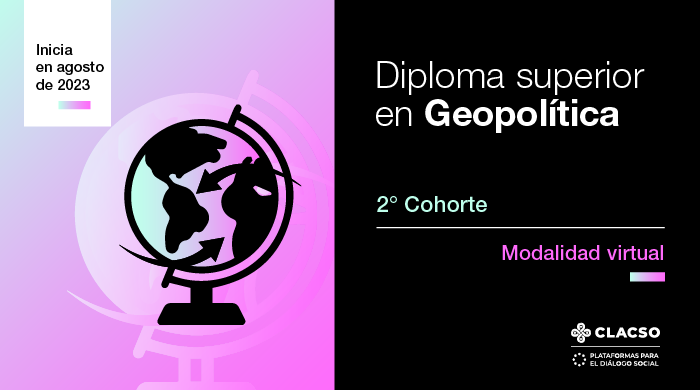
2th Cohort | Virtual Modality
ACADEMIC COORDINATION
Mónica Bruckmann (Federal University of Rio de Janeiro, Brazil) and Juan Agulló (Federal University of Latin American Integration, Brazil)
PROFESSORS
Andrés Rivarola Puntigliano (Stockholm University, Sweden), Enrique Dussel Peters (National Autonomous University of Mexico), Óscar Ugarteche (National Autonomous University of Mexico), María José Rodríguez Rejas (Autonomous University of Mexico City), Tamara Lajtman (University of Buenos Aires, Argentina), Maribel Aponte (University of Puerto Rico), Breno Bringel (State University of Rio de Janeiro, Brazil), Elisa Pinheiro de Freitas (Federal University of Mato Grosso do Sul, Brazil), Andrés Arauz (GT Coordinator), Janaina Figueiredo (O Globo, Brazil), Mónica Bruckmann (Federal University of Rio de Janeiro, Brazil) and Juan Agulló (Federal University for Latin American Integration, Brazil)
Virtual format | August to December 2023
The Advanced Diploma in Geopolitics is designed to provide:
a) A broad perspective on the history of geopolitical thought;
b) methodological tools so that critical production in this area begins to be carried out with academic rigor and cross-cutting themes and
c) A strategic perspective on the contemporary world system, with a special focus on Latin America. To this end, a large group of renowned professors (from up to 12 different countries) will contribute, along with the regular instructors, to introducing schools of thought and authors, providing academic resources, and analyzing specific cases.
GENERAL OBJECTIVES
- To provide a broad overview of the evolution of geopolitical thought.
- To provide methodological tools aimed at promoting rigorous critical production in this area.
- To provide a broad and structural view of the current state of the World-System.
SPECIFIC OBJECTIVES
- Understanding geopolitics as a field of problematization.
- To perceive the differences and similarities that exist between classical and contemporary geopolitical thought.
- To gain an understanding of the characteristics and peculiarities of Latin American geopolitical thought.
- Identify some of the basic geopolitical problems of the contemporary World-System.
- Identify some of the basic geopolitical problems of contemporary Latin America.
- Identify the academic infrastructure for the production and exchange of critical geopolitical knowledge (reference bibliography and newspapers; observatories, associations; etc).
- Incorporate the basic methodological principles of Critical Geopolitics.
The Higher Diploma in Geopolitics is aimed at undergraduate and postgraduate students; teachers at all levels; activists and members of trade unions, social movements and political parties; public officials; members and managers of non-governmental organizations and professionals interested in the subject.
- Andrés Rivarola Puntigliano (Stockholm University, Sweden)
- Enrique Dussel Peters (National Autonomous University of Mexico)
- Oscar Ugarteche (National Autonomous University of Mexico)
- María José Rodríguez Rejas (Autonomous University of Mexico City)
- Tamara Lajtman (University of Buenos Aires, Argentina)
- Maribel Aponte (University of Puerto Rico)
- Breno Bringel (State University of Rio de Janeiro, Brazil)
- Elisa Pinheiro de Freitas (Federal University of Mato Grosso do Sul, Brazil)
- andres arauz (GT Coordinator)
- Janaina Figueiredo (O Globo, Brazil)
- Monica Bruckmann (Federal University of Rio de Janeiro, Brazil)
- Juan Agulló (Federal University for Latin American Integration, Brazil)
The program is organized into modules with weekly classes, each taught consecutively and linked to the others.
Total workload of 128 hours.
The modules that comprise the Higher Diploma are:
The introduction will be done in three parts:
1) An initial meeting so that the participants can introduce themselves and meet the coordinating team, who will take the opportunity to present the contents of the 2023 edition.
2) The official opening in which a renowned Latin American academic will give a master class.
3) A recorded session that will be distributed later in which Geopolitics will be introduced through a delimitation of its contents and orientations based on three basic questions: What is Geopolitics? Why and for what purpose do Geopolitics? How and where do Geopolitics?
The purpose of this module is to map geopolitical thought so that participants in the Diploma program have the necessary references regarding schools of thought, positions, influences, critiques, epistemological ruptures, etc. The sessions will be structured around three main axes: classical thought, contemporary (critical) thought, and Latin American thought.
Class 1: Classical Geopolitical Thought
Responsible: Andrés Rivarola Puntigliano
Class 2 : Critical Geopolitical Thinking
Responsible: Juan Agulló
Class 3 : Critical Geopolitical Thinking in Latin America
Responsible: Mónica Bruckmann
A specter is haunting the world. It's not simply that globally impactful events have occurred in the last three years (such as the Covid-19 pandemic or the war in Ukraine). It's that these events are structurally altering the geopolitical foundations of global governance. This module will address the reconfiguration of the world-system; the increasingly visible conflict between the United States and China; and the emergence of the Global South as an international actor.
Class 4: The geopolitical reconfiguration of the World-System
Responsible: Mónica Bruckmann
Class 5: China/USA: Conflict or Competition?
Responsible: Enrique Dussel Peters
Class 6: Global South: An Emerging Power?
Responsible: Juan Agulló
Latin America, an unequal and dependent region, faces an international system in full transformation… This module proposes to work in three directions in order to weave diagnoses: it seeks to understand what room for maneuver remains for our region in an international context very different from that of the Cold War and post-Cold War; what meaning regional integration can have in this framework and what foreign actors should be considered (and why) in the coming years, in our region.
Class 7: Latin America in the new global context
Responsible: Mónica Bruckmann
Class 8: Latin American integration in the new world system
Responsible: Juan Agulló
Class 9: External Geopolitical Actors in Latin America
Responsible: Óscar Ugarteche
Latin American reality reflects the structural changes taking place internationally. This module will focus on three key issues for our region: 1) security, a problem we all share and which has its own strategic implications; 2) the enormous changes occurring in the Greater Caribbean area, a major strategic connector to global markets; and 3) non-sovereign actors with the capacity for spatial influence.
Class 10: Geopolitics of Security in Latin America
Responsible: María José Rodríguez Rejas and Tamara Latjman
Class 11: The Greater Caribbean in global perspective
Responsible: Maribel Aponte
Class 12: Other actors: territories, movements, resistances
Responsible: Breno Bringel
The final module will address cross-cutting themes that affect the international system as a whole and have specific regional impacts, typical of our time. This module will focus specifically on the environmental crisis, the reconfiguration of the global financial system, and information flows.
Class 13: Geopolitics of the environmental crisis and natural resources in Latin America
Responsible: Elisa Pinheiro de Freitas
Class 14: Reconfiguration of the global financial system and the new financial architecture in Latin America
Responsible: Andrés Arauz
Class 15: Information flows in Latin America
Responsible: Janaina Figueiredo
| In one payment by 15/08 | In one payment after 15/08 | Payment in 3 installments | |
| CM Pleno | $175 | $230 | USD 315 (3 x USD 105) |
| CM Associate | $300 | $360 | USD 540 (3 x USD 180) |
| No link | $300 | $360 | USD 540 (3 x USD 180) |
To participate, you must register using the online form by clicking here. Registration will be open from May 8 to August 20, 2023.
Upon completion of the registration process, you will receive a confirmation in your email.
Classes will begin in August and will conclude in December 2023.
All registered participants will receive the necessary instructions to access the classes, bibliography and discussion forums through the CLACSO Virtual Training Space.
Accessing and navigating the Virtual Learning Environment is very simple and user-friendly. In any case, a technical and academic support team will always be available to you.
Exceptional Criteria: In exceptional cases, and within the first month of the start of the Advanced Diploma program, students may request to withdraw from the cohort and rejoin the following year. In all cases, the reasons for the request must be submitted in writing. After this initial period, no requests will be accepted.
Money paid will only be refunded in cases where the organizing institutions decide to cancel the activity.
| In one payment by 15/08 | In one payment after 15/08 | Payment in 3 installments | |
| CM Pleno | $175 | $230 | USD 315 (3 x USD 105) |
| CM Associate | $300 | $360 | USD 540 (3 x USD 180) |
| No link | $300 | $360 | USD 540 (3 x USD 180) |
Payment can be made in one installment by credit card, bank deposit, or bank transfer. We also offer the option of paying in 3 installments.
Yes. There will be discounts for students belonging to CLACSO Member Centers and CLACSO Associated Centers, for CLACSO Associate Researchers, and for all those who pay within the discount period.
Inquiries: WhatsApp: +54 9 11 3880 – 1388
Email: [email protected]

