
Advanced Diploma in Gender and Climate Change
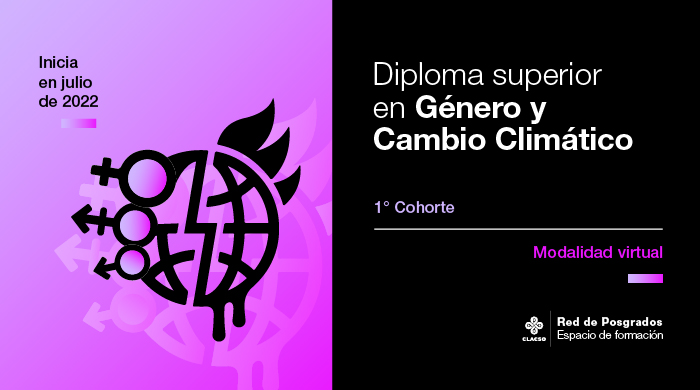
1th Cohort | Virtual Modality
ACADEMIC COORDINATION: Gabriela Merlinsky (University of Buenos Aires, Argentina)
TEACHING TEAM: Melissa Moreano Venegas (Andean University Simón Bolívar, Ecuador), Diana Carolina Ojeda Ojeda (University of the Andes, Colombia), Denisse Roca Servat (Pontifical Bolivarian University, Colombia), Libertad Chávez-Rodríguez (Center for Research and Higher Studies in Social Anthropology, Mexico), Inés Angela Camilloni (University of Buenos Aires, Argentina), Mina Lorena Navarro (Meritorious Autonomous University of Puebla, Mexico), Margarita Velázquez Gutiérrez (National Autonomous University of Mexico), Miriam Lang (Andean University Simón Bolívar, Ecuador).
Virtual format | July to December 2022
In Latin America and the Caribbean, the impacts of climate change are intertwined with the effects of economic globalization, resulting in a “triple exposure” process (climate, colonialism, and capitalism) that disproportionately affects women. It is essential to promote a strategic agenda with a gender perspective in both research and policies on climate change. This requires revisiting the conceptual frameworks of Ecofeminism and Feminist Political Ecology, highlighting how women experience different effects of climate change in their care practices and their relationship with the environment and territory, which are shaped by specific historical and cultural processes. Likewise, it is necessary to challenge the dichotomous social and media representations that portray women either as vulnerable victims or as powerful agents of change. To achieve this, it is indispensable to strengthen relational and intersectional gender perspectives, which emphasize the importance of analyzing the power relations that underlie inequality. This diploma aims to contribute to strengthening women's participation by rescuing, highlighting and positioning in training proposals the different situated experiences of women's movements in pursuit of climate justice.
Objective
- To provide perspectives and conceptual tools that allow for a more complex and enriched understanding of climate policy and justice issues from an intersectional perspective, recognizing complex identities that incorporate class, gender, Afro-descendant identity, sexual diversity, sexuality, ethnicity, religion, and colonial legacy (among others).
Specific objectives
- To foster a perspective of convergence between theoretical-epistemological critique and the different expressions of feminisms and ecofeminisms in Latin America and the Caribbean.
- To offer elements that allow the recovery of knowledge networks between activists and academics to give visibility to territories in resistance and the political processes of building proposals for climate justice.
- To contribute to the creation and consolidation of research and postgraduate training networks in gender and climate change.
The Higher Diploma in Gender and Climate Change is aimed at undergraduate and postgraduate students; teachers at all levels; activists and members of trade unions, social movements and political parties; public officials; members and managers of non-governmental organizations and professionals interested in the subject.
- Melissa Moreano Venegas (Andean University Simón Bolívar, Ecuador)
- Diana Carolina Ojeda Ojeda (University of the Andes, Colombia)
- Denisse Roca Servat (Pontifical Bolivarian University, Colombia)
- Libertad Chávez-Rodríguez (Center for Research and Higher Studies in Social Anthropology, Mexico)
- Inés Angela Camilloni (University of Buenos Aires, Argentina)
- Lorena Navarro Mine (Meritorious Autonomous University of Puebla, Mexico)
- Margarita Velázquez Gutiérrez (National Autonomous University of Mexico)
- Miriam Lang (Andean University Simón Bolívar, Ecuador)
The program consists of 5 modules of 4 weekly classes each, taught consecutively and linked together.
Total workload of 128 hours.
The modules that comprise the advanced diploma are:
- 1 Module: Conceptual bases of climate change and intersectional approaches
- 2 Module: Climate change, extractivism and feminist political ecology
- 3 Module: Gender, urban issues and climate policy
- 4 Module: Gender and climate change: the social organization of care and the “feminization” of environmental care
- 5 Module: Intersectional alternatives, policies, and methodological approaches
| In one payment by 10/07 | In one payment after 10/07 | Payment in 3 installments | |
| CM Pleno | $115 | $230 | USD 315 (3 x USD 105) |
| CM Associate | $240 | $360 | USD 540 (3 x USD 180) |
| No link | $240 | $360 | USD 540 (3 x USD 180) |
To participate, it is essential that you register using the online form.
Upon completion of the registration process, you will receive a confirmation in your email.
Classes will begin in July and will conclude in December 2022.
All registered participants will receive the necessary instructions to access the classes, bibliography and discussion forums through the CLACSO Virtual Training Space.
Accessing and navigating the Virtual Learning Environment is very simple and user-friendly. In any case, a technical and academic support team will always be available to you.
Exceptional Criteria: In exceptional cases, and within the first month of the start of the Advanced Diploma program, students may request to withdraw from the cohort and resume it the following year. In all cases, the reasons for the request must be submitted in writing. After this period has elapsed since the start of the course, no requests will be accepted. Under no circumstances will the money paid be refunded.
| In one payment by 10/07 | In one payment after 10/07 | Payment in 3 installments | |
| CM Pleno | $115 | $230 | USD 315 (3 x USD 105) |
| CM Associate | $240 | $360 | USD 540 (3 x USD 180) |
| No link | $240 | $360 | USD 540 (3 x USD 180) |
Payment can be made in one installment by credit card, bank deposit, or bank transfer. We also offer the option of paying in 3 installments.
Yes. There will be discounts for students belonging to CLACSO Member Centers and CLACSO Associated Centers, for CLACSO Associate Researchers, and for all those who pay within the discount period.
Inquiries: WhatsApp: +54 9 11 3880 – 1388
Email: [email protected]

