
Advanced Diploma in Social Studies of Work
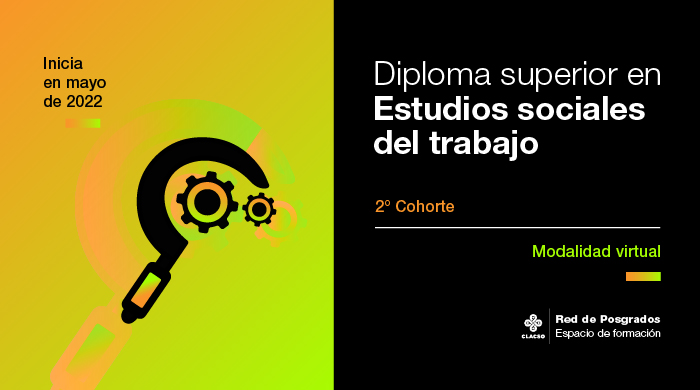
2th Cohort | Virtual Modality
ACADEMIC COORDINATION: Hernán Palermo (CEIL-CONICET, Argentina), Lorena Capogrossi (CIECS-CONICET and UNC, Argentina) and Carlos León Salazar (UAQ, Mexico)
TEACHING TEAM: Lorena Capogrossi (CIECS-CONICET and UNC, Argentina), Norma Fuller Osores (PUCP, Peru), Osnaide Izquierdo Quintana (UH, Cuba), Carlos León Salazar (UAQ, Mexico), María José Magliano (CIECS-CONICET, Argentina), Jaime Santos Júnior (UFPR, Brazil), Liliana Vargas (JAVERIANA, Colombia), Cristina Vega Solis (FLACSO, Ecuador), Areli Veloz (UABC, Mexico), Luis Reygadas (UAM, Mexico), Patricia Ventrici (CEIL-CONICET, Argentina).
Virtual format | May to October 2022
How can we understand the world of work in the 21st century? This question is vital for understanding and analyzing the heterogeneous dynamics and transformations taking place in the world of work today. The new management forms that consolidated as a result of the globalization of the Toyot system and the flexibilization of labor relations have shaped a new paradigm that has taken on particular characteristics in different regions of Latin America and the Caribbean. These transformations have not only modified labor markets, the technical organization of production, and the knowledge mobilized, but also union structures, identities, values, and the daily lives of those who identify as workers. Nevertheless, we find structural continuities in capitalism's historical attempt to discipline the workforce in relation to its interests.
Furthermore, in Latin America, women's increasingly active participation in the workforce, their demands, the processes of the sexual division of labor, and occupational segmentation challenge our understanding of the importance of addressing work from a gender perspective. The inclusion of the reproductive dimension as a point of contention for women has broadened—to some extent—the scope of the concept of work, which, until now, only considered its productive and public dimensions, rendering invisible the tasks performed primarily by women. Care work, vital for the reproduction of capitalism, takes place—both within and outside the market—in the domestic sphere, but also in spaces of professionalized public experience such as healthcare and education. In these approaches, it is important to consider studies on masculinities in the workplace, which provide relevant findings for understanding men's labor dynamics.
As a recent phenomenon, new forms of work have emerged following the integration of information technologies. The use of computers, cell phones, the internet, social networks, applications, and so on, has transformed people's lives, and work is no exception. In this context, we observe the growth of the global phenomenon known as "platform economies." The novelty of these platforms lies in their ability to provide the infrastructure to mediate between different groups of users, who contribute all kinds of data that, refined through algorithmic technology, becomes a vital resource for business organization and work arrangements. Especially in the last 15 years, we have seen transformations in the world of work linked, for example, to what is called the "platformization of prosumption"—that is, the production and consumption of informational goods (software, audiovisual content, texts, data) distributed through freely accessible internet platforms (for profit or non-profit), carried out during leisure time and without necessary financial compensation. These are production processes that strain the distinction between work time and leisure time, and even the very notion of work. Furthermore, this context highlights what is known as the “platformization of employment”: for-profit companies that present themselves as mere intermediaries of supply and demand, but in practice structure the entire production process by “hiring” workers—legally classified as self-employed—who perform labor activities worldwide in exchange for payment per task.
The common denominator in all these experiences is "work" as a fundamental axis in social and human dynamics, indispensable for the material and subjective production of people's lives. Work is the primary means of subsistence, identity, and conflict, and occupies a central place in social dynamics.
GENERAL PURPOSE:
To offer a fruitful environment for debates and discussions about the problems of work that provides theoretical and practical resources oriented to various areas of professional action.
SPECIFIC OBJECTIVES:
- To promote a reflective view on the experiences and organizational practices that express the complexities of the world of work in Latin America and the Caribbean.
- To contribute to the development of activities related to research and teaching.
- To provide conceptual tools regarding the dynamics and tensions of the world of work for those who work in public administration, private management or trade union organizations.
The Higher Diploma in Social Studies of Work is aimed at undergraduate and postgraduate students; teachers at all levels; activists and members of trade union organizations, social movements and political parties; public officials; members and managers of non-governmental organizations and professionals interested in the subject.
- Hernán M. Palermo (CEIL-CONICET/UBA, Argentina)
- Lorena Capogrossi (CIECS-CONICET and UNC, Argentina)
- Osnaide Izquierdo (UH, Cuba)
- Jaime Santos (UFPR, Brazil)
- Cristina Vega (FLACSO, Ecuador)
- Liliana Vargas (JAVERIANA, Colombia)
- María José Magliano (CIECS-CONICET/UNC, Argentina)
- Carlos León (UAQ, Mexico)
- Luis Reygadas (UAM, Mexico)
- Patricia Ventrici (CEIL-CONICET, Argentina)
- Norma Fuller (PUCP, Peru)
- Areli Veloz (UABC, Mexico)
The program consists of 7 modules with weekly classes, each taught consecutively and linked to the others.
Total workload of 128 hours.
The modules that comprise the advanced diploma are:
Class 1: Presentation.
Class 2: The meanings of work throughout history and contemporary transformations.
Class 3: Delimitation of the disciplinary field and historical contextualization. Main theoretical and methodological influences of the anthropology of work.
Class 4: Ethnography as a method for approaching work
Class 5: Latin American Anthropology of Work: Problematizations and Theoretical Frameworks.
Class 1: “The construction of the working subject in contemporary societies”
Class 2: “The formalization of informality. Development models and the dynamics of (re)production of everyday life”
Class 3: “Work conflicts in social theory”
Class 4: “Interpretations on forms of resistance”
Class 1: “Introduction to the studies of Marxist and socialist feminism.”
Class 2: “Primitive accumulation, reproduction and disciplining in Latin America”
Class 3: “Governance and gender in the workplace”
Class 1: “Introduction to masculinity and work studies”
Class 2: “Management as a device for constructing masculinities”
Class 3: “Rethinking machismo in Latin America”
Class 1: “Migration and work in the 21st century”
Class 2: “Informality, job insecurity and migrant economies”
Class 3: “Intersectionality, migration and work”
Class 1: “Digital platforms: a new organizational model for capitalism?”
Class 2: “Working conditions, work process, algorithmic control and resistance”
Class 3: “Case Analysis”
Class 1: “Integrative workshop for the final project”
Class 2: “Integrative workshop for the final project”
Closing class
|
MODULE |
CLASS |
DATE |
TITLE |
TEACHER |
FORMAT OF THE CLASS |
|
1 (4 weeks)
|
1 |
20/5 |
Presentation class: “Labor studies in Latin America” |
Hernán Palermo |
Synchronous |
|
2 |
1 MODULE
“The meanings of work throughout history and contemporary transformations.” |
Hernán Palermo |
Writing |
||
|
3 |
27/5 |
Delimitation of the disciplinary field and historical contextualization. Main theoretical and methodological influences of the anthropology of work. |
Lorena Capogrossi |
Synchronous |
|
|
4 |
3/6 |
Ethnography as a method for approaching work. |
Lorena Capogrossi |
Writing |
|
|
5 |
10/6 |
Latin American anthropology of work: problematizations and theoretical frameworks. |
Lorena Capogrossi |
Writing |
|
|
2 (4 weeks)
|
6 |
17/6 |
2 MODULE
“The construction of the working subject in contemporary societies” |
Osnaide Izquierdo |
Recording |
|
7 |
24/6 |
“The formalization of informality. Development models and the dynamics of (re)production of everyday life” |
Osnaide Izquierdo |
Recording |
|
|
8 |
1/7 |
“Work conflicts in social theory” |
James Santos |
Synchronous |
|
|
9 |
5/7 |
“Interpretations on forms of resistance” |
James Santos |
Synchronous |
|
|
10 |
8/7 |
3 MODULE
“Introduction to the study of Marxist and socialist feminism.” |
Areli Veloz |
Recording |
|
|
3 (4 weeks)
|
11 |
29/7 |
“Primitive accumulation, reproduction and disciplining in Latin America” |
Cristina Vega |
Writing |
|
12 |
5/8 |
“Governance and gender in the workplace.” |
Liliana Vargas Monroy |
Synchronous |
|
|
13 |
12/8 |
4 MODULE
“Introduction to the study of masculinities and work” |
Carlos León |
Writing |
|
|
14 |
16/8 |
“Management as a device for constructing masculinities” |
Carlos León |
Writing |
|
|
15 |
19/8 |
“Rethinking machismo in Latin America”
|
Norma Fuller |
Synchronous |
|
|
16 |
26/8 |
5 MODULE
“Migration and work in the 21st century” |
María José Magliano |
Synchronous |
|
|
|
17 |
2/9 |
“Informality, job insecurity and migrant economies” |
María José Magliano |
Writing |
|
4 (4 weeks) |
18 |
9/9 |
“Intersectionality, migration and work” + Submission of instructions for the final integrative project |
María José Magliano |
Video recorded |
|
19 |
16/9 |
6 MODULE
“Digital platforms: a new organizational model for capitalism?” |
Luis Reygadas |
Synchronous |
|
|
5 (4 weeks)
|
20 |
23/9 |
“Working conditions, work process, algorithmic control, and resistance” |
Luis Reygadas |
Synchronous |
|
21 |
30/9 |
“Case analysis” |
Luis Reygadas |
Recorded |
|
|
22 |
7/10 |
7 MODULE
“Integrative workshop for the final project” |
Patricia Ventrici |
Synchronous |
|
|
23 |
14/10 |
“Integrative workshop for the final project” |
Patricia Ventrici |
Synchronous |
|
|
24 |
Closing class |
Hernán Palermo |
Synchronous |
||
|
TIF Delivery |
2/11 |
Submission of final integrative work. |
- |
|
|
| In one payment by 20/02 | In one payment after 20/02 | Payment in 3 installments | |
| CM Pleno | $175 | $230 | USD 315 (3 x USD 105) |
| CM Associate | $300 | $360 | USD 540 (3 x USD 180) |
| No link | $300 | $360 | USD 540 (3 x USD 180) |
To participate, you must register using the online form by clicking here. Registration will be open from December 6, 2020, to May 3, 2022.
Upon completion of the registration process, you will receive a confirmation in your email.
Classes will begin in May and will conclude in December 2022.
All registered participants will receive the necessary instructions to access the classes, bibliography and discussion forums through the CLACSO Virtual Training Space.
Accessing and navigating the Virtual Learning Environment is very simple and user-friendly. In any case, a technical and academic support team will always be available to you.
If the student decides not to enroll in the Advanced Diploma program before its formal start date, they may request a refund of their tuition fees. CLACSO will retain the equivalent of 10% for administrative costs.
Exceptional Criteria: In exceptional cases, and within the first month of the start of the Advanced Diploma program, students may request to withdraw from the cohort and rejoin the following year. In all cases, the reasons for the request must be submitted in writing. After this initial period, no requests will be accepted.
| In one payment by 20/02 | In one payment after 20/02 | Payment in 3 installments | |
| CM Pleno | $175 | $230 | USD 315 (3 x USD 105) |
| CM Associate | $300 | $360 | USD 540 (3 x USD 180) |
| No link | $300 | $360 | USD 540 (3 x USD 180) |
Payment can be made in one installment by credit card, bank deposit, or bank transfer. We also offer the option of paying in 3 installments.
Yes. There will be discounts for students belonging to CLACSO Member Centers and CLACSO Associated Centers, for CLACSO Associate Researchers, and for all those who pay within the discount period.
Inquiries: WhatsApp: +54 9 11 3880 – 1388
Email: [email protected]

