
Advanced Diploma in Studies of Far-Right Politics and the Undermining of Democracy
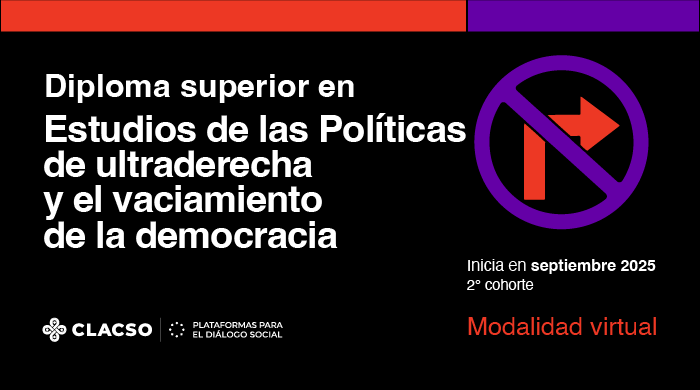
2th Cohort | Virtual Modality
ACADEMIC COORDINATION
Elvin Calcaño Ortiz (Dominican Republic)
PROFESSORS
Amparo Marroquín Parducci (Central American University, El Salvador); Omar Rincón (University of the Andes, Colombia); Magdalena Broquetas (University of the Republic, Uruguay); Ernesto Bohoslavsky (National University of General Sarmiento, Argentina); Elvin Calcaño Ortiz (Dominican Republic), Hernán Ouviña (IALC-UBA, Argentina), Danilo Martusceli (Federal University of Uberlândia, Brazil), Mariana Aparicio Ramírez (National Autonomous University of Mexico, Mexico) and Tzinti Ramírez (Monterrey Institute of Technology, Mexico)
Virtual format | September to November 2025
Start: 10/09/2025 | Registration: 09/05/2025 to 09/09/2025
This Diploma arises in response to the rise of far-right political alternatives in Latin America and other regions of the world, alternatives that champion reactionary ideology, the elimination of the adversary transformed into an existential enemy, and the dismantling of the common good. Under the guise of what various authors describe as a neoliberalized, and therefore hyper-individualistic and anti-political, common sense of our time, reactionary sectors, labeled as “libertarians,” “patriots,” and similar, now wield significant political and cultural influence globally.
The Advanced Diploma offers training that allows one to understand these phenomena at different levels and from different methodologies, organized in two parts:
- the first, oriented towards a theoretical training in which categories and concepts of political theory and science will be addressed that are fundamental to understanding in their proper dimension the current process of rightward shift and reactionism turned into common sense that is seen in so many countries of the world.
The second part is practical and focuses on understanding how these concepts and categories operate in relation to the current rise of the far right. For example, how these discourses circulate and are structured on social media, how they can be measured and classified using technological tools and advanced political analysis, and how trends are constructed in digital conversations (now central spaces for public discussion) based on fake news, hoaxes, and manipulations from far-right sectors.
It is proposed that the participants of the Higher Diploma be able to visualize and develop tools to detect these discourses and combat them from their everyday virtual and conventional spaces, within the framework of a perspective of defending democratic coexistence and ideological pluralism.
Why does a young Argentinian, living in a working-class neighborhood on the outskirts of Buenos Aires, find a liberating horizon in Milei's anti-state and extremist discourse? What makes a Ryder, a truly precarious worker with a precarious working life, feel that he is his own boss and therefore "free"?
To find answers to these questions, we must consider two key issues: currently, reactionary and ultracapitalist discourses connect organically with dominant common sense, circulating naturally without much explanation. Because of this, the far right is better able to represent and embody the prevailing discontent than sectors ranging from the left to centrist progressives.
Speaking out against the State today becomes, firstly, something of “common sense” because it is supposedly true that the state sphere would take away our freedom, and secondly, it is anti-system since there would be a “progressive” hegemony that through a “global agenda” imposes on us what we should think, prefer and do.
On social media, this type of discourse circulates with great ease, connecting with millions who consume and share it simply because they believe it to be true. The communicative paradigm that, according to Zuboff (2020), social media imposes by segmenting users (people) into niches based on tastes, fears, and prejudices, reinforces this type of dynamic and framing.
In today's digital conversation spaces, the effects of truth are more important than the truth itself: the way something is said is more effective than what it actually is. The way social networks operate facilitates this process of ideological confirmation, since "news" circulates among niche groups that instantly project it to millions of accounts.
In this context, democracy is threatened on two fronts:
- First, because the currently dominant neoliberal rationality (Brown, 2016) empties it of its specifically political content by deepening individualism and economizing everything. Thus, citizens, in the context of a life reduced to competing in the market and managing their lives as if they were businesses, do not see public spaces as sources of freedom, and politics, understood as participating in the common good and organizing collectively, loses importance. Without politicized citizenship in the sense of participating in the affairs of the res publica, democracy is reduced to a mere procedure for electing ruling elites.
- And second, because without truth and a public discussion based on facts, democratic coexistence within the political community (society) is impossible. Respect for the rules of the democratic game and those minimum agreements that guarantee coexistence amidst the inherent differences of society are replaced.
The threats to democracy today are numerous, and the rise of the far right and reactionary movements are a sign of this. Insofar as we live in societies shaped by a digital communication paradigm, traditional social movements and academic activism are no longer sufficient.
In today's world, limiting ourselves to this (which certainly remains valid) is tantamount to letting democracy slip away. Therefore, we believe we must resort to other methods and refocus our academic efforts.
We propose this Diploma course from a perspective of defending democracy, aimed at training people to participate in their spaces of civic discussion and combat the discourses and frameworks of the reactionary far right, based on understanding its foundations and how this political logic operates in public discussion.
It will be a Diploma program in which classes and training activities will not only be taught by traditional academics but also by experts in Big Data, electoral consultants and experts in digital political communication.
General objective:
To offer rigorous and up-to-date training on the specific characteristics of the contemporary phenomenon of the emergence of far-right political sectors and to contribute to the defense of democracy in these times of such serious threats.
Specific objectives:
- Explain how the coordinates of political-ideological conflict function today in terms of left and right
-
To characterize the far right, on the conceptual and factual levels, as a specific political logic that involves ruptures and deepenings of what has historically been liberal-conservatism.
-
Analyzing neoliberalism as a dominant rationality that was historically built from the margins of dominant consensuses, and as a strategy of economic elites to reconfigure and socially unanchor capitalism and thus decouple the economy from democracy.
-
To explain, using digital conversation data and artificial intelligence tools, how social networks, from the communicative paradigm they establish, intervene by creating trends and circulating fake news and hoaxes about democracy and politics in general.
-
To characterize the case studies as phenomena of the far-right political logic of Trump, Milei and Bukele from a practical perspective focused on generating militancy against them.
The Higher Diploma in Studies of Far-Right Politics and the Undermining of Democracy is aimed at undergraduate and postgraduate students; teachers at all levels; activists and members of trade unions, social movements and political parties; public officials; members and managers of non-governmental organizations and professionals interested in the subject.
The program consists of 5 modules of 3 weekly classes each, taught consecutively and linked together.
Total workload of 128 hours.
The modules that comprise the Higher Diploma are:
CLASS 1: What is politics: Arendt, Pitkin and Schmitt
Teacher: Elvin Calcaño
CLASS 2: Validity of the left and right dyad
Teacher: Elvin Calcaño
CLASS 3: Radicalization of the ideological conflict in Mexico: consolidation of a progressive project in times of far-right rise
Teacher: Tzinti Ramírez
CLASS 1: Denialism or relativization of the right-wing dictatorships of the 20th century
Teachers: Magdalena Broquetas and Ernesto Bohoslavsky
CLASS 2: The philosophical thinking behind the political logic of the far right
Teacher: Hernán Ouviña
CLASS 3: Fascism or post-fascism as part of the far-right ideological family
Teacher: Danilo Martusceli
CLASS 1: The Rise of Neoliberal Rationality
Teacher: Tzinti Ramírez
CLASS 2: The electoral logic of the far right
Teacher: Mariana Aparicio Ramírez
CLASS 3: Democracy as a hindrance to the accumulation of business sectors
Teacher: To be confirmed
CLASS 1: The counter-coolture of rights to escape democratic dystopia
Teacher: Omar Rincón
CLASS 2: Political communication in times of uncertainty and technological disruptions
Teacher: To be confirmed
CLASS 3: How digital conversations are built and measured
Teacher: Ismael Batista
CLASS 1: Trumpism 2.0: tariff threats, anti-progressive culture war and deglobalization
Teacher: To be confirmed
CLASS 2: Ideology and social networks in Milei's government management
Teacher: To be confirmed
CLASS 3: Consolidation of the Bukele paradigm: from cool president to repression and concentration of power
Teacher: Amaparo Marroquin Parducci
| Early registration (until 27/08) | General registration (May 6th to May 03st) | Registration without discount (September 4th to 9th) | Payment in 3 installments | |
| Full or Associate Member Center | $125 | $185 | $240 | USD 315 (3 x USD 105) |
| No Link | $250 | $310 | $370 | USD 540 (3 x USD 180) |
* Residents of Argentina will pay the equivalent in Argentine pesos according to the official exchange rate of the Banco de la Nación Argentina (BNA) on the day of payment.
You must be registered in the CLACSO Single Registration System (SUIC) and enter your username and password. If you are not registered, click here . To access the registration form, click the "Register" button on the webpage of the Diploma program you are interested in.
Upon completion of the registration process, you will receive a confirmation in your email.
Classes will begin in September and will conclude in December 2025.
All registered participants will receive on the first day of activities the necessary instructions to access the classes, bibliography and discussion forums through the CLACSO Virtual Training Space.
Accessing and navigating the Virtual Learning Environment is very simple and user-friendly. In any case, a technical and academic support team will always be available. For inquiries, you can write to [email protected]
You must send an email with the request to [email protected] and we will send you the requested certificate as soon as possible.
Exceptional Criteria: In exceptional cases, and within the first 20 days of the start of the Advanced Diploma program, students may write to [email protected] requesting to withdraw and stating the reasons. After evaluation of the case, a response will be sent to the request. If approved, the student may resume the Advanced Diploma program if a new cohort is offered the following year. After this period has elapsed since the start of the course, no requests will be accepted.
Money paid will only be refunded in cases where the organizing institutions decide to cancel the activity.
Yes, the advanced diploma is certified by CLACSO. The diploma will be sent digitally and is completely free of charge.
Payment can be made in one installment, by credit card or bank transfer. We also offer the option of paying in 3 installments.
Yes. There will be discounts for students belonging to CLACSO Member Centers and CLACSO Associated Centers, for CLACSO Associate Researchers, and for all those who pay within the discount period.
You can check if you belong to a member center here:
The Advanced Diploma program integrates a dynamic of asynchronous and synchronous classes. Classes are primarily asynchronous. The schedule for synchronous sessions will be communicated by the Diploma coordinator at the beginning of the program, and participation in these sessions is not a prerequisite for passing the program.
Inquiries: WhatsApp: +54 9 11 3880 – 1388
Email: [email protected]

