
Advanced Diploma in Popular and Feminist Economies
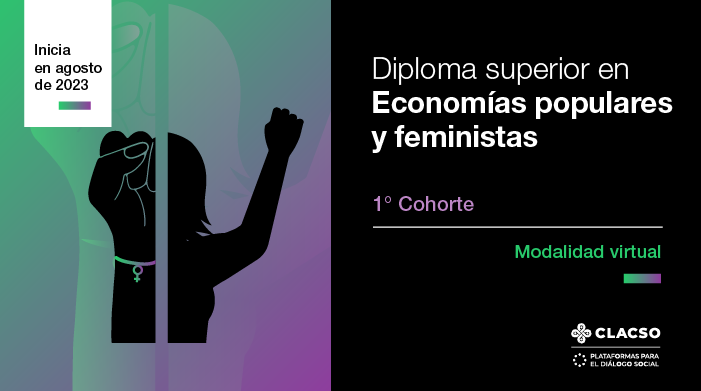
1th Cohort | Virtual Modality
ACADEMIC COORDINATION
María Verónica Gago (National University of San Martín, Argentina), Maria Cristina Cielo (FLACSO, Ecuador) and Alioscia Castronovo (National University of San Martín, Argentina and National University of Colombia)
PROFESSORS
Alioscia Castronovo (National University of San Martín, Argentina and National University of Colombia), Martha Lucia Bernal Suárez (National University of San Martín, Argentina and National University of Colombia), Ana Julia Bustos (University of Buenos Aires and CONICET, Argentina), Maria Cristina Cielo (FLACSO, Ecuador), Alfonso Hinojosa Gordonava (Universidad Mayor de San Andrés, Bolivia), Ana María Morales Troya (National University of San Martín, Argentina), Victor Miguel Castillo (University of Buenos Aires, Argentina), Maisa Bascuas (University of Buenos Aires, Argentina), Santiago Azzati (University of Buenos Aires, Argentina), Cristina Bertha Vera Vega (FLACSO, Ecuador), Delia Colque Quillca (Universidad Mayor de San Andrés, Bolivia), Alexandre Roig (National University of San Martín, Argentina), Cesar Augusto Giraldo (National University of Colombia), Anahí Durand Guevara (National University of San Marcos, Peru) and María Verónica Gago (National University of San Martín, Argentina)
Virtual format | August to December 2023
This diploma program addresses the field of popular economies in Latin America from diverse political, epistemological, and conceptual perspectives, linking them to feminist economics, political ecology, migration studies, public policy, and social conflict studies. How do they function? What experiences and subjectivities do they encompass? What are their genealogies, forms of work, and territories? Why and how are they linked to feminist economics and political ecology? What productive and political logics do they employ? What relationships do they have with public policy and social movements? Through these questions, we will explore popular economies in their multiplicity—that is, from the diverse economic, social, cultural, and political processes they involve—thus outlining a constellation of problems, conjunctures, and spatialities.
The conceptualization of the popular economy is relatively new and remains a subject of ongoing debate. With this Advanced Diploma, we aim to explain how this field is formed, emphasizing the open nature of its definition. Drawing on contributions from diverse perspectives, we propose a pluralistic understanding of popular economies as a set of diverse experiences and economic practices related to forms of production, circulation, and consumption; modes of reorganizing social reproduction; social cooperation; and the production of political subjectivity.
Informal economies have become a stable feature of the region's metropolises, serving as modes of reproduction for the majority of the population, as surfaces where the crisis is inscribed, and as multiple and varied strategies for stabilizing and contesting new labor dynamics. Particularly during the pandemic, "essential" and indispensable tasks, with their inherent ambivalence, have revealed the capacity to create "popular infrastructure." From this perspective, we are interested in problematizing and investigating the complex dynamics of popular institutions that emerge from their social, logistical, productive, and reproductive infrastructures. Using a cartographic and ethnographic approach, we propose mapping an ongoing process that accounts for the reproduction of life and the forms of work for large majorities.
In temporal terms, popular economies emerge in response to the neoliberal dismantling of the wage-earning world as a model for the inclusion of working populations, and to the deepening of unprotected labor regimes globally, characterized by the hegemony of financial capitalism and widespread indebtedness. Within the problematic field of popular economies, a whole series of interconnected concepts and premises must be critiqued: informality as synonymous with illegality, and so-called subsistence economies as synonymous with poverty. Furthermore, the privatization of public services has intensified the burden of reproductive labor to ensure social reproduction. Therefore, we propose to consider popular economies from the perspective of feminist economics; one cannot be understood without the other. Consequently, we incorporate a feminist perspective that values care and domestic work as fundamental elements of their daily fabric.
In spatial terms, popular economies appear most generally as an experience of the peripheral neighborhoods of Latin American metropolises or the so-called Global South, but peasant and indigenous economies must also be considered. We therefore propose to consider a constellation of practices and concepts where popular economies are not understood as "the other" of work, but rather their multiplication, heterogenization, and transformation are questioned and analyzed in order to discuss periphery, marginality, and exclusion, and to analyze the processes of capital valorization as part of a colonization process toward new territories (not only urban) that are transformed into spaces of conflict. We propose to systematize the main debates of this problematic field in the social and political sciences, in institutions and in social movements around five axes, the modules of the Higher Diploma: 1) the multiplication of work and the new dynamics of exploitation, 2) the perspectives of feminist economics, 3) collective dynamics and the production of the common, 4) migrant mobilities and subjectivities and 5) public policies and finance.
GENERAL OBJECTIVES
The general objectives of the Higher Diploma in Popular and Feminist Economies are to provide a broad introduction to Latin American debates within the field of popular and feminist economies and their intersections, contributing to mapping theoretical and practical perspectives in relation to field studies, concrete experiences of popular and feminist economies, and public policy proposals. An initial focus will be on the genealogies of these economies in relation to different perspectives and territories, including the intersections, conflicts, and overlaps between popular and feminist economies and political ecology.
SPECIFIC OBJECTIVES
Based on the five proposed thematic modules, the Diploma is developed with multiple teachers through a journey around the perspectives of popular economies with the following specific objectives:
- To introduce course participants to the reading and conceptual, political and experiential debate surrounding the actors of the popular economy, their specific territories and the conflicts that run through them
- To produce critical approaches to thinking about economic, political and social practices in Latin America
- To update the debates on the multiple realities of work in the metropolises of our region and in the various territories from the perspective of popular economies as a mass reality and laboratory of the crises and recompositions of neoliberalism
- To cross the debates of popular economies from the conceptual tools of feminist economics
- Understanding, from this intersection, new forms of work and sex-gender relations, within the broader context of a colonial and patriarchal accumulation regime
- To intertwine the debates of popular economies with the perspectives of political ecology, community networks and the commons
- To problematize the relationships between finance, public policies and popular economies.
The Higher Diploma in Popular and Feminist Economies is aimed at undergraduate and postgraduate students; teachers at all levels; activists and members of trade unions, social movements and political parties; public officials; members and managers of non-governmental organizations and professionals interested in the subject.
The program consists of 5 modules of 3 weekly classes each, taught consecutively and linked together.
Total workload of 128 hours.
The modules that comprise the Higher Diploma are:
Class 1: Beyond informality
Teacher in charge: Alioscia Castronovo and Martha Lucia Bernal
Conceptual summary of the class
In this class, we propose introductory discussions characterizing popular economies within Latin American debates. We offer a critique of the categories of informality and marginality used to conceptualize the productive and reproductive activities of large majorities of urban and rural populations in the region. Furthermore, we propose a dialogue between Latin American perspectives and debates on urban popular economies in Africa, aiming for a perspective that integrates the debates of the Global South. We propose an initial reading that allows us to analyze popular economies as a composition of subjectivities, networks, and practices that challenge the limits and boundaries of the urban, recomposing and reinventing from below the bonds of solidarity, community structures, and collective dynamics in the face of dispossession, precarization, and the progressive establishment of the neoliberal logic of individual competition as the dominant form of social relation.
Class 2: Work and lives without pay in the cities of the global south
Teacher in charge: Alioscia Castronovo
Conceptual summary of the class
This class proposes a debate on the condition of the unpaid worker and the dynamics of the multiplication of labor in the contemporary world, exploring different perspectives on the conceptualization of the processes of labor reconfiguration. Conceptualizing these processes in contemporary capitalism allows for the development of a broader notion of work and of the forms of production and reproduction in "lives without wages." Focusing the analysis on the relationship between the new international division of labor, processes of accumulation, multiplication, and heterogenization of labor, as proposed by Mezzadra and Neilson, the objective of this class is to propose an expansion of the categories of work and exploitation in popular economies in order to contribute to the development of an anthropology of work in the current stage of crisis dominated by global financial capitalism. The proposal is to focus on the processes of dispossession, urban and rural disputes surrounding land, access to housing, and the advance of the agribusiness and drug trafficking frontier as part of a renewed deployment of multiple forms of violence and dynamics of exploitation in the territories.
Class 3: Extractivism, value and popular economies
Teacher in charge: Veronica Gago and Santiago Azzati
Conceptual summary of the class
This class will present the concept of expanded extractivism and the relationship between extraction and exploitation in popular economies from a theoretical perspective, as well as through concrete experiences and practices that confront the multiple forms of value extraction within the dynamics of production and social reproduction in the networks of popular and indigenous economies in Latin America. Furthermore, it will delve deeper into the debate surrounding the processes of primitive accumulation in Marx and other authors within contemporary critical discourse.
Class 4: Exploitation and extraction: popular economy and feminist economy
Teacher in charge: Veronica Gago and Maisa Bascuas
Conceptual summary of the class
The class aims to introduce and discuss central issues in feminist economic critiques and the links between accumulation, exploitation, and the valorization of labor, particularly with a focus on differential forms of exploitation. Furthermore, it proposes an analysis of the political, reproductive, and political mobilization networks of informal economies in relation to the international feminist strike in Argentina and Latin America. Various discussions from feminist economics have shown that reproductive labor is not limited to the domestic sphere but extends to the reproduction of life in neighborhoods and communities. Many informal economies are woven and built in networks; therefore, it is vital to understand their community dimension and their coexistence with reproductive labor.
Class 5: Expanded reproduction of life: between feminist economics and political ecology
Teacher in charge: Cristina Cielo
Conceptual summary of the class
In this class, we present a particular approach to the intersection of feminist economics, reproductive and care studies, and feminist and urban political ecology. This approach focuses on the politics of the commons, that is, those that explore the collaborative aspects involved in the expanded reproduction of life. Developed in Latin America in dialogue with other regions of the Global South, this approach involves redefining the political through the safeguarding and recreation of the commons for re-existence, based on three axes: the materialities of expanded reproduction; the trajectories and interconnections for sustenance; and the modes of cooperation, negotiation, and dispute for re-existence.
Class 6: Challenges of addressing intersectionality in/from popular economies
Teacher in charge: Cristina Vera; guest: Magali Marega
Conceptual summary of the class
This class aims to delve into the conceptual complexities of grassroots economies from a feminist perspective of intersectionality. This perspective allows us to understand life-sustaining practices as a product of the dynamic intersection of sex/gender, class, and race within historically constructed contexts of domination. We retain the term intersectionality because of its genealogy and the emancipatory potential it represents, stemming from Black Latin American feminisms in convergence with Black feminism and the contributions of community and Indigenous feminisms. We emphasize that this perspective does not refer to a mere sum of segments, but rather to historically shifting relationships of domination, resistance, and re-existence.
Class 7: Cooperativism, trade unionism, self-management
Teacher in charge: Alioscia Castronovo and Maysa Bascuas
Conceptual summary of the class
In this class, we aim to present the organizational dynamics of social cooperation and the creation of new popular institutions, analyzing, through field studies and activist experiences, the processes of self-organization and self-management in cooperatives and the union dynamics of the popular economy in Argentina. To explore the complexities and complexities of the multiple experiences of self-organization and the strategies of social struggles, we propose different readings to construct a framework for interpreting the processes of producing the commons from diverse perspectives and territories.
Class 8: Crisis, revolts and popular economies
Teacher in charge: Anahí Durand and Victor Miguel
Conceptual summary of the class
In this seminar, we aim to delve deeper into the Peruvian experience with two approaches that allow us to explore the dynamics of social conflict from a critical perspective of the logic of informality. One approach involves a presentation of the emblematic struggle linked to the eviction of the La Parada popular market in Lima. The other approach, featuring sociologist Anahi Durand, professor at San Marcos University, member of the Working Group, and former Minister of Women in Peru, focuses on a debate about the processes of popular uprisings in recent years in Peru, examining the processes of popular economies to consider the possibility of social transformation and a politics of emancipation linked to the search for new constituent processes that confront reactionary, repressive, and violent dynamics on the part of the political and economic establishment.
Class 9: Disputes over the value of rural territories: between family farming and illegal economies
Teacher in charge: Castronovo Alioscia; guests: Hernan Vargas and Juan Camilo Torres
Conceptual summary of the class
The focus of this class is linked to the question of what value is at stake in rural areas across different regions of Venezuela and Colombia. It connects the understanding of value production with various productive activities, specifically the experiences of family farming. Family farming, the most widespread form of organization in the world, accounts for 90% of all production methods, produces over 80% of the world's food in terms of value, and is the sector that generates the most jobs globally. How does this situation play out in Venezuela? Based on the first periodic report from the Venezuelan Observatory of Popular Economies on the "Contribution of Popular Economies to Food Sovereignty" and on research conducted with cooperatives in the Argentine peasant popular economies, this class delves deeper into the debate surrounding agroecology, food sovereignty, and the communal economy in the context of the crisis.
On the other hand, two rural processes in Colombia linked to activities considered illegal—coca leaf cultivation and artisanal mining—are vying for hegemonic power. In the search for answers, the ways in which actors and groups of actors, subjects of the Popular Economy, become visible in the public sphere, legitimize their decisions, make their strategies known, and energize their meanings will emerge. This will seek to problematize notions of value and justice in popular economies in border territories.
Class 10: Popular Mobilities, Strategies and Infrastructures
Teacher in charge: Alfonso Hinojosa and Ana Julia Bustos
Conceptual summary of the class
Migration, understood as movement, is taken as a specific lens for inquiry. Using migration as a critical perspective allows us to explore how movement and being moved are intertwined, where what is at stake is how movement puts them into practice and the worlds it makes possible. In these new contexts, national spaces and their borders, the cities and territories that are articulated, as well as the diverse practices of self-organization that subjects in motion deploy, lead us to consider an autonomist perspective on migration.
Class 11: Genealogy of popular economies: an approach from the ethnohistory and economic history of Latin America
Teacher in charge: Ana Julia Bustos and Ana Maria Morales Troya
Conceptual summary of the class
Thinking about popular economies as ways of reproducing and earning a living in times of neoliberal crisis also means looking back at the genealogies of political and economic organization in our continent. In our studies, it is essential to examine history, long-term memories, and their fragments that are constantly being re-evaluated in the present to analyze the networks of migrant popular economies, which involve forms of know-how in mobility and strategies of community organization. Studies in ethnohistory and economic history of the Andes, focusing on long-standing transnational trade routes, enduring economic patterns, and the generation of markets that allowed for the articulation of diverse economic and geographic spaces, constitute a fundamental foundation for understanding popular economies today.
Class 12: New subjectivities and migrant political struggles
Teacher in charge: Alioscia Castronovo and Delia Colque
Conceptual summary of the class
In this class, we aim to present case studies and concrete experiences of the emergence of new migrant political subjectivities from and within popular and feminist economies in Latin America, particularly between Argentina and Bolivia. Based on ethnographic and activist research, the class will discuss how communal life resists being restricted and governed through mechanisms such as racism and the fixed and reactionary use of borders and cultural identities. Furthermore, it will question the system of hierarchical production in the world of work and migration, in which various political and economic actors of diverse nationalities are involved. Within this framework, we will analyze the emergence of new political and social processes such as the Migrant Workers' Bloc, the Ni Una Migrante Menos (Not One More Migrant) movement, and the processes of union, production, and political organization of Bolivian migrant workers in Argentina.
Class 13: The home as a laboratory: finance, housing, and essential work
Teacher in charge: Verónica Gago; guest lecturer: Luci Cavallero
Conceptual summary of the class
This class presents and discusses the research published in the book "The Home as a Laboratory," which summarizes and condenses the questions that arose during the pandemic and is, at the same time, a continuation of the research on the impacts of public and private debt on the daily lives of women, lesbians, transvestites, and trans people, conducted within the framework of the Feminist Intervention and Research Group (GIIF). The meeting will delve into a series of debates related to the following questions: How did the politicization of domestic space—a historical banner and achievement of feminism—impact the public policies implemented during the COVID-19 pandemic? How did this influence the perception of domestic life as a space of obligatory and unpaid labor?
Class 14: Institutional framework of popular economies
Teacher in charge: Alexandre Roig
Conceptual summary of the class
This class proposes an analysis and approach to the processes of new institutionalization within popular economies. Strengthening the autonomy of organizations, transferring capital, knowledge, and rights, and mediating the asymmetrical relationships between capital and labor are the actions the State must undertake to guarantee a new institutional framework in the world of work. This reflection draws on the experience of union, professional, and political organizing, considering both social movements and public policies implemented by the State in Argentina, with all their ambivalences, tensions, potential, and limitations.
Class 15: Public policies for popular economies
Teacher in charge: Martha Lucia Bernal and Cesar Giraldo
Conceptual summary of the class
This class presents the debates, experiences and political challenges in the Colombian experience between a long experience of research work within the framework of the Socioeconomics, Institutions and Development Group of the National University and the experiences of experimenting with public policies for popular economies from public policy instances in the state and district framework, analyzing their challenges, limits and potentialities.
- Alioscia Castronovo (National University of San Martín, Argentina and National University of Colombia)
- Martha Lucia Bernal Suárez (National University of San Martín, Argentina and National University of Colombia)
- Ana Julia Bustos (University of Buenos Aires and CONICET, Argentina)
- Maria Cristina Cielo (FLACSO, Ecuador)
- Alfonso Hinojosa Gordonava (Universidad Mayor de San Andrés, Bolivia)
- Ana María Morales Troya (National University of San Martín, Argentina)
- Victor Miguel Castillo (University of Buenos Aires, Argentina)
- Maisa Bascuas (University of Buenos Aires, Argentina)
- Santiago Azzati (University of Buenos Aires, Argentina)
- Cristina Bertha Vera Vega (FLACSO, Ecuador)
- Delia Colque Quillca (Universidad Mayor de San Andrés, Bolivia)
- Alexandre Roig (National University of San Martín, Argentina)
- Cesar Augusto Giraldo (National University of Colombia)
- Anahí Durand Guevara (National University of San Marcos, Peru)
- María Verónica Gago (National University of San Martín, Argentina)
| In one payment by 15/08 | In one payment after 15/08 | Payment in 3 installments | |
| CM Pleno | $175 | $230 | USD 315 (3 x USD 105) |
| CM Associate | $300 | $360 | USD 540 (3 x USD 180) |
| No link | $300 | $360 | USD 540 (3 x USD 180) |
To participate, you must register using the online form by clicking here. Registration will be open from May 8 to August 20, 2023.
Upon completion of the registration process, you will receive a confirmation in your email.
Classes will begin in August and will conclude in December 2023.
All registered participants will receive the necessary instructions to access the classes, bibliography and discussion forums through the CLACSO Virtual Training Space.
Accessing and navigating the Virtual Learning Environment is very simple and user-friendly. In any case, a technical and academic support team will always be available to you.
Exceptional criteria: In exceptional cases, and within the first month of the start of the Advanced Diploma program, students may request to withdraw from the cohort and rejoin the following year. In all cases, the reasons for the request must be submitted in writing. After that period of time has elapsed since the start of the course, no requests will be accepted.
Money paid will only be refunded in cases where the organizing institutions decide to cancel the activity.
| In one payment by 15/08 | In one payment after 15/08 | Payment in 3 installments | |
| CM Pleno | $175 | $230 | USD 315 (3 x USD 105) |
| CM Associate | $300 | $360 | USD 540 (3 x USD 180) |
| No link | $300 | $360 | USD 540 (3 x USD 180) |
Payment can be made in one installment by credit card, bank deposit, or bank transfer. We also offer the option of paying in 3 installments.
Yes. There will be discounts for students belonging to CLACSO Member Centers and CLACSO Associated Centers, for CLACSO Associate Researchers, and for all those who pay within the discount period.
Queries: WhatsApp: +54 9 11 3880 – 1388
E-mail: [email protected]

