
Advanced Diploma in Political Economy
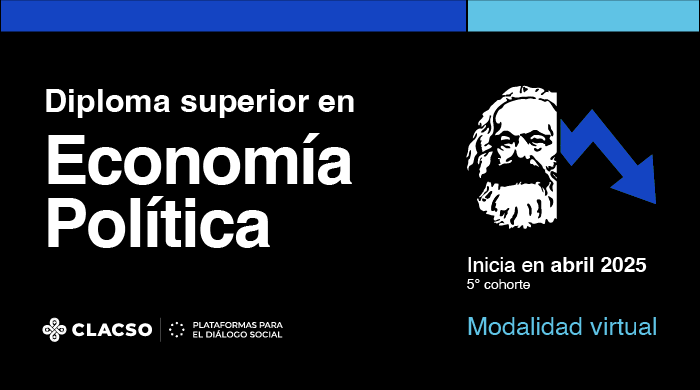
5rd Cohort | Online Program | Starts in April 2025
ACADEMIC COORDINATION: Julio Gambina (Foundation for Social and Political Research, Argentina)
TEACHING TEAM: Alejandra Ciriza (CONICET, Argentina) | Beatriz Rajland (Foundation for Social and Political Research / University of Buenos Aires, Argentina) | Claudius Katz (Institute of Latin American and Caribbean Studies-Faculty of Social Sciences, University of Buenos Aires – Argentina) | Daniel Campione (Foundation for Social and Political Research / University of Buenos Aires, Argentina) | Enrique Elorza (UNSL, Argentina) | Gabriela Roffinelli (Foundation for Social and Political Research / University of Buenos Aires, Argentina) | Germán Pinazo (Foundation for Social and Political Research - National University of General Sarmiento, Argentina) | Jaime Estay (Meritorious Autonomous University of Puebla, Mexico) | Jairo Estrada (National University of Colombia) | José Puello Socarrás (Higher School of Public Administration, Colombia) | Julio Gambina (Foundation for Social and Political Research, Argentina) | Lucas Castiglioni (Foundation for Social and Political Research / University of the Center, Argentina) | Marcelo Carcanholo (Fluminense Federal University, Brazil) | Ricardo Antunes (Institute of Philosophy and Human Sciences, Brazil)
Start: 09/04/2025 | Registration: 28/11/2024 to 08/04/2025
Virtual format | April to July 2025
The training proposal for the Diploma students involves introducing the analytical categories of Marxist theory for the historical-concrete confrontation of the theoretical and practical problems presented by the deployment of the world capitalist economy in crisis and, particularly, in the forms that the deployment of the law of value assumes in Latin America and the Caribbean.
Today we are witnessing profound global transformations. In 2008-2009, the financial crisis erupted in the heart of US imperialism and quickly spread to the rest of the developed economies, as well as to dependent or peripheral ones. Since the Great Recession of 2009, but especially with the emergence of the coronavirus pandemic in 2020, processes of economic recession with rising inflation have expanded globally. In the post-pandemic era, the intensification of the armed conflict in Ukraine and the Middle East, the climate, food, and energy crises, and, fundamentally, the trade competition between the US and China are accentuating ongoing structural transformations with unpredictable consequences, such as the decline of the US as the undisputed power of the global capitalist order.
The economy is at the center of global attention. Faced with this global crisis, efforts are underway to diagnose and propose solutions to overcome the array of problems confronting humanity. Therefore, it is necessary to review some central themes of the debate within contemporary political economy and its critique. First, we must introduce the discussion between ECONOMICS and POLITICAL ECONOMY, but also between the latter and its CRITIQUE. This is a logical and historical question, one that involves debating common categories in theory and politics that address issues such as the causes of recessions, inflationary processes, and the exacerbation of social inequality in income and wealth. This diploma program, then, proposes moving from historical categories to the analysis of everyday life, which implies discussing the civilizational crisis in its multiple dimensions.
Since the last major crisis and recession (2007/09), and especially with the emergence of the coronavirus pandemic (2020), the war in Ukraine (2022), and the conflict in the Middle East and the genocide in Gaza (2023), the global crisis has deepened, placing economic issues at the center of global attention. From the various schools of economic thought—liberal, orthodox, monetarist, neoclassical, and from neo-Keynesian or post-Keynesian critiques—diagnoses and proposals (orthodox or purportedly reformist) are being discussed, which, despite their nuances, collectively support the need for a “reboot” of global capitalist economic expansion. Therefore, from Marx's critique of political economy, it is necessary to rethink the central axes of the current debate: What are the causes of the recessions affecting our economies? What is the magnitude of the ongoing economic crisis? How are the trends of capitalist accumulation imposed on dependent economies? What role do inflationary processes play? What role does the State play in the current context of economic crisis? What is the burden of public debt? How have the pandemic and wars exacerbated social inequalities? Why is there such insistence on reactionary labor, tax, and pension reforms? How should we interpret the emergence of reactionary, misogynistic, patriarchal, and racist far-right political forces? What are the alternatives from the perspective of the working classes and the people? This diploma program aims to introduce the foundations of a critique of contemporary political economy. That is, it seeks to recover the categories of analysis (logical and historical) for theoretical and political debate in the face of the civilizational crisis, in its multiple dimensions and scope, that humanity is facing.
GENERAL OBJECTIVES
that the participants of the Diploma:
- They appropriate the dialectical method, the essential theoretical categories contained in Karl Marx's Capital, such as value and surplus value, with special emphasis on the historical character of the origin of the capital regime.
- They should familiarize themselves with the contributions of Marx, Engels, and classical Marxists, such as Lenin and Rosa Luxemburg, to the development of the critical theory of the capitalist social order, and be able to update these foundational aspects and categories in a historical sense.
The Diploma program aims to update the debate on relations of exploitation and domination and the plundering of natural resources, revisiting the classical school's maxim of the labor theory of value and the nature of accumulated labor as expressed in capital, with an emphasis on Marx's theory of value. Our overall purpose is to review the historical critique of capitalism from its origins to the present, re-evaluating the validity of Marx's thought and that of his followers as a critical conception of society and history.
SPECIFIC OBJECTIVES
That students develop the ability to:
- Identifying the structural regularities that account for expanded capitalist reproduction and its crises throughout history, their meanings in the adjustments of capitalist social relations, as a way of thinking about and discussing ongoing changes, especially in the area of the relationship of exploitation: the relationship between capital and labor,
- To characterize the transformations of capitalism in its imperialist stage. The polarized expansion of imperialist development. The uneven development of socio-economic formations and the dialectic of developed centers and dependent peripheries in the 21st century.
- Understanding the historical development of Latin America and the Caribbean from the concept of Social Formation (variegated), contributing to the explanation and analysis of the State, society and their articulations in the region in historical and contemporary terms.
- To critically consider the phenomenon of the double oppression of women at the intersection of patriarchy and capitalism and the historical responses of feminisms, reviewing and reconstructing a tradition of struggle with enormous presence in current debates on the issue of gender and diversity.
- To analyze the aggression of capitalism towards nature and humanity, and its manifestations such as climate change, environmental crisis, global warming, proliferation of epidemics, etc. And to evaluate the various forms that the contemporary ecological debate takes;
- To critically reconstruct the historical experiences of transition from capitalism to socialism, from the socialism of Eastern Europe to current experiences in the name of socialism, and especially the expectations generated in Our America with the processes of change at the beginning of the 21st century.
The Higher Diploma in Political Economy is aimed at undergraduate and postgraduate students; teachers at all levels; activists and members of trade unions, social movements and political parties; public officials; members and managers of non-governmental organizations and professionals interested in the subject.
- Alejandra Ciriza (CONICET, Argentina)
- Beatriz Rajland (Foundation for Social and Political Research, University of Buenos Aires, Argentina)
- Claudio Katz (Institute of Latin American and Caribbean Studies, Faculty of Social Sciences, University of Buenos Aires, Argentina)
- Daniel Campione (Foundation for Social and Political Research, University of Buenos Aires, Argentina)
- Enrique Elorza (UNSL, Argentina)
- Gabriela Roffinelli (Foundation for Social and Political Research, University of Buenos Aires, Argentina)
- Germán Pinazo (Foundation for Social and Political Research, National University of General Sarmiento, Argentina)
- Jaime Estay (Meritorious Autonomous University of Puebla, Mexico)
- Jairo Estrada (National University of Colombia)
- José Puello Socarrás (Higher School of Public Administration, Colombia)
- Julio Gambina (Foundation for Social and Political Research, Argentina)
- Lucas Castiglioni (Foundation for Social and Political Research, University of the Center, Argentina)
- Marcelo Carcanholo (Fluminense Federal University, Brazil)
- Ricardo Antunes (Institute of Philosophy and Human Sciences, Brazil)
The program consists of 5 modules, each with 3 weekly classes, taught consecutively and interconnected. The course combines synchronous and asynchronous learning.
Total workload of 128 hours.
The modules that comprise the advanced diploma are:
Presentation of activities, teachers, academic program and work schedule.
Teachers: Julio Gambina and Gabriela Roffinelli
- CLASS 1: La Political Economy as a theoretical discipline and its implications for the critique of economic policy
Teacher: Julio Gambina
-
CLASS 2: Marxist contributions to addressing the debt problem
Teacher: Lucas Castiglioni
-
CLASS 3: Background and impacts of the current global crisis
Teacher: Jaime Estay
- CLASS 1: Current debates on Imperialism
Teacher: Claudius Katz
-
CLASS 2: Marxist Dependency Theory: Uneven, Multilinear, and Combined Development. Transfer of Value and Super-Exploitation of Labor
Teacher: Marcelo Carcanholo
-
CLASS 3: The relevance of TMD and TSCM to understanding the dialectic of uneven development in the global capitalist system in the 21st century
Teacher: Gabriela Roffinelli
- CLASS 1: The relevance of Marxism in the analysis of the State
Teacher: Beatriz Rajland
-
CLASS 2: The State in the Marxist debate
Teacher: Daniel Campione
-
CLASS 3: Rise and setbacks of the global and Latin American (ultra)right
Teachers: José Francisco Puello-Socarrás and Andrés Lozano Reyes
- CLASS 1: The working class and contemporary capitalism
Teacher: Ricardo Antúnes
-
CLASS 2: Class struggle in Our America today
Teacher: Jairo Estrada
- CLASS 3: Center and periphery within the framework of the new international division of labor
Teacher: Germán Pinazo
- CLASS 1: The relationship between feminism and Marxism. The theory of patriarchy as a central contribution of Marxism to the critique of the monogamous family and the sexual division of labor.
Teacher: Alejandra Ciriza
-
CLASS 2: The problems of the transition
Teacher: Enrique Elorza
-
CLASS 3: Subjects and alternatives to capitalism
Teacher: Julio Gambina
|
In one payment by 31/03 |
In one payment after 31/03 |
Payment in 3 installments |
|
|
Full or Associate Member Center |
$185 |
$240 |
USD 315 (3 x USD 105) |
|
No link |
$310 |
$370 |
USD 540 (3 x USD 180) |
* Residents of Argentina will pay the equivalent in Argentine pesos according to the official exchange rate of the Banco de la Nación Argentina (BNA) on the day of payment.
You must be registered in the CLACSO Single Registration System (SUIC) and enter your username and password. If you are not registered, click here . To access the registration form, click the "Register" button on the webpage of the Diploma program you are interested in.
Upon completion of the registration process, you will receive a confirmation in your email.
Classes will begin in April and will conclude in July 2025.
From June 9 to 13, 2025, our 10th Latin American and Caribbean Conference of Social Sciences will take place in Bogotá, Colombia. #CLACSO2025 (more information here ). To ensure everyone's participation, we have planned a break from training activities during that week.
All registered participants will receive on the first day of activities the necessary instructions to access the classes, bibliography and discussion forums through the CLACSO Virtual Training Space.
Accessing and navigating the Virtual Learning Environment is very simple and user-friendly. In any case, a technical and academic support team will always be available. For inquiries, you can write to [email protected]
You must send an email with the request to [email protected] and we will send you the requested certificate as soon as possible.
Exceptional Criteria: In exceptional cases, and within the first 20 days of the start of the Advanced Diploma program, students may write to [email protected] requesting to withdraw and stating the reasons. After evaluation of the case, a response will be sent to the request. If approved, the student may resume the Advanced Diploma program if a new cohort is offered the following year. After this period has elapsed since the start of the course, no requests will be accepted.
Money paid will only be refunded in cases where the organizing institutions decide to cancel the activity.
Yes, the advanced diploma is certified by CLACSO. The diploma will be sent digitally and is completely free of charge.
Payment can be made in one installment, by credit card or bank transfer. We also offer the option of paying in 3 installments.
Yes. There will be discounts for students belonging to CLACSO Member Centers and CLACSO Associated Centers, for CLACSO Associate Researchers, and for all those who pay within the discount period.
You can check if you belong to a member center here:
The Advanced Diploma program integrates a dynamic of asynchronous and synchronous classes. Classes are primarily asynchronous. The schedule for synchronous sessions will be communicated by the Diploma coordinator at the beginning of the program, and participation in these sessions is not a prerequisite for passing the program.
Inquiries: WhatsApp: +54 9 11 3880 – 1388
Email: [email protected]

