
Advanced Diploma in Political Economy
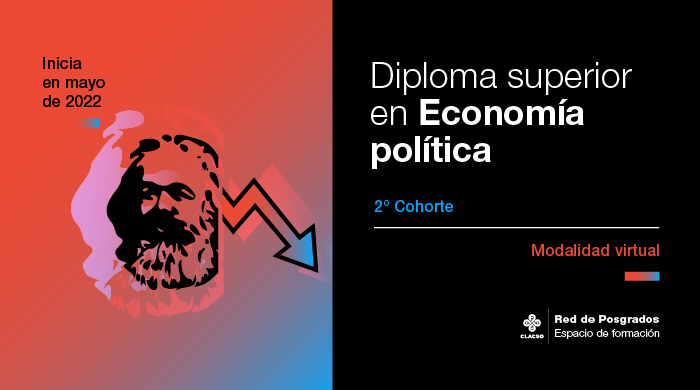
2th Cohort | Virtual Modality
ACADEMIC COORDINATION: Julio Gambina (FISYP, Argentina) and Josefina Morales (UNAM, Mexico)
TEACHING TEAM: Marcelo Carcanholo (UFF, Brazil), Beatriz Rajland (UBA, Argentina), Matias Bosch (Juan Bosch Foundation, Dominican Republic), Alejandra Ciriza (CONICET, Argentina), Andrés Lozano Reyes (UNAL, Colombia), Gabriela Roffinelli (FISYP, Argentina), Daniel Campione (UBA, Argentina), Carlos Pérez Soto (Arcis University, Chile), Enrique Elorza (UNSL, Argentina), José Francisco Puello-Socarrás (UNAL, Colombia), Lucas Castiglioni (UNICEN, Argentina), Gabriela Roffinelli (UBA, Argentina) and Germán Pinazo (IDES, Argentina).
Virtual format | May to October 2022
Since the last major recession (2007/09) and, especially, with the emergence of the coronavirus pandemic, which deepened the global crisis, the economy has taken center stage in the world's attention. From the various schools of economic thought—liberal, orthodox, monetarist, neoclassical, and from neo-Keynesian or post-Keynesian critiques—diagnoses and proposals (orthodox or reformist) are being discussed, which, taken together, rather superficially promise a swift "restart" of global capitalist economic expansion.
Therefore, from Marx's critique of political economy, it becomes necessary to rethink the central axes of the debate: What are the causes of the recessions our economies are experiencing? What is the magnitude of the current economic crisis? How are the trends of capitalist accumulation imposed on dependent economies? What role do inflationary processes play? What role does the State play in the current context of economic crisis? What is the burden of public debt? How has the pandemic exacerbated social inequalities? Why is there such insistence on labor, tax, and pension reforms? What are the alternatives from the perspective of the working classes?
This diploma program aims to introduce the foundations of the critique of political economy. That is, it seeks to recover the categories of analysis (logical and historical) for theoretical and political debate in the face of the civilizational crisis, in its multiple dimensions and scope, that humanity is facing.
GENERAL PURPOSE:
The aim of this Diploma program is for participants to master the dialectical method and the essential theoretical categories contained in Karl Marx's Capital , such as value and surplus value, with particular emphasis on the historical nature of the origins of capitalism. Participants will delve into the contributions of Marx and Engels to the development of a critical theory of the capitalist social order and be able to apply these foundational aspects and categories to a historical context. The Diploma program seeks to update the debate on exploitation, domination, and plunder, revisiting the classical school's maxim of the labor theory of value and the nature of accumulated labor as expressed in capital. Our overall purpose is to review the historical critique of capitalism from its origins to the present, reaffirming the validity of Marxism as a critical conception of society and history.
SPECIFIC OBJECTIVES:
That students develop the ability to:
- Identifying the structural regularities of the process of capitalist crises throughout history, their meanings in the adjustments of capitalist social relations, as a way of thinking about and discussing the changes underway, especially in the relationship between capital and labor, the realm of exploitation.
- To critically consider the phenomenon of the double oppression of women at the intersection of patriarchy and capitalism and the historical responses of feminisms, reviewing and reconstructing a tradition of struggle with enormous presence in current debates on the issue of gender and diversity.
- To analyze the aggression of capitalism towards nature and humanity, and its manifestations such as climate change, environmental crisis, global warming, proliferation of epidemics, etc., and to evaluate the various forms that the contemporary ecological debate takes.
- To critically reconstruct the historical experiences of transition from capitalism to socialism, from the socialism of Eastern Europe to current experiences in the name of socialism, and especially the expectations generated in Our America with the processes of change at the beginning of the 21st century.
- To understand the historical development of Latin America and the Caribbean from the concept of Social Formation (variegated), in order to contribute to the explanation and analysis of the State, society and its articulations in the region in historical and contemporary terms.
The Higher Diploma in Political Economy is aimed at undergraduate and postgraduate students; teachers at all levels; activists and members of trade unions, social movements and political parties; public officials; members and managers of non-governmental organizations and professionals interested in the subject.
- Marcelo Carcanholo (UFF, Brazil)
- Beatriz Rajland (UBA, Argentina)
- Matías Bosch (Juan Bosch Foundation, Dominican Republic)
- Alejandra Ciriza (CONICET, Argentina)
- Andrés Lozano Reyes (UNAL, Colombia)
- Gabriela Roffinelli (FISYP, Argentina)
- Daniel Campione (UBA, Argentina)
- Carlos Pérez Soto (Arcis University, Chile)
- Enrique Elorza (UNSL, Argentina)
- José Francisco Puello-Socarrás (UNAL, Colombia)
- Lucas Castiglioni (UNICEN, Argentina)
- Germán Pinazo (IDES, Argentina)
Class 1: Political Economy as a theoretical discipline and its implications for the critique of economic policy (I)
Class 2: Political Economy as a theoretical discipline and its implications for the critique of economic policy (II)
Class 3: Epistemological differences in Marxist social analysis. Exploitation, domination, oppression
Class 4: Class analysis and social stratification analysis. Class analysis in the second decade of the 21st century
Class 1: Classical Theory of Imperialism
Class 2: Marxist Dependency Theory: Uneven, Multilinear, and Combined Development. Transfer of Value and Super-Exploitation of Labor.
Class 3: Latin American Marxism and current debates about the region's problems within the framework of global capitalist accumulation
Class 1: The current debate on the State and the contributions of Marx and his successors
Class 2: The State in conditions of diversity. Multisocietality and the Commons in Our America
Class 3: The rise of the global and Latin American right wing. Economy and politics in the 21st century.
Class 1: The comprehensive nature of the crisis in capitalism. Different phases of the capitalist crisis: economic and financial crisis, food crisis, ecological crisis and climate change; the debt crisis, energy crisis, comprehensive crisis, civilizational crisis
Class 2: Crisis and hegemonic dispute, the US-China relationship; international organizations; transnational corporations
Class 3 Center and periphery within the framework of the new international division of labor
Class 4: Capitalism at its limits. The general trends of capitalist accumulation and the specific problems of contemporary capitalism.
Class 5: The debate on the “future of work”. Digital transformations, capitalism 4.0 and new forms of intervention in value chains. Resistance and self-management.
Class 6: Exploitation, Plunder and Dispossession. New logics of accumulation based on labor: the case of pensions and health.
Class 1: An invitation to reread: The contribution of classical Marxism to the theoretical and political critique of patriarchy. Engels/Marx. Feminisms/Marxisms in times of proletarian and peasant revolutions. Tensions with bourgeois feminism.
Class 2: Towards a Marxist and feminist critique of the current imbrication between capitalism, patriarchy and racism.
Class 3: The problems of transition in classical economics and in real socialism
Class 4: The Cuban experience and its link with the region.
Class 5: The regional debate in other experiences in Our America.
Closing class.
MODULE
|
CLASS |
DATE |
TITLE |
TEACHER |
FORMAT OF THE CLASS |
|
|
1 (4 weeks)
|
1 |
20/5 |
Presentation class |
Coordination team |
Synchronous |
|
2 |
Political Economy as a theoretical discipline and its implications for the critique of economic policy. (I)
|
Julio Gambina |
Asynchronous Video |
||
|
3 |
27/5 |
Political Economy as a theoretical discipline and its implications for the critique of economic policy. (I)
|
Julio Gambina |
Asynchronous Video |
|
|
4 |
3/6 |
Epistemological differences in Marxist social analysis. Exploitation, domination, oppression
|
Carlos Pérez Soto |
Synchronous |
|
|
5 |
10/6 |
Class analysis and social stratification analysis. Class analysis in the second decade of the 21st century
|
Carlos Pérez Soto |
Synchronous |
|
|
2 (3 weeks)
|
6 |
17/6 |
The classical theory of Imperialism
|
Josefina Morales/Gabriela Roffinelli |
synchronous |
|
7 |
24/6 |
Peripheral capitalism. Uneven, multilinear, and combined development. Transfer of value and super-exploitation of labor.
|
Marcelo Carcanholo/ Gabriela Roffinelli |
Asynchronous Video |
|
|
8 |
1/7 |
Latin American Marxism and current debates on the region's problems within the framework of global capitalist accumulation.
|
Gabriela Roffinelli |
Asynchronous Video |
|
|
9 |
5/7 |
The current debate on the State and the contributions of Marx and his successors. |
Beatriz Rajland |
synchronous |
|
|
10 |
8/7 |
The State in conditions of diversity. Multisocietality and the Commons in Our America.
|
José Puello Socarrás Andrés Lozano Reyes |
Asynchronous Video |
|
|
|
11 |
29/7 |
The rise of the global and Latin American right. Economy and politics in the 21st century. |
José Puello Socarrás Andrés Lozano Reyes |
Asynchronous Video |
|
12 |
5/8 |
Alternatives. Political struggles, hegemony, and awareness for grassroots socialism. The agents of change, the program, and the organizational forms that the struggle for emancipation will take.
|
Daniel Campione |
Asynchronous Video |
|
|
13 |
12/8 |
The comprehensive nature of the crisis in capitalism. Different phases of the capitalist crisis: economic and financial crisis, food crisis, ecological crisis and climate change crisis; the debt crisis, energy crisis, comprehensive crisis, civilizational crisis |
Julio Gambina |
Asynchronous Video |
|
|
14 |
16/8 |
Crisis and hegemonic dispute, the US-China relationship; international organizations; transnational corporations |
Jaime Estay |
synchronous |
|
|
15 |
19/8 |
Center and periphery within the framework of the new international division of labor |
Germán Pinazo |
Asynchronous Video |
|
|
|
16 |
26/8 |
Capitalism at its limits. The general trends of capitalist accumulation and the specific problems of contemporary capitalism |
Germán Pinazo |
Asynchronous Video |
|
|
17 |
2/9 |
The debate on the “future of work”. Digital transformations, Capitalism 4.0 and new forms of intervention in value chains |
Lucas Castiglioni |
Asynchronous Video |
|
) |
18 |
9/9 |
Exploitation, Plunder and Dispossession. New logics of accumulation based on labor: the case of pensions and health. Submission of instructions for the final integrative project |
Matias Bosch |
Synchronous |
|
|
19 |
16/9 |
An invitation to reread: The contribution of classical Marxism to the theoretical and political critique of patriarchy. Engels/Marx. Feminisms/Marxisms in times of proletarian and peasant revolutions. Tensions with bourgeois feminism |
Alejandra Ciriza |
Synchronous |
|
|
20 |
23/9 |
For a Marxist and feminist critique of the current imbrication between capitalism, patriarchy and racism.
|
Alejandra Ciriza |
Synchronous |
|
21 |
30/9 |
The transition in classical studies and in real socialism |
Enrique Elorza |
Asynchronous |
|
|
22 |
7/10 |
The Cuban experience and its link with the region |
Enrique Elorza |
Asynchronous video and text |
|
|
23 |
14/10 |
The regional debate in other experiences in Our America |
Enrique Elorza |
Asynchronous |
|
|
24 |
Closing class |
Coordination Team |
Synchronous |
||
|
TIF Delivery |
2/11 |
Submission of final integrative work. |
- |
- |
|
|
Delivery of MINUTES |
2/12 |
The teaching team will have 1 month from the delivery of the assignments to evaluate them and prepare the final report. |
Faculty |
- |
|
| In one payment by 20/02 | In one payment after 20/02 | Payment in 3 installments | |
| CM Pleno | $175 | $230 | USD 315 (3 x USD 105) |
| CM Associate | $300 | $360 | USD 540 (3 x USD 180) |
| No link | $300 | $360 | USD 540 (3 x USD 180) |
To participate, you must register using the online form by clicking here. Registration will be open from December 6, 2020, to May 3, 2022.
Upon completion of the registration process, you will receive a confirmation in your email.
Classes will begin in May and will conclude in December 2022.
All registered participants will receive the necessary instructions to access the classes, bibliography and discussion forums through the CLACSO Virtual Training Space.
Accessing and navigating the Virtual Learning Environment is very simple and user-friendly. In any case, a technical and academic support team will always be available to you.
If the student decides not to enroll in the Advanced Diploma program before its formal start date, they may request a refund of their tuition fees. CLACSO will retain the equivalent of 10% for administrative costs.
Exceptional Criteria: In exceptional cases, and within the first month of the start of the Advanced Diploma program, students may request to withdraw from the cohort and rejoin the following year. In all cases, the reasons for the request must be submitted in writing. After this initial period, no requests will be accepted.
| In one payment by 20/02 | In one payment after 20/02 | Payment in 3 installments | |
| CM Pleno | $175 | $230 | USD 315 (3 x USD 105) |
| CM Associate | $300 | $360 | USD 540 (3 x USD 180) |
| No link | $300 | $360 | USD 540 (3 x USD 180) |
Payment can be made in one installment by credit card, bank deposit, or bank transfer. We also offer the option of paying in 3 installments.
Yes. There will be discounts for students belonging to CLACSO Member Centers and CLACSO Associated Centers, for CLACSO Associate Researchers, and for all those who pay within the discount period.
Inquiries: WhatsApp: +54 9 11 3880 – 1388
Email: [email protected]

