
Advanced Diploma in Political Ecology and Disputed Territories
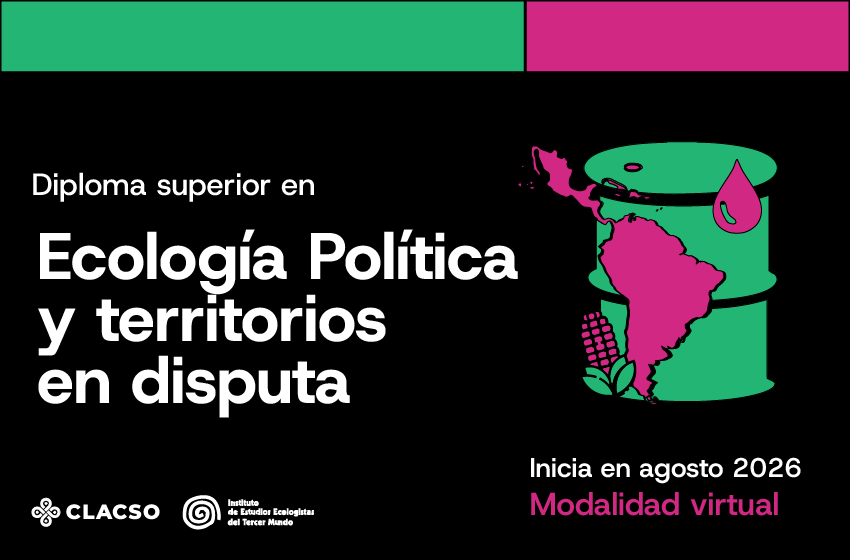
1th Cohort | Virtual Modality
ACADEMIC COORDINATION
Ana María De Veintimilla (Institute of Ecological Studies of the Third World, Ecuador) | Antonia Manresa Axisa (Durham University, England)
PROFESSORS
Ana María De Veintimilla (Institute of Ecological Studies of the Third World, Ecuador) | Antonia Manresa Axisa (Durham University, England) | Alberto Acosta (Southern Ecosocial and Intercultural Pact, Ecuador) | Nathalia Bonilla (Ecological Action Collective, and the Collective of Anthropologists, Ecuador) Elena Gálvez (Center for Social Studies of the University of Coimbra, Portugal) | Geovana Lasso (Andean University Simón Bolívar / Member of the Agroecological Collective of Ecuador) | Horacio Machado Aráoz (CONICET, Argentina) | Catalina Pérez Toro (National University of Colombia) Jeremy Rayner (Max Planck Institute for Social Anthropology, Germany) Leonardo Rossi (CONICET, Argentina) | Juan Pablo Soler (CENSAT-AGUA VIVA Organization, Colombia) | Fernanda Solíz Torres (Andean University Simón Bolívar, Colombia) | Emiliano Terán Mantovani (Center for Development Studies, Central University of Venezuela / Political Ecology Observatory of Venezuela) | Ivonne Yánez (Ecological Action Collective, Ecuador) | Felipe Bonilla (Ecological Action Collective, Ecuador)
Virtual format | August to November 2026
Start date : 19/08/2026 | Registration : 15/05/2026 to 18/08/2026
With the support of :
Institute for Ecological Studies of the Third World
The Advanced Diploma in Political Ecology and Disputed Territories aims to provide critical and contextualized training on the main socio-ecological problems in Ecuador and Latin America, the struggles for the defense of the commons and life in the context of the civilizational crisis. Through the participation of environmental organizations and the contributions of leading Latin American authors in Political Ecology, the program offers a space to historicize, reflect upon, and exchange ideas on the multiple dimensions of socio-ecological conflicts, the expansion of extractive activities, mega-infrastructure projects, and agribusiness, the struggles of peoples to defend their territories, and post-extractive proposals from the Global South.
Latin America has historically been a key region in the logic of global capitalism through the systematic plunder of its people and nature. This problem has intensified with the consolidation of the extractivist model, which is now expanding the frontiers of extractive industries, opening new areas for mineral extraction while oil and agribusiness exploitation continues, generating serious socio-environmental impacts, forced displacements, and the destruction of the possibilities for life reproduction that affect women and Indigenous peoples, peasants, and rural and urban communities.
Latin American Political Ecology, as an interdisciplinary and transdisciplinary field, has been fundamental in understanding and denouncing these dynamics, while simultaneously weaving together key elements for ecosocial transformation. From a critical, decolonial, and territorial perspective, this approach analyzes the power relations that structure ecological conflicts, as well as the resistance and proposals that emerge from women, communities, and peoples in defense of the production of collective life and nature.
Leading figures such as Héctor Alimonda, Maristella Svampa, Enrique Leff, Esperanza Martínez, Arturo Escobar, Joan Martínez Alier, Horacio Machado Aráoz, Walter Porto Gonçalves, and Catalina Toro, among many others, along with social organizations and movements, have developed profound reflections, tools, and analytical and political frameworks that connect ecology, economics, culture, and power. Their work offers fundamental tools for considering alternative paradigms centered on caring for life and ethical engagement with the planet, such as Buen Vivir (Good Living), the Rights of Nature, environmental justice, and interculturality, among others.
This advanced diploma is part of CLACSO's critical tradition and seeks to strengthen training and research processes committed to the ecosocial transformation of the region from community proposals, social movements and committed academia and from environmental collectives.
GENERAL PURPOSE
To contribute to the critical, political and methodological training of activists, territorial leaders, defenders of nature, members of social organizations, students and interested people, through an interdisciplinary approach to Latin American Political Ecology, which allows understanding the relationships between coloniality, nature and power, analyzing contemporary socio-environmental conflicts and strengthening capacities for collective action and the construction of alternatives from the territories.
SPECIFIC OBJECTIVES
- To analyze the theoretical, historical and ontological foundations of Latin American Political Ecology, recognizing its links with the coloniality of nature, epistemological disputes and debates on the ontologies of the Earth.
- Understanding the dynamics of extractivism, the financialization of nature and new forms of green colonization, as well as their socio-environmental, territorial, food and metabolic impacts in Latin America.
- Examining socio-environmental conflicts from a geopolitical, ecological, and socio-metabolic perspective, considering the relationships between water, energy, minerals, food, labor, knowledge, and territory.
- To make visible the struggles and resistance of local peoples and communities, with emphasis on the role of women in the defense of the forest, the sea, collective health and the commons.
- To delve deeper into Political Ecology as a field of collective action, exploring tools for thinking about collective action
- Reflecting on post-extractivism in the face of hegemonic development, incorporating the contributions of the rights of nature, the rights of peoples, post-extractivism, community energies and agroecology.
- Strengthening the perspective of collective health and nature from Political Ecology, based on participatory action research experiences with communities affected by socio-environmental conflicts.
- Promote the exchange between academic knowledge, community knowledge, plural methodologies and political actions, favoring the production of situated and plural knowledge from the territories.
The Higher Diploma in Political Ecology and disputed territories is aimed at undergraduate and postgraduate students; teachers at all levels; activists and members of trade unions, social movements and political parties; public officials; members and managers of non-governmental organizations and professionals interested in the subject.
The program consists of 5 modules of 3 weekly classes each, taught consecutively and linked together.
Total workload of 128 hours.
The modules that comprise the Higher Diploma are:
- Class 1: The entity “America” and the coloniality of Nature. Debates on Earth ontologies
Teachers: Horacio Machado Araóz and Leonardo Rossi
The invention of "America" was a colonial act that defined this territory not as a space of civilizations, but as "pure nature," as a geography, raw material, territory to be conquered. Thus, we analyze nature in modernity, where an ontology is constructed that separates human beings from nature, turning nature into a passive, exploitable, and commodifiable entity. We revisit the concept of "coloniality" to explain how the power patterns of colonialism persist even after political independence, perpetuating asymmetrical relationships. The coloniality of nature implies the imposition of a Eurocentric, utilitarian, and scientistic vision of the Earth, rendering invisible other forms of human-environmental relationships. We question the notion of the "Anthropocene" (the age of man) and propose considering the term "Capitalocene." Finally, we bring to the forefront perspectives that the current ecological crisis has its roots in the 16th century with the conquest of America, a milestone that reconfigured the global metabolism of capital. - Class 2: Political Ecology as a field of epistemological and political dispute. Contributions of critical environmental thought in America
Teachers: Horacio Machado Araóz and Leonardo Rossi
In this class, Political Ecology is analyzed as a fundamental battleground where ways of conceiving, inhabiting, and giving meaning to nature are contested, intrinsically linked to social struggles against extractivism in Latin America. We propose a profound critique of the modern-colonial rationality that reduces "Nature" to "natural resources" or mere commodities. - Class 3: The Earth as a Community of Co-existing Communities: Geometabolism and Sociometabolism
Teachers: Horacio Machado Araóz and Leonardo Rossi
This class explores the idea of a relational ontology, drawing on Andean worldviews and currents of popular environmentalism. We reflect on the Earth not as a set of "resources" for exploitation, but as a web of life where human beings are an integral part of a complex community; we call this "Feeling-thinking Earth." We will analyze the sociometabolism of capital versus geometabolism, framing the current ecological crisis as a "metabolic fracture," where capitalist social metabolism (sociometabolism) destroys the rhythms and forms of nature (geometabolism).
- Class 4: Extractive regimes in Latin America: Megaprojects, ecologies of dispossession and socio-environmental conflicts
Teacher: Emiliano Terán Mantovani
In Latin America and the Caribbean, a significant geoeconomic reorganization of territory is taking place around extractivism: an expansion toward the new “commodity frontiers” in which large-scale mining is being incorporated among its most important economic activities. This course analyzes the features and characteristics of the current expansion of extractivist frontiers from the perspective of political ecology and ecological economics. Some discursive modalities of appropriation of nature and territorialization derived from this policy on the “fabric of life” will also be examined. Furthermore, some potential consequences and implications of these processes are highlighted, emphasizing socio-environmental damage and the various conflicts and disputes they generate. - Class 5: Geopolitics, marine extractivism, militarization and the struggle for the defense of the sea
Teacher: Catalina Pérez Toro
This class analyzes, through the research conducted by Professor Catalina Pérez Toro, the geopolitics of marine extractivism and its threats to the self-determination processes of Indigenous peoples. The history of colonialism in Latin America is expressed in the way the geopolitics of extractive development on a planetary scale is understood (from the perspective of environmental history and philosophy, political economy, cultural studies, and critical geography of Latin America) as a model of extraction from nature and the dispossession of peoples (bodies, minds, knowledge, territories), within production relations structured by the process of the incessant accumulation of capital. From this historical and political ecology perspective, extractivism will be analyzed not only as a mode of production, but as a form of participation in the development of global capitalism, through a concentration and centralization of economic, political and cognitive power that displaces historical construction processes of modes and styles of coexistence between society and nature expressed in knowledge, technology, social organization and mythical and symbolic elaborations. - Class 6: Financialization of nature and new forms of green colonization
Teacher: Ivonne Yánez
This class explores the idea of a relational ontology, drawing on Andean worldviews and currents of popular environmentalism. We reflect on the Earth not as a set of "resources" for exploitation, but as a web of life where human beings are an integral part of a complex community; we call this "Feeling-thinking Earth." We will analyze the sociometabolism of capital versus geometabolism, framing the current ecological crisis as a "metabolic fracture," where capitalist social metabolism (sociometabolism) destroys the rhythms and forms of nature (geometabolism).
- Class 7: Tools for thinking about collective action
Instructor: Jeremy Rayner
This class offers tools for thinking about collective action. Some of these focus on resistance and building power "from below" in specific territories; others center on politics as a public space of freedom and pluralistic expression; still others represent a paradigm shift in economic and political theory, demonstrating that communities can sustainably manage shared resources without privatization or centralized state control. The class will present diverse approaches to collective action from various authors and examine specific case studies of social organizing processes in Latin America. - Class 8: Struggles of peasant women and Afro-descendant communities in defense of the Chocó forest
Teacher: Natalia Bonilla
This class shares the struggle of Afro-Ecuadorian and Indigenous communities to defend the Chocó forest, a megadiverse ecosystem considered one of the world's ten hotspots. Currently, both the ecosystem and its inhabitants face significant threats due to the agro-industrial extraction of oil palm. This activity, which is rooted in structural racism—a concept that will be addressed in the class—has a palpable, though not exclusive, effect: the destruction of vital sources of subsistence through environmental devastation.
The strategies of communities and women to defend their territory will also be analyzed, as well as the actions of palm oil companies to maintain territorial control, taking advantage of the weakness of the judicial system, corruption, and their political and economic power. - Class 9: From resource-territory to subject territories: Emancipation of nature from the commodities regime
Teacher: Elena Gálvez
This class addresses several concepts, including the commodity regime and the territory-resource, and the transition from territory-resource to territories-as-subjects. This analysis represents a fundamental epistemic and political shift in Latin America, seeking the emancipation of nature and communities from the extractive commodity regime. This change proposes moving away from viewing nature as an inexhaustible source of raw materials for export and recognizing it as a living entity, a holder of rights, and a fabric that sustains life. It explores the idea of territory as a subject and the new subjectivities it encompasses.
- Class 10: Rights of peoples and rights of nature for the ecosocial transition
Teacher: Alberto Acosta
This lecture, given by Alberto Acosta, one of the leading figures in the recognition of the Rights of Nature, proposes a radical reconfiguration of the human-nature relationship, essential for an ecosocial transition. His proposal is based on overcoming anthropocentrism, extractivism, and the traditional vision of "development," proposing Sumak Kawsay (Good Living) as a civilizational alternative. Acosta analyzes the link between the rights of nature and the rights of Indigenous peoples to sovereignty over their territories, incorporating elements of their worldview and the political ecology of caring for the land and the interdependence of human life with it. He focuses on a critique of dispossession, a reflection on the transition, and on extractivism, opening the debate on post-extractivist proposals from the perspective of Indigenous communities. - Class 11: Collective health and political ecology: experiences of participatory action research with communities affected by socio-environmental conflicts
Teacher: Fernanda Solíz Torres
This class analyzes the concepts of the social determinants of health, the relationship between society and nature, socio-environmental conflicts, and their serious consequences. It also offers reflections on the capitalist social metabolism in specific cases such as waste and public health.
It presents experiences of participatory action research with communities affected by different industries, and by the State, opening a debate on what environmental justice, social organization, collective and shared work entails. - Class 12: Post-extractive transitions: Community energies, challenges and opportunities
Teacher: Juan Pablo Soler
This class analyzes the prevailing energy model based on burning fossil fuels and its impacts on the climate crisis. It describes its irreversible impacts, such as forced displacement, the extinction of entire communities, water pollution, global climate imbalance, harmful effects on the health and culture of local communities, biodiversity loss, and the systematic violation of human rights. In response, it presents case studies of various grassroots community organizations that have developed transformative practices and processes to challenge the prevailing energy model. It also describes and analyzes the implementation of community energy initiatives, along with a proposed training program in community energy for farmers involved in social movements.
- Class 13: Participatory action research methodologies and collaborative mapping for the defense of our territories against extractivism
Teachers: Geovanna Lasso and Ana María de Veintimilla
This class offers an overview of various methodologies from the perspectives of political ecology and critical geography, such as participatory action research and collaborative mapping, to contribute to strengthening the processes of territorial defense by communities and peoples against extractive industries, including mining, oil extraction, and agribusiness. Through a dialogue between two concrete experiences, the positive aspects of these methodologies are highlighted, enabling us to collectively envision new emancipatory horizons based on our own knowledge and practices, and finding in dialogue with the "other" a gateway to decolonizing learning. - Class 14: Dialogue between two participatory research experiences: Agroecology and its geographies of resistance to resist extractivism and Recipes of Resistance
Teachers: Geovanna Lasso and Ana María de Veintimilla
Continuing the dialogue begun in the previous class, this class presents two participatory research experiences from the perspectives of political ecology and critical geography. One of these is from the Agroecological Collective of Ecuador, which explains the methodology of collaborative mapping with 13 organizations in Ecuador. In this case, the results of the research and mapping of agroecological territories are discussed, along with ideas such as geographies of resistance, the material conditions of life and the reproduction of care work, and political subjectivities in resonance with their particular contexts and territories. The other participatory research project, "Recipes of Resistance," presents the experience of creating a recipe book with women environmental defenders from various territories in Ecuador affected by extractivism, and explores cooking as a strategy for sustaining the defense of territories and fostering unity. - Class 15: Creative resistance to extractivism: art, community and political action
Teacher: Felipe Bonilla Ramos
This class provides knowledge of spontaneous theater in the activist struggle for the defense of nature. It outlines types of protest actions through art and creativity, through active nonviolence and the occupation of public space. It also covers practices of direct democracy, such as popular consultations in favor of nature and against extractivism, by evoking images that appeal to the human sensitivity of our relationship with the earth.
- Ana María De Veintimilla (Institute of Ecological Studies of the Third World, Ecuador)
- Antonia Manresa Axisa (Durham University, England)
- Alberto Acosta (Southern Ecosocial and Intercultural Pact, Ecuador)
- Nathalia Bonilla (Ecological Action Collective, and the Collective of Anthropologists, Ecuador)
- Elena Gálvez (Center for Social Studies of the University of Coimbra, Portugal)
- Geovana Lasso (Andean University Simón Bolívar / Member of the Agroecological Collective of Ecuador)
- Horacio Machado Aráoz (CONICET, Argentina)
- Catalina Pérez Toro (National University of Colombia)
- Jeremy Rayner (Max Planck Institute for Social Anthropology, Germany)
- Leonardo Rossi (CONICET, Argentina)
- Juan Pablo Soler (CENSAT-AGUA VIVA Organization, Colombia)
- Fernanda Solíz Torres (Andean University Simón Bolívar, Colombia)
- Emiliano Terán Mantovani (Center for Development Studies, Central University of Venezuela / Political Ecology Observatory of Venezuela)
- Ivonne Yánez (Ecological Action Collective, Ecuador)
- Felipe Bonilla (Ecological Action Collective, Ecuador)
| Early registration (until 07/07) | General registration (May 6th to May 12st) | Registration without discount (13/08 to 19/08) | Payment in 3 installments | |
| Full or Associate Member Center | $190 | $260 | $340 | USD 420 (3 x USD 140) |
| No Link | $340 | USD 410 | $460 | USD 630 (3 x USD 210) |
* Residents of Argentina will pay the equivalent in Argentine pesos according to the official exchange rate of the Banco de la Nación Argentina (BNA) on the day of payment.
You must be registered in the CLACSO Single Registration System (SUIC) and enter your username and password. If you are not registered, click here . To access the registration form, click the "Register" button on the webpage of the Diploma program you are interested in.
Upon completion of the registration process, you will receive a confirmation in your email.
Classes will begin in August and will conclude in December 2026.
All registered participants will receive on the first day of activities the necessary instructions to access the classes, bibliography and discussion forums through the CLACSO Virtual Training Space.
Accessing and navigating the Virtual Learning Environment is very simple and user-friendly. In any case, a technical and academic support team will always be available. For inquiries, you can write to [email protected]
You must send an email with the request to [email protected] and we will send you the requested certificate as soon as possible.
Exceptional Criteria: In exceptional cases, and within the first 20 days of the start of the Advanced Diploma program, students may write to [email protected] requesting to withdraw and stating the reasons. After evaluation of the case, a response will be sent to the request. If approved, the student may resume the Advanced Diploma program if a new cohort is offered the following year. After this period has elapsed since the start of the course, no requests will be accepted.
Money paid will only be refunded in cases where the organizing institutions decide to cancel the activity.
Yes, the advanced diploma is certified by CLACSO. The diploma will be sent digitally and is completely free of charge.
Payment can be made in one installment, by credit card or bank transfer. We also offer the option of paying in 3 installments.
Yes. There will be discounts for students belonging to CLACSO Member Centers and CLACSO Associated Centers, for CLACSO Associate Researchers, and for all those who pay within the discount period.
You can check if you belong to a member center here:
The Advanced Diploma program integrates a dynamic of asynchronous and synchronous classes. Classes are primarily asynchronous. The schedule for synchronous sessions will be communicated by the Diploma coordinator at the beginning of the program, and participation in these sessions is not a prerequisite for passing the program.
Inquiries: WhatsApp: +54 9 11 3880 – 1388
Email: [email protected]

