
Advanced Diploma in Democracy, Political Participation and Citizenship
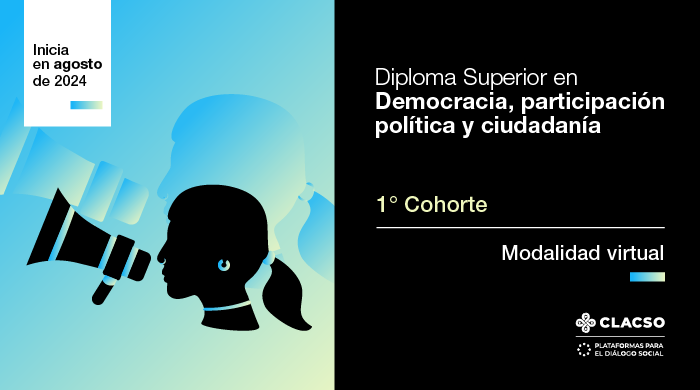
1th Cohort | Virtual Modality
ACADEMIC COORDINATION
César Ricardo Cansino Ortíz (Benemérita Universidad Autónoma de Puebla, Mexico) and Erick Gómez Tagle López (Benemérita Universidad Autónoma de Puebla, Mexico)
PROFESSORS
César Ricardo Cansino Ortíz (Benemérita Universidad Autónoma de Puebla, Mexico); Samuel Schmidt (Texas University); Lucía Álvarez (Universidad Nacional Autónoma de México); Leonardo Avritzer (Universidad Federal de Minas Gerais, Brazil); Flavia Freidenberg (Universidad Nacional Autónoma de México); Erick Gómez Tagle López (Benemérita Universidad Autónoma de Puebla, Mexico) and Leonardo Avritzer (Universidad Federal de Minas Gerais, Brazil)
Virtual format | August to November 2024
Start date : 26/08/2024 | Registration : 28/05/2024 to 25/08/2024
The Diploma in Democracy, Public Space, and Citizenship in Latin America is an academic initiative designed to provide a deep and critical understanding of democratic processes, citizen participation, and the shaping of public space in the Latin American region. This program aims to train professionals with the theoretical and practical tools necessary to analyze, understand, and address the challenges and opportunities facing Latin American societies in the areas of democracy and citizenship.
The importance and relevance of this Diploma program lie in the need to understand and strengthen democratic processes in Latin America, a region characterized by a complex history of fragile democracies, social exclusion, and persistent challenges to citizen participation. In a context marked by inequality, corruption, violence, and a crisis of political representation, it is crucial to train professionals with the capacity to critically analyze these realities and contribute to building more democratic, inclusive, and participatory societies.
GENERAL PURPOSE
To train professionals with a deep and critical understanding of democratic processes, citizen participation and the configuration of public space in Latin America, capable of contributing to the strengthening of democracy and citizenship in the region.
SPECIFIC OBJECTIVES
1. To delve deeper into the study of the theoretical and conceptual foundations of democracy, citizenship and public space in Latin America.
2. To critically analyze the challenges and opportunities that Latin American societies face in terms of democracy and citizen participation.
3. Develop research skills to study and address issues related to democracy, public space and citizenship in the region.
4. Promote active participation and civic engagement in building inclusive and democratic public spaces.
5. Promote interdisciplinary dialogue and the exchange of experiences among professionals interested in these topics in Latin America.
The Higher Diploma in Democracy, Public Space and Citizenship in Latin America is aimed at undergraduate and postgraduate students; teachers at all levels; activists and members of trade union organizations, social movements and political parties; public officials; members and managers of non-governmental organizations and professionals interested in the subject.
The program consists of 5 modules of 3 weekly classes each, taught consecutively and linked together.
Total workload of 128 hours.
The modules that comprise the Higher Diploma are:
Class 1: DEMOCRACY AND REPRESENTATION
Teacher: César Cansino
Conceptual summary of the class
This session will analyze the historical evolution and current characteristics of democracy and political representation in Latin America. It will examine political systems, electoral processes, political parties, and mechanisms for citizen participation in the region, as well as the challenges and prospects for democratic representation in the 21st century.
Class 2: DEMOCRACY AND GOVERNANCE
Teacher: Samuel Schmidt
Conceptual summary of the class
This session will focus on analyzing the relationship between democracy and governance in Latin America. It will examine decision-making processes, the quality of political institutions, accountability, transparency, and government effectiveness in the region, as well as the challenges and prospects for strengthening democratic governance.
Class 3: DEMOCRACY AND INEQUALITY
Teacher: Lucía Álvarez
Conceptual summary of the class
This session will address the relationship between democracy and inequality in Latin America. It will examine the causes and consequences of social, economic, and political inequality in the region, as well as public policies and collective actions to address this problem and promote inclusion and equity in Latin American democracies.
Class 4: POLITICAL DISAFFAMILY AND DISSATISFACTION
Teacher: Leonardo Avritzer
Conceptual summary of the class
In this session, students will explore the causes and manifestations of political disaffection and citizen dissatisfaction with democracy in Latin America. They will analyze the socioeconomic, cultural, and institutional factors that contribute to the loss of trust in democratic institutions, as well as the implications of this disaffection for political stability and the exercise of citizenship in the region.
Class 5: POLITICAL AND INSTITUTIONAL EROSION
Teacher: Flavia Freidenberg
Conceptual summary of the class
This session will examine the challenges facing Latin American democracies in terms of political and institutional deterioration. It will analyze the processes of corruption, clientelism, state capture, and the weakening of institutional checks and balances that threaten democratic quality in the region.
Class 6: POPULISM AND POLARIZATION
Teacher: César Cansino
Conceptual summary of the class
This session will analyze the phenomena of populism, political polarization, and other risks to Latin American democracies. It will examine the discursive strategies, political dynamics, and social consequences of these trends, as well as measures to strengthen democratic resilience in the region.
Class 7: AUTHORITARIAN ENCLAVES, IMPUNITY AND CORRUPTION
Teacher: César Cansino
Conceptual summary of the class
This session will examine the persistence of authoritarian enclaves, impunity, and corruption in Latin America. It will analyze the historical legacies, political and economic structures, and mechanisms of social control that perpetuate these phenomena, as well as strategies to combat them and strengthen the rule of law in the region.
Class 8: FAILED STATE AND DE FACTO POWERS
Teacher: Samuel Schmidt
Conceptual summary of the class
This session will explore the phenomenon of failed states and de facto powers in Latin America. It will analyze the political, economic, and social factors that contribute to the weakening of the state and the rise of non-state actors with power and influence, as well as strategies for strengthening state capacity and addressing the challenges of power fragmentation in the region.
Class 9: LAWFARE AND JUDICIALIZATION OF POLITICS
Teacher: César Cansino
Conceptual summary of the class
This session will analyze the phenomenon of lawfare and the politicization of the judiciary in Latin America. It will examine strategies for manipulating the judicial system for political ends, emblematic cases of selective judicial persecution, and the challenges these phenomena pose to democracy and the rule of law in the region.
Class 10: RULE OF LAW AND DEMOCRACY
Teacher: Erick Tagle
Conceptual summary of the class
This session will address the relationship between the rule of law and democracy in Latin America. It will examine the challenges facing the consolidation of the rule of law in the region, including judicial independence, the fight against corruption, and the guarantee of fundamental rights, as well as the prospects for strengthening the rule of law as a fundamental pillar of democracy.
Class 11: DEMOCRACY AND HUMAN RIGHTS
Teacher: Erick Tagle
Conceptual summary of the class
This session will analyze the relationship between democracy and human rights in Latin America. It will examine the role of human rights as an essential component of democracy, the challenges to protecting and promoting human rights in the region, and past and present experiences of human rights violations in democratic contexts.
Class 12: DEMOCRACY AND COUNTER-DEMOCRACY
Teacher: Leonardo Avritzer
Conceptual summary of the class
This session will explore the concept of counter-democracy and citizen checks and balances in Latin America. It will analyze forms of citizen participation, civil society, and social movements as fundamental elements for monitoring and defending democracy against authoritarian threats and anti-democratic practices.
Class 13: PUBLIC SPACE AND NEW POLITICAL ACTORS
Teacher: Lucía Álvarez
Conceptual summary of the class
This session will focus on the role of social media in shaping public space and political participation in Latin America. It will analyze the dynamics of mobilization, communication, and political organization through digital platforms, as well as the challenges and opportunities that social media presents for democracy and citizenship in the region.
Class 14: OLD AND NEW FORMS OF MOBILIZATION AND PROTEST
Teacher: Lucía Álvarez
Conceptual summary of the class
This session will examine the diverse forms of social mobilization and protest in Latin America, from traditional street demonstrations to the most recent forms of collective action. It will analyze the factors driving mobilization, resistance strategies, and the dynamics of social change in the region.
Class 15: INDIGNATION, RESISTANCE AND RESILIENCE
Teacher: Flavia Freidenberg
Conceptual summary of the class
This course will explore experiences of outrage, resistance, and resilience in Latin America in the face of political, economic, and social challenges. It will analyze strategies of struggle, narratives of resistance, and ways of building alternatives to adversity and injustice in the region.
- César Ricardo Cansino Ortíz (Meritorious Autonomous University of Puebla, Mexico)
- Samuel Schmidt (University of Texas)
- Lucia Alvarez (National Autonomous University of Mexico)
- Leonardo Avritzer (Federal University of Minas Gerais, Brazil)
- Flavia Freidenberg (National Autonomous University of Mexico)
- Erick Gómez Tagle López (Meritorious Autonomous University of Puebla, Mexico)
- Leonardo Avritzer (Federal University of Minas Gerais, Brazil)
| In one payment by 19/08 | In one payment after 19/08 | Payment in 3 installments | |
| CM Pleno | $185 | $240 | USD 315 (3 x USD 105) |
| CM Associate | $185 | $240 | USD 315 (3 x USD 105) |
| No link | $310 | $370 | USD 540 (3 x USD 180) |
To participate, it is essential that you register using the online form.
Upon completion of the registration process, you will receive a confirmation in your email.
Classes will begin in August and will conclude in November 2024.
All registered participants will receive the necessary instructions to access the classes, bibliography and discussion forums through the CLACSO Virtual Training Space.
Accessing and navigating the Virtual Learning Environment is very simple and user-friendly. In any case, a technical and academic support team will always be available to you.
Exceptional Criteria: In exceptional cases, and within the first month of the start of the Advanced Diploma program, students may request to withdraw from the cohort and rejoin the following year. In all cases, the reasons for the request must be submitted in writing. After this initial period, no requests will be accepted.
Money paid will only be refunded in cases where the organizing institutions decide to cancel the activity.
Payment can be made in one installment by credit card, bank deposit, or bank transfer. We also offer the option of paying in 3 installments.
Yes. There will be discounts for students belonging to CLACSO Member Centers and CLACSO Associated Centers, for CLACSO Associate Researchers, and for all those who pay within the discount period.
Inquiries: WhatsApp: +54 9 11 3880 – 1388
Email: [email protected]

