
Advanced Diploma in Climate Change: Ethical Challenges for Public Policies
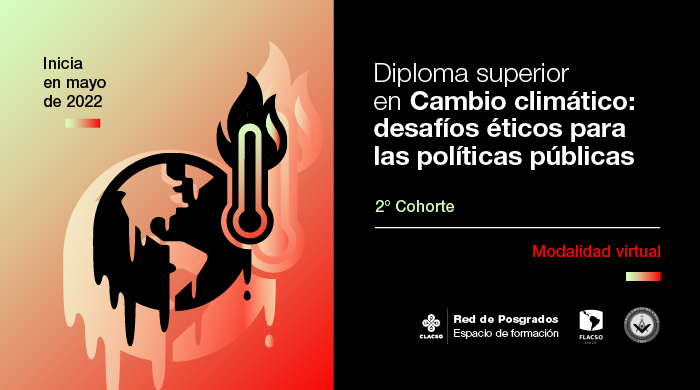
2th Cohort | Virtual Modality
ACADEMIC COORDINATION: Rodrigo Andrade (FLACSO Chile and GLCH Chile)
TEACHING TEAM : Diana Guzmán (The Climate Reality Project) | Pablo Sepúlveda (Latin American Energy Dialogue) | Augusto Castro (Pontifical Catholic University of Peru) | Cristian Mosella (Latin American Platform for Sustainable Leadership) | Marcos Gibson (University of Buenos Aires) | Constanza Troppa (University of La Frontera, Chile) | Gabriela Soto (University of Queensland, Australia) | Erika Pires Ramos (South American Network for Environmental Migration and Latin American Observatory on Human Mobility, Climate Change and Disasters, Brazil) | Olga Alcaraz (Polytechnic University of Catalonia) | Ximena Apéstegui (London School of Economics and Political Science) | Magaly Beltrán (San Simón University, Bolivia) | Rodrigo Andrade (FLACSO Chile and GLCH Chile)
Virtual format | May to October 2022
This Higher Diploma has been developed jointly by the Latin American Faculty of Social Sciences- FLACSO-Chile, the Latin American Council of Social Sciences – CLACSO, and the Grand Lodge of Chile-GLCH, with the participation of professionals dedicated to the subject of climate change and ecological transition.
The serious and evident climate crisis is the result of global climate change, generated by both natural causes and processes, as well as human actions. This change is evident in shifts, at different scales and timescales, in climatic parameters such as temperature, precipitation, droughts, and other extreme natural phenomena, with a direct and often severe impact on the planet's ecosystems and, consequently, on society and its economic systems.
Since 1992, climate change has become a global concern, primarily due to the scientific evidence that identified it. The United Nations embraced this line of work and established the United Nations Framework Convention on Climate Change (UNFCCC). The first Conference of the Parties (COP) was held in 1995, paving the way for COP 21, which took place in Paris in 2015. The negotiations at COP 21 marked a milestone with the signing of the Paris Agreement, which solidified a long-term vision for the world's nations regarding this urgent issue. To date, 26 climate summits have been held.
The Paris Agreement establishes, as its main objective, within a global framework to avoid dangerous climate change, keeping global warming well below 2°C and pursuing efforts to limit it to 1,5°C.
The actions of States (or Parties) to address this reality have resulted in doing everything within their power, through nationally determined contributions (NDCs), and redoubling their efforts in the coming years to move closer to the main objective.
Whether COP26 was a success is under debate and will remain so for some time. The Glasgow Climate Pact that emerged from the summit includes a commitment to double adaptation funding and calls on countries to submit more ambitious climate commitments by 2022. The meeting, which lasted more than two weeks, was seen as a critical moment for climate commitments and action, especially since wealthier nations failed to raise the $100 billion in annual climate funds they had pledged to vulnerable countries, and the gap to stay below 1,5°C widened.
The Glasgow Climate Change Conference finally materialized after a year's postponement and strong restrictive measures, where the Parties were able to adopt the Glasgow Climate Pact: a series of broad-coverage decisions that provide an overall political narrative of the Conference of the Parties (COP).
In turn, and for the first time in the process of the United Nations Framework Convention on Climate Change (UNFCCC), a reference was agreed to the phasing out of coal-fired power and the elimination of inefficient fossil fuel subsidies.
Before the COP26 meeting, 153 countries, representing 49% of global greenhouse gas emissions, had updated their Nationally Determined Contributions (NDCs) to the Paris Agreement. According to estimates in the Secretariat's NDC Synthesis Report, these would lead to 2,7°C of global warming by 2100. Meanwhile, developed countries had also published a roadmap admitting they would not reach the $100 billion per year pledged for the 2020 climate finance target, and likely would not achieve it before 2023.
Against this backdrop, the World Leaders Summit brought together more than 120 Heads of State and Government from Saturday, November 30, to Monday, December 1. There were powerful calls for greater ambition, and several developed countries made new financial pledges. The UK Presidency announced that $800 million had been pledged for adaptation during COP 26, including the first US contribution to the Adaptation Fund.
Therefore, to participate in and understand the rapid process of negotiations and important discussions that will translate into policies and plans for every government in the world, and to contribute constructively, it is essential not only to stay informed but also to become educated on these issues that will shape the future of nations. Countries need people with solid training who are capable of leading the way toward sustainability.
General Purpose
This program of study aims to empower students to actively participate in the discussion, reflection, design, and development of initiatives and proposals that seek actions or mechanisms to understand and ultimately address the environmental crisis. This is achieved by providing them with knowledge, experiences, and tools that enable them to grasp key concepts related to the environmental problem, the ongoing climate crisis, and the urgent ecological transition, as well as the importance of achieving sustainability in each of the activities they undertake in their respective study, work, or reflection groups.
Specific objectives
- To understand the fundamental, theoretical and practical concepts related to climate change and its effects worldwide.
- To delve deeper into the discussions and analyses currently taking place at the regional and global levels, with a special emphasis on the ethical dimension of the problems associated with climate change.
- Analyze the agreements and actions being reached and implemented in the countries leading these processes, as well as the Latin American situation.
- Studying the development, design and implementation of all types of actions and policies, from the local level and economic agents, to public policies that seek sustainability.
- To train students to be drivers of change and innovation in matters of sustainability and climate change mitigation, both within their organizations, in their different areas of action or in society itself.
- To carry out, through the implementation of methodologies, studies and research that allow for a deeper understanding of the topics related to or those that mitigate the effects of climate change;
- To lead the various actions that will be required to achieve the objectives associated with the ecological transition.
This study program is geared towards all individuals interested in the topic of climate change, its impacts and how to address it; workers and professionals in the public and private sectors; for-profit or non-profit organizations; individual or community-based ventures; academics, intellectuals, independent professionals, and social leaders of any origin, group or collective whose commitment to intergenerational climate responsibility compels them to want to delve deeper or gain a general overview of the climate crisis we are experiencing, from an approach that originates in the social sciences and extends to public policies and programs and all types of initiatives with an ethical environmental focus.
- Diana Guzman (The Climate Reality Project)
- Pablo Sepúlveda (Latin American Energy Dialogue)
- Augusto Castro (Pontifical Catholic University of Peru)
- Cristian Mosella (Latin American Platform for Sustainable Leadership)
- Marcos Gibson (University of Buenos Aires)
- Constanza Troppa (University of La Frontera, Chile)
- Gabriela Soto (University of Queensland, Australia)
- Erika Pires Ramos (South American Network for Environmental Migration and Latin American Observatory on Human Mobility, Climate Change and Disasters, Brazil)
- Olga Alcaraz (Polytechnic University of Catalonia)
- Ximena Apestegui (London School of Economics and Political Science)
- Magaly Beltrán (University of San Simón, Bolivia)
- rodrigo andrade (FLACSO Chile and GLCH Chile)
The academic program is delivered in a virtual learning environment, which provides relevant resources for autonomous and meaningful learning. It is structured into 12 sequential modules , plus 5 didactic workshops, with a total duration of 15 weeks (including the final project and the preparatory section for learning how to use the platform).
- Presentation of the Program
- Use of the virtual classroom
Prof. Rodrigo Andrade (FLACSO Chile and GLCH Chile)
- It offers an overview of key concepts such as climate, weather, and greenhouse gases.
- It examines the human contribution to climate change and provides an overview of the most important greenhouse gases, as well as their main sources.
- Future trends and projected effects of climate change on surface temperature, precipitation, ocean pH, sea level and Arctic sea ice extent.
Prof. Diana Guzmán (The Climate Reality Project)
- Building environmental and climate governance in light of science.
- The transition from the “Meadows Report or The Limits to Growth” and the roadmap of the Climate Change Summits.
- From the Kyoto Protocol to the Paris Agreement and the new configuration of global climate blockade and/or denialism.
- Multilateralism and the new conditions for international climate cooperation, within the United Nations Framework Convention on Climate Change (UNFCCC).
- Other international agreements and international climate initiatives.
- On the road to COP 26 and the implementation of the Paris Agreement.
Prof. Rodrigo Andrade (FLACSO Chile and GLCH Chile)
- The international legal and regulatory framework addresses climate change as it has developed over time and highlights some of the key issues under negotiation.
- It offers a historical overview of the legal principles guiding international negotiations on climate change.
- It presents the Kyoto Protocol and its associated bodies, as well as the key commitments undertaken by the parties.
- The ecological crisis caused by anthropogenic climate change, the contemporary debate on sustainability.
- Unforeseeable possibilities for human beings to radically modify and transform the environment.
- Philosophical reflection on environmental issues of the new relationship of man with nature.
Prof. Augusto Castro (Pontifical Catholic University of Peru)
Prof. Magaly Beltrán (Bolivia)
- Review theories from the economic discipline to study climate change and environmental problems.
- Game Theory methodology to study the strategic behavior of countries when asked to cooperate on climate change.
- Using decision theory to study how to make rational decisions in the face of profound uncertainty about future climate change.
- Overcoming development models to transition to low-carbon economies.
Prof. Cristian Mosella (Catholic University of Chile)
- Recognition of factors and vulnerability in climate risk management.
- Managing the resilience of countries, communities and economies to the present and future effects of climate change.
- Adoption of a multidisciplinary approach, considering science, human geography and economics.
Prof. Ximena Apéstegui (London School of Economics and Political Science)
- Public policies and practical challenges to ensure that the environment and natural resources are maintained and used sustainably.
- The problems that arise when extractivism and the environment clash with development models.
- Physical and social dimensions of scarcity, access, variability and crises of natural resources.
- Nature as the protagonist of development.
Prof. Gabriela Soto (University of Queensland, Australia)
- Adaptation and Mitigation to Climate Change.
- Policies for reducing greenhouse gases.
- Building resilience to climate change.
Prof. Olga Alcaraz (Polytechnic University of Catalonia)
- The role of indigenous peoples in the climate struggle.
- The rights of nature, from the interdependence of rights to interdisciplinarity.
- Intersectionality through sentence analysis.
- Ancestral, interdisciplinary, and globally focused research, with a focus on low-income and developing countries.
Prof. Constanza Troppa (University of La Frontera, Chile)
- Impacts of climate change on human mobility.
- Mobility categories and affected groups.
- Political and legal challenges for the recognition and protection of climate migrants/displaced persons.
- Progress and challenges for local and regional agendas in Latin America.
Prof. Erika Pires Ramos (South American Network for Environmental Migration and Latin American Observatory on Human Mobility, Climate Change and Disasters, Brazil)
- Development and supervision of the final project
- Final project presentation and comments
Prof. Rodrigo Andrade (FLACSO Chile and GLCH Chile)
Payment method – Climate Change Diploma
| In one payment by 11/4 | In one payment after 11/4 | Payment in 3 installments | |
| CM Pleno | $250 | $350 | USD 450 (3 x USD 150) |
| CM Associate | $300 | $450 | USD 600 (3 x USD 200) |
| No link | $350 | $450 | USD 600 (3 x USD 200) |
To participate, it is essential that you register using the online form.
Upon completion of the registration process, you will receive a confirmation in your email.
Classes will begin in May and will conclude in October 2022.
All registered participants will receive the necessary instructions to access the classes, bibliography and discussion forums through the CLACSO Virtual Training Space.
Accessing and navigating the Virtual Learning Environment is very simple and user-friendly. In any case, a technical and academic support team will always be available to you.
Yes, the advanced diploma is certified and accredited by FLACSO-Chile and CLACSO. The diploma will be sent digitally and is completely free of charge.
Payment method – Climate Change Diploma
| In one payment by 11/4 | In one payment after 11/4 | Payment in 3 installments | |
| CM Pleno | $250 | $350 | USD 450 (3 x USD 150) |
| CM Associate | $300 | $450 | USD 600 (3 x USD 200) |
| No link | $350 | $450 | USD 600 (3 x USD 200) |
Payment can be made in one installment by credit card, bank deposit, or bank transfer. We also offer the option of paying in 3 installments.
Yes. There will be discounts for students belonging to CLACSO Member Centers and CLACSO Associated Centers, for CLACSO Associate Researchers, and for all those who pay within the discounted date.
WhatsApp inquiries: +5491138801388
Email: [email protected]

