
Ten years since the Paris Agreement on climate change

The French Embassy in Argentina hosted, on Wednesday, December 17, the conference " Ten years of the Paris Agreement: Science and cooperation for a common future ", organized together with the Latin American Council of Social Sciences.

The welcoming remarks were given by the French Ambassador Romain Nadal , and by Pablo Vommaro , Executive Director of CLACSO.

The panel included Esteban Serrani , from CONICET, UNSAM, CLACSO Energy and Sustainable Development Working Group; Elisabeth Möhle , from Fundar, UNSAM, doctoral fellow specializing in climate change; and Tais Gadea Lara , journalist specializing in climate change; moderated by Bruno Sirote , Director of the Clima Sur program, Youth for Climate Argentina.

According to Ambassador Romain Nadal , “For the first time, the international community adopted a legally binding treaty in Paris with a clear objective: to keep global warming well below two degrees and to continue efforts to limit it to 1,5 degrees globally. In fact, as the Intergovernmental Panel on Climate Change has demonstrated, above 1,5 degrees the consequences are often irreversible.” Thus, “If before COP21 the world was heading towards warming of more than 4 degrees, the latest forecasts now point to warming of between 2,3 and 2,5 degrees. This shows that the Paris Agreement and the COPs are working, but also that we still need to redouble our efforts.”
He added that, “ten years after its signing, the Paris Agreement reminds us that international cooperation, multilateralism, solidarity, and science are our best allies in the face of the climate crisis. At a time when science is being questioned like never before, we want to reaffirm its central role. Science guides our actions, and we must defend it from the attacks it suffers and from climate misinformation.”
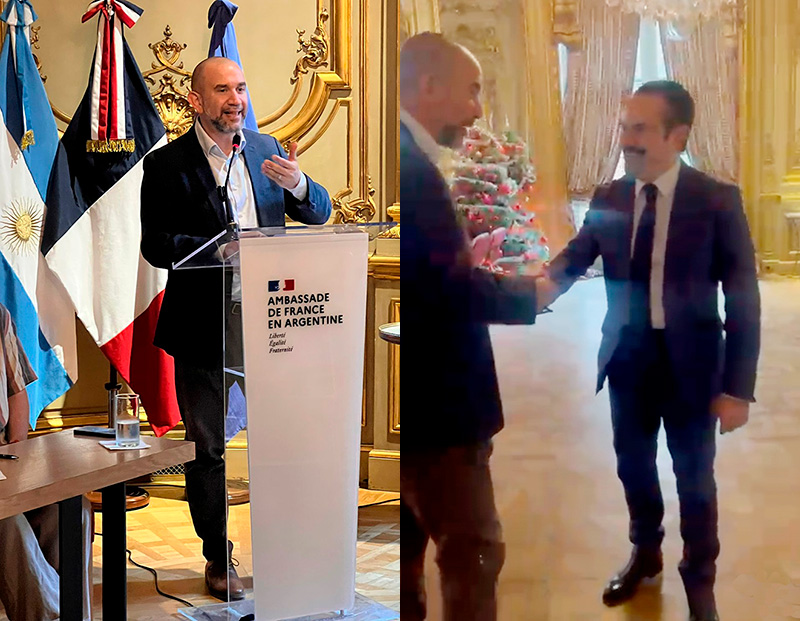
Pablo Vommaro , in turn, contributed that “we think that climate change, democracy and inequalities go hand in hand; a more environmentally sustainable world is also a much more egalitarian world or one with fewer inequalities,” after which he added that “re-emphasizing the importance of horizontal international cooperation is very important, as is the role of science, of a critical transformative academy in building common futures.”
He pointed out that “global challenges require collective responses based on knowledge and solidarity, on collaboration rather than competition. Thinking about just transitions means integrating social justice, equality, territorial sovereignty, and the defense of public and common goods. It also means avoiding cannibalistic transitions, avoiding extractivism.”
Following this, he concluded: “Critical, transformative, and collaborative research can contribute to energy sovereignty, the defense of territories, water governance, and the construction of cities that care for the climate and, by caring for the climate, care for and make life sustainable. (…) CLACSO reaffirms its commitment to ensuring that the production of knowledge as a common good—always in open access—is a transformative tool for building shared futures.”

For Bruno Sirote, “the Paris Agreement is one of the great milestones of international diplomacy in the last ten years, but also of the entire 21st century. (…) The Paris Agreement is the best instrument we managed to achieve, and yet, the story is not over; we still have some outstanding issues.” Regarding COP30 in Belém, Brazil, he believes that “it left us with some unfulfilled expectations regarding progress in terms of implementation.”
Tais Gadea Lara stated that “the COP is not going to solve climate change. Often, the expectation is that it has to solve all the problems, and that's not going to happen. The COP is the multilateral forum where governments decide how they will implement the Paris Agreement, and then it is up to the governments, along with all the other stakeholders, to move forward.” She added that “the results of COP30 were minimal consensus; it lacked ambition. The climate agenda is not a green bubble; it is connected to everything else, and financing is the backbone for implementation.”
Esteban Serrani analyzed that it's not just about "denialist governments; it's an agenda about who will dominate the industrial economy of green policy and how international trade will be reconfigured. How do we reduce inequality, how do we reduce energy poverty, and how do we generate a process of democratization in access to energy, how do we make a just energy transition," which, in his view, "is directly tied to the territories: the big solutions come from small measures."
Elisabeth Möhle characterized “this historical moment as an intermediate transition: when a structural transformation begins, it makes sense that these tensions start to emerge.” She understands that “ultimately it is always a political decision, but science has a very important role in charting possible paths and providing the necessary knowledge.” She added: “There is a scenario of fragmentation and another scenario of cooperation where the transition not only considers how quickly it is mitigated but also how it supports job creation and technological capabilities.”

The 2015 Paris Agreement is a legally binding international treaty, adopted at COP21, that seeks to limit global warming to below 2°C (ideally 1.5°C) above pre-industrial levels, achieving carbon neutrality by mid-century through ambitious emissions reductions and support for developing countries, marking a milestone in collective climate action.
Other key objectives are to increase the capacity to adapt to the impacts of climate change and to promote low-emission development and steer financial flows towards low-carbon and resilient development.
How Does It Work?
-Nationally Determined Contributions (NDCs): Countries submit and maintain their own emissions reduction plans, which are reviewed and expected to increase over time.
-Transparency: Establishes a transparency framework to report on progress and support provided and received.
-Ambition Mechanism: A five-year review process for countries to increase their commitments (the first cycle was in 2020/2021).
-Support to Developing Countries: Framework for developed nations to assist developing nations in mitigation and adaptation.
Impact and Current Status
The Paris Agreement entered into force in November 2016 and has been ratified by more than 190 countries. It spurred the creation of national climate laws and strategies and is essential to the Sustainable Development Goals (SDGs). However, despite progress, fossil fuel consumption has increased, and much more ambitious action is needed to meet its targets, as highlighted in the recent COP30 in Belém, Brazil.

CLACSO at the Climate Change Conference
Is climate change a multiplier of inequalities and territorial violence? – InfoCLACSO, November 5, 2025
Is it possible to achieve sustainable development without full environmental democracy? – InfoCLACSO, November 19, 2025
Conversation “Towards COP30”

