
Juan Bosch Award for Critical Thinking in the Dominican Republic and the Caribbean
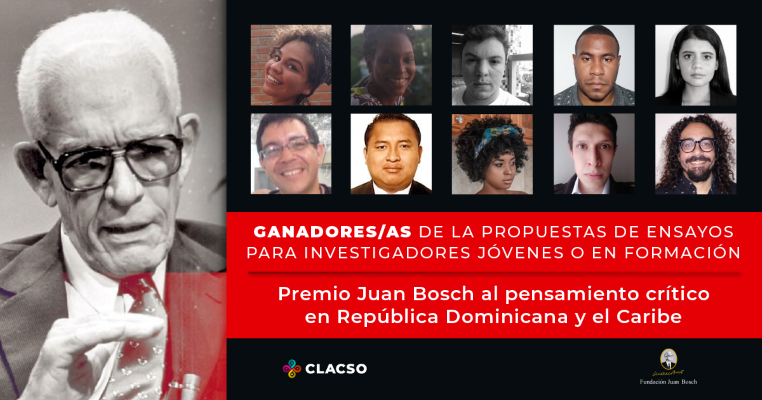
The Latin American Council of Social Sciences (CLACSO) announces the results of the Call for essay proposals “Juan Bosch Prize for critical thinking in the Dominican Republic and the Caribbean”, organized through the Working Group “Crisis, responses and alternatives in the Greater Caribbean” in conjunction with the Juan Bosch Foundation.
Juan Bosch is a leading figure in literature and critical thought in the Dominican Republic, the Caribbean, and Latin America in general. This call for papers aligns with CLACSO's mission to promote reflection and critical analysis of Caribbean thought, recognizing Bosch's intellectual, ethical, and political legacy. It also addresses the need to foster critical thinking and analysis in the Dominican Republic and the Caribbean, especially among younger generations, as essential for strengthening the political practice of social and grassroots movements, as well as academia, in the pursuit of the common good and social justice.
We congratulate the young researchers who responded to this Call and submitted their essay proposals.
Of the applications received, 36 were deemed eligible for evaluation by the International Committee. The Committee considered the quality, relevance, coherence, and timeliness of the proposals, in accordance with the Call for Proposals guidelines.
The evaluation assessed the quality of the submitted essay proposals, as well as their rigor and intellectual contribution to the issues addressed in the Call for Papers. As stipulated, three (3) prizes were awarded to the winning proposals, each consisting of one thousand (1.000) US dollars, publication of the final essays, and a full scholarship to attend one of CLACSO's virtual seminars between 2022 and 2023.
Furthermore, in recognition of the quality and excellence of most of the submissions, it was decided to award seven honorable mentions . These seven final essays will also be included in the publication, and their authors will also be awarded a scholarship to attend one of CLACSO's virtual seminars between 2022 and 2023.
The publication will be a co-edition between CLACSO and the Juan Bosch Foundation and will be available in open access, free of charge. Authors will have up to 90 days from the publication of this decision to prepare the final papers to be published in the planned book.
The evaluation process was carried out by an International Committee made up of the following intellectuals: Georgina Alfonso (Cuba), Jacqueline Laguardia (Cuba-Trinidad and Tobago), Pablo Mella (Dominican Republic), Amaury Pérez (Dominican Republic), Angel Villarini (Puerto Rico) and Yolanda Wood (Cuba-Mexico).
Based on the evaluation, the list of the three winning essay proposals is presented below. The final essays will be included in the publication, receive the aforementioned financial support, and be awarded training scholarships:
|
Researchers |
Country |
Essay title |
|
Ana Hurtado Pliego |
Mexico |
Blackness, soundscape and body in contemporary Dominican narrative: an approach from Cultural Studies |
|
Ada Lescay Gonzalez |
Cuba |
Cuba: Race and Representation; Exegesis of Raciality from Visual Culture |
|
Victor Miguel Castillo de Macedo |
Brazil |
Juan Bosch from late capitalism to contemporary Dominican capitalism: social theories and political projects in perspective |
Below is the list of the 7 (seven) essay proposals with honorable mention; the final essays will be recognized with their publication in the collective book and will receive training grants:
|
Researchers |
Country |
Essay title |
|
Laura Luz Cárdenas Tavera |
Colombia |
After the No |
|
Adaivis Marrón Pérez |
Cuba |
The role of women in the folk-popular stage. Obini Bata's performance at the Casa de África museum |
|
Jorge Luis González González |
Chile |
The contribution of critical thinking in the work of Juan Bosch to popular movements in Latin America in the struggle against neocolonialism and imperialism |
|
Juan W Ruiz Goyco |
Colombia |
Aesthetic-pedagogical resonances in the anti-imperialist thought of Juan Bosch, Roberto Fernández Retamar and Jose Luis González. An approach from the epistemologies of the South. |
|
Duvan Fernando Ramírez Zamora Nhorelsy Camila Thowinson De León |
Colombia |
Juan Bosch's thinking for understanding decolonial critique and politics |
|
Aaron Bracho |
Panama |
The Panamanian Caribbean: extraction, periphery and marginality |
|
Erick Leonardo Gutierrez Garcia |
Venezuela |
Decolonial critique of the hegemonic legal episteme |
This ruling is irrevocable and cannot be appealed.
Buenos Aires and Dominican Republic, October 5, 2022.

