
OPINION – Multiple dimensions of gender-based violence
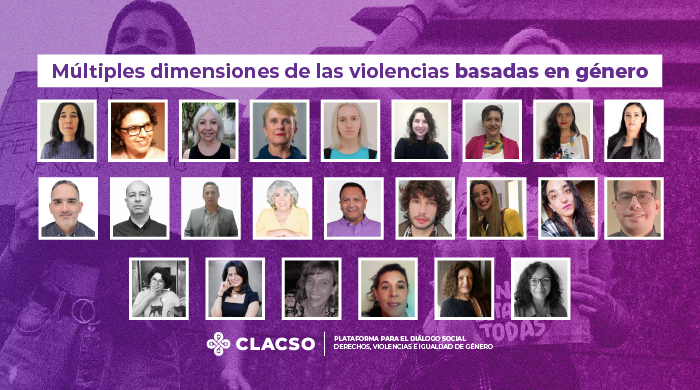

Gender-based violence is neither homogeneous nor one-dimensional; rather, it is shaped and influenced by dimensions such as ethnicity, race, class, gender identity, age, disability, and territory, among others. These intersections can exacerbate or modify the nature, experience, and impact of this violence. We are witnessing an intensification of gender-based violence, a fact that motivates CLACSO to encourage research on this topic. To this end, it issues this Call for Proposals, inviting researchers to focus on the analysis of gender-based political violence against women leaders, activists, human rights defenders, and environmental activists, from a multidimensional perspective, with an emphasis on its connection to economic and symbolic violence. This multidimensional and intersectional approach is key to developing policies and strategies that consider diverse realities, thereby enriching practice with responses that promote more effective, just, and context-specific interventions.
It is in this sense that CLACSO launched the Research Call for teams “Multiple dimensions of gender-based violence”, which is part of the Platform for Social Dialogue Rights, Violence and Gender Equality and promotes the application of research teams made up of academics from diverse disciplines, trajectories and experiences, together with activists and representatives of social movements, public policy decision-makers and people with work and activities related to the topic.
They were opened 171 forms and were finally received 51 applications, which after the technical and formal review, were in a position to be qualitatively evaluated by the Committee to consider the quality, relevance and coherence of the proposals according to the Call.
The evaluation process was carried out by a Committee composed of 11 experts: Rita Alves (Brazil), Alba Carosio (Venezuela), Patricio Dobreé (Paraguay), Ivonne Farah (Bolivia), Javier Gómez Aguilar (Bolivia), Gracia González (Spain), Marcia Leite (Brazil), Catalina Mendoza (Ecuador), Daniela Perrotta (Argentina), Natalia Quiroga (Colombia) and Jenny Torres (Dominican Republic).
Following the evaluation, which recognized the excellent quality, relevance and rigor of most of the applications, 6 proposals were selected.
The list of selected proposals from the Call for Proposals is as follows:
|
Selected proposals |
|||
|
Authors |
Member Center |
Country |
Title of the proposal |
|
Claudia Andrea Bacci – Maria Alejandra Oberti – Mariela Peller – Cristina Scheibe Wolff – Luiza Raquel Waulczinski – Morgani Guzzo |
Institute of Latin American and Caribbean Studies – IEALC/UBA – Faculty of Social Sciences – University of Buenos Aires |
Argentina |
Gender-based political violence, antifeminism, and misogyny on the internet: Local expressions of a global phenomenon (Argentina and Brazil) |
|
Luisa Alejandra Saldarriaga Quintero – Dora Cecilia Saldarriaga Grisales – Gihomara Aristizábal Morales – Juan Jacobo Agudelo Galeano – Gerzon Yair Calle Álvarez |
Center for Socio-Legal Research – CISJ/UNAULA – Faculty of Law – Latin American Autonomous University |
Colombia |
Political violence against women of the Electas Movement in the political context of the Department of Antioquia (Colombia) during the period 2022 – 2024. |
|
Wilson Salvador Oliden Zuñiga – María Esther Pozo Vallejo – Jose Constantino Castellon Onofre |
Center for Planning and Management – CEPLAG/UMSS – Faculty of Economic Sciences – Universidad Mayor de San Simón |
Bolivia |
“She’s clueless… What does she know about being an authority figure?”: Intersecting epistemic exclusions in the exercise of jurisdictional authority for indigenous women from “the interior” |
|
Camila Pérez – Tatiana Rocío Rivadeneira Burbano – Ádamo Insfran |
Luiz Inácio Lula da Silva Institute – Lula Institute |
Brazil |
Gender and sexuality on the far-right agenda: a cartography of digital communication in Brazil, Uruguay and Ecuador |
|
Manuel Salvador Funes Narváez – Mariantonia Bermúdez González – Suhey Mercedes Funes Narváez |
Institute for Research in Socio-Humanistic Sciences – ICESH – Rafael Landívar University |
Guatemala |
Violence against women workers in the maquiladora industry in Guatemala and Nicaragua: a comparative study |
|
Leticia Echavarri – Cintia Rizzo – Ana María Falu – Lilian Susana Soto Baudi |
Documentation and Studies Center – CDE |
Paraguay |
Women in politics: feminist agendas and political violence. Argentina and Paraguay. What challenges in the new contexts? |
This ruling is irrevocable and cannot be appealed.
Buenos Aires, September 10, 2024

