
OPINION – Academic Freedom in the Global South: social and institutional lessons from Latin America, the Caribbean and Africa
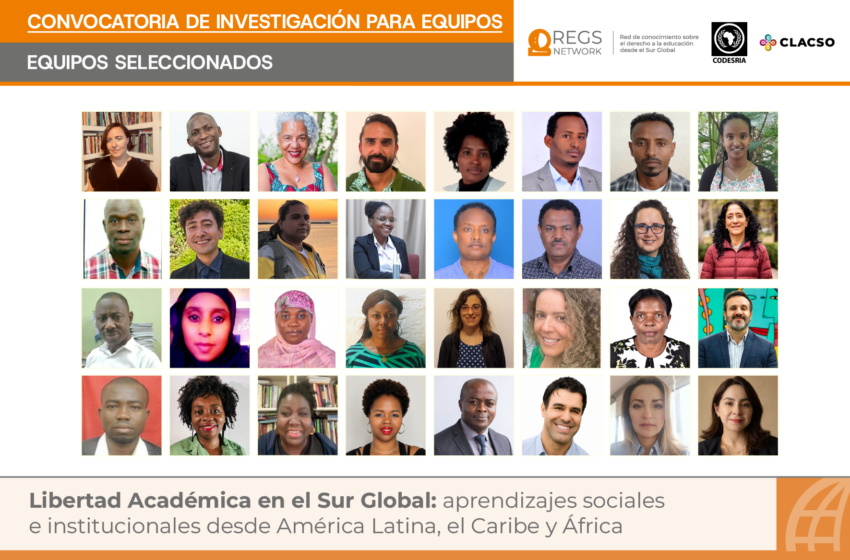
The Latin American Council of Social Sciences (CLACSO), together with the Council for the Development of Social Science Research in Africa (CODESRIA), announces the results of the research call for teams entitled “Academic Freedom in the Global South: Social and Institutional Learnings from Latin America, the Caribbean, and Africa.” This call aims to: promote empirical and theoretical research on the state of academic freedom in Latin America, the Caribbean, and Africa; strengthen academic cooperation and the exchange of experiences and lessons learned among research teams from both regions; and produce input that contributes to public debate and influences on higher education policies that guarantee autonomy and the right to science.
We thank the entire research community for the positive response to this call for proposals. We received 49 applications which, after a technical review in accordance with the terms of reference, were then evaluated by the International Committee. This Committee considered the quality, relevance, and coherence of the projects based on the call's guidelines.
The evaluation process was carried out by an International Committee composed of 20 expert evaluators from 9 countries: Lourdes Nayeli Quevedo Huerta (Mexico); Daniela Perrotta (Argentina); Geoffrey Pleyers (Belgium); Ana Carolina Hetch (Argentina); Cristiano Macuamule (Mozambique); Muhidin Shangwe (Tanzania); Ana Rivoir (Uruguay); Estela Quintar (Mexico); Jaquelina Noriega (Argentina); Mariela Peller (Argentina); Martha Nélida Ruiz Uribe (Mexico); Florencia Falabella (Paraguay); Astrid Ximena Cortés Lozano (Colombia); María Florencia Noya Dive (Argentina); Nicolas Dip (Mexico); Gustavo Fischman (Argentina); Amaurys Giordano Perez Vargas (Dominican Republic); Luciana García Guerreiro (Argentina); María Paula González (Argentina) and Victoria Kandel (Argentina).
Based on the above, the list of the 7 selected projects is as follows:
| Team | Institutional link | Countries | Title of the project | Thematic Area of the Call for Proposals |
|---|---|---|---|---|
| Rodrigo Andres Mardones Carrasco - Carla António Zavale Timane - Camila Morales | CL-005 - Vice-Rectorate for Research and Postgraduate Studies - VRIP-UAHC - University of Christian Humanism | CHILE (2); MOZAMBIQUE (1) | Situated Practices of Academic Freedom from Critical Extension in the Global South: A Comparative Participatory Action Research (PAR) between Chile and Mozambique | Comparative studies: Transregional analyses between countries in Latin America, the Caribbean and Africa. |
| Lucía Trotta- Mónica de la Fare - Maria Yamile Socolovsky - Grace Chitayi Nyongesa - Cristine Jaques Ribeiro | BR-111 - Post-Graduation Program in Social Politics and Human Rights - PPGPSDH - UCPEL - Universidade Católica de Pelotas and AR-044 - Research Institute in Humanities and Social Sciences | BRAZIL (2); ARG(2); KENYA (1) | Work organization and academic freedom in the patriarchal university. Collective strategies for its democratization | Intersectionality and Academic Freedom: Analysis of inequalities of gender, race, ethnicity, territory and class in educational, academic trajectories and in scientific production + The university in a neoliberal context: the question of intellectual freedom, institutional and academic integrity, work and unionization of staff, the commodification of education, neo-managerialism. |
| Fernando Ariel López - Arianna Becerril García - Diana Vilchis Hinojosa - Eurico Wongo Gungula - Fabiano Cuoto Correa | MX-014- Center for Research and Advanced Studies in Political Science and Public Administration AR-062 - October Foundation - Building Workers - FO | MEX (2); ANGOLA (1); BRAZIL (1); ARG (1) | Sovereignty over scientific infrastructures and academic freedom in the Global South. From Diamond Open Access to algorithmic justice: experiences and cooperative models between Latin America, the Caribbean, and Africa | The human right to science and knowledge: Access gaps and their impact on freedom of thought and intellectual work. Production and social circulation of knowledge as a public and common good |
| Chikasie Ruth Ikpeama - Sadiya Lawal Danyora - Afamefuna Angus Eze - Halima Sadiya Yahaya - Abdul Lateef Bisi Adeoti | University of Nigeria, Nsukka, Nigeria | NIGERIA (5) | Academic Freedom and University Governance: The role of students and academic staff in university governance in Nigeria | Academic freedom and university governance |
| Carla María Morasso - Santiago Molfino - Luena Nascimento Nunes Pereira - Emmanuel Phiri - Kizito Shinyonje Sabala | AR-038 - Secretariat of Research and Postgraduate Studies - SIP/UNR - Faculty of Political Science and International Relations - UNR - National University of Rosario and BR-098 Postgraduate Program in Social Sciences Federal Rural University of Rio de Janeiro | BR (1); ZAMBIA (1); KENYA (1);ARG (2) | South - South Academic Networks: Decolonizing International Relations and Advancing Academic Freedom Through Epistemic Alliances between Africa and Latin America | Democracy, autonomy, and academic freedom: Impact on academic freedom, freedom of learning, and research agendas. Resistance to external pressures, harassment, and denialism (research agendas). |
| Anny Ocoró Loango - Maria Camila Landazuri Ocoró - Ana Julia Chaverra Rivas - Antonieta Lopes Ortet | AR-020 - Latin American Faculty of Social Sciences, Argentina - FLACSO - Argentina Program | ARG(2); COL(1); CAPE VERDE (1) | Black women, academic freedom, networks and the circulation of knowledge: Brazil, Colombia and Cape Verde | Intersectionality and Academic Freedom: Analysis of inequalities of gender, race, ethnicity, territory and class in educational, academic and scientific production trajectories. |
| Alem Gashe - Temesgen Kassa - Gebeyaw Zeleke - : Turuwark Warkineh - Mulugeta Gobeze | ET-001 - Organization for Social Science Research in Eastern and Southern Africa - OSSREA | Ethiopia (5) | Contested Academic Freedom in the Global South: Institutional Autonomy, Shared Governance, Academic Participation and Epistemic Justice in Ethiopian Public Universities | Academic freedom and university governance |
This ruling is irrevocable and cannot be appealed. City of Buenos Aires, September 18, 2026

