
OPINION – Strengthening comparative research and critical thinking within the framework of academic freedom in the Americas

Consolidating research on academic freedom in the Americas has profound significance for advancing our understanding of and capacity to advocate for and protect it. Despite its critical importance for the advancement of human rights and democracy, this field remains under-researched, particularly in the face of escalating attacks on academic freedom in the context of growing authoritarianism worldwide.
The need to promote research on academic freedom becomes even more urgent when considering the results of the 2023 Academic Freedom Index (AFI), which point to a decline in academic freedom worldwide and in the Americas. Examples of this decline include the erosion of university autonomy, the prosecution of academics, increasing online threats and harassment, and a lack of protective measures coupled with an inadequate institutional response. Attacks against student organizations are also part of the struggle for academic freedom, and an intersectional lens is crucial both for understanding these attacks and for overcoming them.
Considering the aforementioned regional and global context, five lines of research were proposed for the Call, indicative but not exclusive: Academic freedom and the strengthening of democracy, academic freedom and the pursuit of scientific development, academic freedom and technology, academic freedom and university autonomy, and finally academic freedom and structural inequalities.
Based on this background, the Coalition for Academic Freedom in the Americas (CLAA) and the Latin American Council of Social Sciences (CLACSO) launched this Call for the strengthening of comparative research and critical thinking within the framework of academic freedom in the Americas.
Ninety-eight forms were opened and 34 complete applications were finally received, which, after technical and formal review, were in a condition to be qualitatively evaluated by the International Committee to consider the quality, relevance and coherence of the proposals in accordance with the Call.
The evaluation process was carried out by an International Committee composed of 6 experts from different countries: Camilla Croso (Brazil), Rafael Ibarra Garza (Mexico), Isaac Nahon-Serfaty, (Venezuela/ Canada), Lia Pinheiro Barbosa (Brazil), Juan Piovani (Argentina) and Laura Rovelli (Argentina).
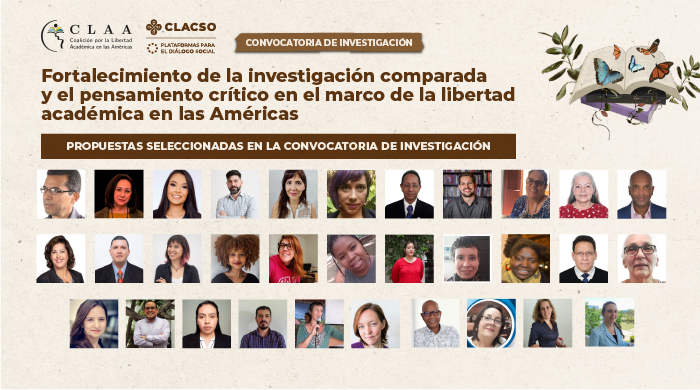
Based on the evaluations received, the list of selected proposals is as follows:
|
Authors |
Institutional link |
Country |
Title of the proposal |
|
Anny Ocoró Loango – María Camila Landazury – Clara Luisa Martins Brandão – ARBEY BUSTAMANTE – Jorge Enrique Garcia Rincón |
Latin American Faculty of Social Sciences, Argentina – FLACSO – Argentina Program |
Argentina |
Academic freedom and struggles against structural inequalities from an intersectional perspective: The role of Afro-Latin American research associations |
|
Milena Pereira Fukuoka – Patricia Lima Pereira – Evelyn Mendoza Baez – Ever Enriquez – Magdalena Rivarola – Gustavo Setrini |
Latin American Faculty of Social Sciences, Paraguay – FLACSO Paraguay |
Paraguay |
Commodification, Credentialism and Political Capture: a historical-comparative study of the barriers to the development of academic freedom and university autonomy in Paraguay |
|
Rodolfo Dynnik Asencios Lindo – Stephanie Hatsumi Gutierrez Otsu – Milagros Maria Badillo Palomino |
Institute of Peruvian Studies – IEP |
Peru |
Academic Freedom in Times of Inequality: A Laboratory for Reflection for Peru |
|
Juan Alfredo Tuesta Panduro – Vilda Rodríguez Méndez – Norbisley Fernández – Ognara García García – Yailé Caballero Mota |
National Agrarian University of the Jungle Tingo María – UNAS |
Peru |
Inclusive editorial management of open academic digital books in Latin America |
|
Mario Rolando Chocoj Méndez – Silvia Calderon – Clara María Josefina Arenas Bianchi de Recinos – Jorge Waldemar Urquiza Martínez – Rodolfo Rubio Pérez – María Estela Rivero Fuentes |
Association for the Advancement of Social Sciences – AVANCSO |
Guatemala |
Academic freedom and its relationship with democracy and inclusion in Central America: risks, vulnerability and resilience. |
|
Fernando Romani Sales – Paula Aldana Lucero – Rosario Figari Layús – Maria Fernanda Silva Assis |
Faculty of Law of the University of São Paulo (USP) |
Brazil |
Academic freedom and scientific development in Mexico: extreme climate and scientific denial in Brazil and Argentina |
|
Ana Lucía Ramazzini Morales – Marisa Gisele Ruiz Trejo – Tania Selene Mata Parducci |
Faculty of Social Sciences Campus III – UNACH – Autonomous University of Chiapas |
Mexico |
Critical thinkers and the crises of academic freedom in Chiapas and Central America (1910-2024) |
This ruling is irrevocable and cannot be appealed.
Buenos Aires, December 16, 2024

