
Dialogues on feminist foreign policy. The future of equality
The Pact for the Future , recently adopted by the UN General Assembly in September 2024, proposes 54 actions to address global challenges based on five priority areas: sustainable development and development financing, international peace and security, science, technology, innovation and digital cooperation, youth and future generations, and the transformation of global governance.
The importance of the participation of women and feminist organizations has been established in preamble paragraph 15 of the Covenant, which states that:
“None of our goals can be achieved without the full, safe, equal and meaningful participation and representation of all women in political and economic life. We reaffirm our commitment to the Beijing Declaration and Platform for Action, to accelerating our efforts to achieve gender equality, women’s participation and empowerment of all women and girls in all spheres, and to eliminating all forms of discrimination and violence against women and girls.”
Thus, Action No. 8 of the Pact for the Future is intended to achieve gender equality and the empowerment of all women and girls as a key contribution to advancing and achieving the Sustainable Development Goals of the 2030 Agenda.
Furthermore, Action 43 proposes strengthening the work of the Economic and Social Council, recognizing its importance in achieving a balanced integration of the three dimensions of sustainable development and advancing the 2030 Agenda for Sustainable Development. Specifically, regarding gender equality, the Pact states:
“(d) To request the Economic and Social Council, through an inclusive intergovernmental process involving all Member States, to explore options, in the context of the upcoming 30th anniversary of the Fourth World Conference on Women, for revitalizing the Commission on the Status of Women in order to promote the full and effective implementation of the Beijing Declaration and Platform for Action, achieve gender equality and the empowerment of all women and girls and promote and protect their human rights, and to ensure that the Commission is fit for purpose, while reaffirming the Commission’s mandate, and to consider possible options, if necessary, for strengthening other subsidiary bodies of the Council.”
It is within this framework and with the objective of making a contribution to the debate and implementation of the agreements framed in the Pact for the Future from a feminist perspective of the Global South, through the promotion and strengthening of the participation and representation of women in the different discussion forums and in the different processes and instances of decision-making, that we propose the realization of the Dialogues on Feminist Foreign Policy from the perspective of feminist epistemology and diplomacy with a human rights approach.
Methodologically, we plan to conduct two series of virtual dialogues (with the possibility of a hybrid format) with thematic axes linked to the Pact for the Future and the feminist foreign policy agenda during the first half of 2025, as detailed below:
Series ITowards a renewed, inclusive, fair and effective multilateralism. Reform of global institutions and governance of the commons
(April-May 2025)
Chapter 1: International Financial Institutions (IFIs), World Trade Organization (WTO), Security Council (SC).
Chapter 2: International tribunals, special procedures of international organizations, Commission on the Status of Women (CSW), instruments of international cooperation.
Serie IIFeminist Foreign Policy and gender equality as a principle to advance towards solutions for regional and global challenges, and the strengthening of cooperation for sustainable development
(May-June 2025)
Chapter 1Social justice and decent work; human mobility (migrants, refugees and displaced persons); climate change and environmental rights; artificial intelligence and technological transition.
Chapter 2: Advance of the far right, neoconservatism and anarcho-libertarianism; hate speech; feminist and human rights strategies from the Global South to implement the 2030 Agenda and the Future Pact.
The people invited to participate in the various Dialogues will be government decision-makers of feminist foreign policy, representatives of international organizations, political figures, diplomats, parliamentarians, union members, academics, experts and activists/representatives of feminist organizations from the Global South, including instances that promote North-South, South-South and triangular debates and exchanges.
As a result, plans are underway to produce a publication compiling the presentations, discussions, and conclusions. To this end, when inviting presenters, they will be asked to submit a text outlining their main contributions in addition to their presentation.
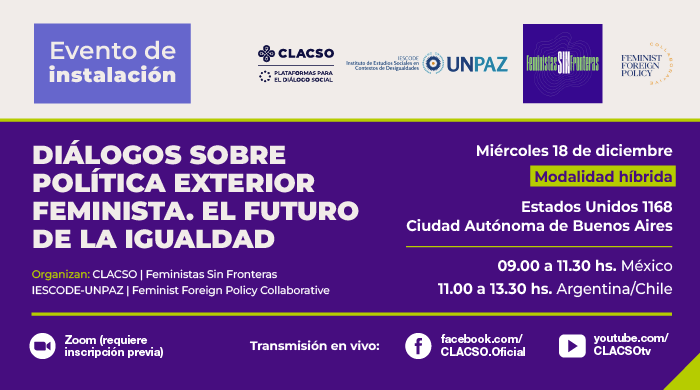
INSTALLATION EVENT
DIALOGUES ON FEMINIST FOREIGN POLICY. THE FUTURE OF EQUALITY
Wednesday, December 18 | Hybrid format | City of Buenos Aires, Argentina
⏰ 11.00 to 13.30 hours
United States 1168, CLACSO Headquarters
OPENING WORDS
Karina BatthyányExecutive Director of CLACSO
Cecilia AlemanyDeputy Regional Director of UN Women for the Americas and the Caribbean
Marita PercevalPresident of Feminists Without Borders
Lyric Thompson. Founder & CEO of Feminist Foreign Policy Collaborative
Nora GorenDirector of IESCODE-UNPAZ
HIGH-LEVEL PANEL: THE AGENDA FOR THE FUTURE FROM A FEMINIST FOREIGN POLICY PERSPECTIVE
Citlalli Hernández MoraSecretary of Women – Mexico
Glory de la FuenteUndersecretary of Foreign Affairs – Chile
Coordinates and moderates
Pablo VommaroAcademic Secretary of CLACSO
ORGANIZE


