
World Science and Technology Day
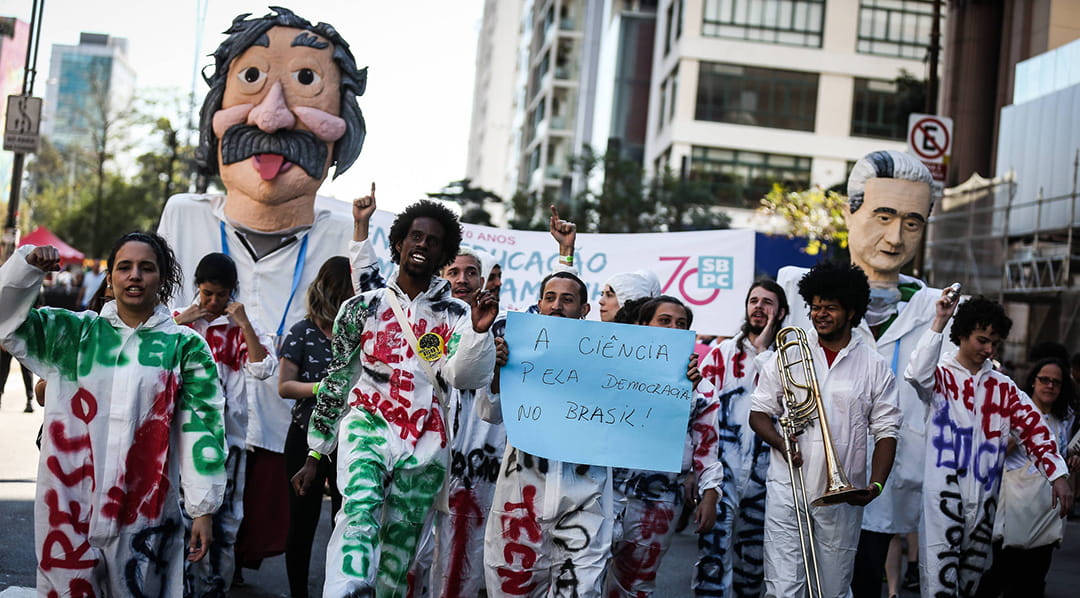
The UNESCO General Conference proclaimed the April 10 “Science and Technology Day” in honor of the birth of Argentine physician and pharmacist Bernardo Houssay, Nobel Prize in Medicine in 1947, for his scientific and medical discoveries, particularly in the role of the pituitary gland in regulating the amount of sugar in the blood, through the metabolism of carbohydrates.
LATIN AMERICA
In May 2018, journalist Javier Flores of The Journey from Mexico analyzed what he called the “Causes of scientific backwardness in Latin America.”
“The similarities among Latin American nations in their scientific and technological development are striking. In 2016, estimated research and development expenditure (R&D) for the region averaged just 0,48% of gross domestic product (GDP), while among the member countries of the Organisation for Economic Co-operation and Development (OECD), the average percentage was 2,38% in 2014. A similar pattern is observed when examining indicators such as the number of researchers, patents, and so on. While uniformity cannot be claimed, as each nation has its own history and particularities, it is inevitable to ask why this enormous gap has emerged and persists.”
Political factors certainly play a role in every nation. For example, in 2014 Brazil allocated 1,14% of its GDP to research and development (the highest in Latin America), but after the coup against President Dilma Rousseff, there have been continuous cuts to the science budget, which in 2017 was 44% lower than the previous year. On a different scale, in Mexico this spending reached 0,54% of GDP in 2014, but also, due to continuous cuts, in 2018 this figure will fall below half a percentage point.
But in addition to the effects of the political instability that characterizes the region, there is a common denominator: the limited presence of the private sector in the spending structure. In all Latin American countries, without exception, the majority of resources come from government sources. Thus, public spending is 94% in Costa Rica and private contribution is 2% (the remaining 4% comes from other sources), Panama (81/11), Argentina (76/17), Mexico (67/20), Brazil (61/26), and Chile (43/33). For some points of reference, in Japan the percentage ratio between public and private GDI is completely reversed (15/78), in China (21/75), in Korea (24/75), in Germany (28/66), and in the United States (24/64).
To update some information from the article The Day, We expand on three examples from our region: Brazil, Argentina, and Chile.
BRAZIL
The Brazilian science sector has been suffering budget cuts for several years. Upon assuming office after the impeachment of Dilma Rousseff, Michel Temer merged the Ministry of Science, Technology and Innovation with the Ministry of Communications.
Jair Bolsonaro campaigned on a promise to cut funding for universities and research institutes. According to a government decree issued on March 29, this year's budget for Brazil's Ministry of Science, Technology, Innovation and Communication (MCTI) will be slashed by 41,9%. The new allocation of 2.947 billion reais (US$750 million) represents a reduction of approximately US$543 million compared to the 2019 budget.
This is the lowest budget allocated to the sector in over a decade in Brazil. Until now, the lowest budget was in 2006, when it was allocated 3,1 billion reais (US$790 million).
According to physicist Ildeu de Castro, president of the Brazilian Society for the Advancement of Science, the 41,9% budget cut to the Ministry of Science, Technology and Innovation (MCTI) will jeopardize funding for postgraduate scholarships awarded by the National Council for Scientific and Technological Development (CONACYT) and programs that incentivize scientific research. “Many international research networks will be dismantled, while the purchase of laboratory equipment will be interrupted, compromising the development of research,” he asserts.
ARGENTINA
In 2018, the Ministry of Science, Technology and Productive Innovation was downgraded to a Secretariat.
Since Mauricio Macri took office in December 2015, Argentine scientists have been warning the government that it must preserve and invest in science and technology and have been demanding answers regarding the various cuts made to the budget of this sector under the slogan: "Without science and technology there is no future."

Furthermore, they are requesting that the Executive Branch approve the Science and Technology Law, which has already received preliminary approval in the Senate and guarantees a budget increase. The law establishes a phased increase in the Science and Technology budget, rising from 0,51% in 2018 to 3% of Gross Domestic Product (GDP) by 2030. The 3% target for 2030 is a percentage approaching that of the countries that invest the most in Science and Technology, which allocate 4% of their GDP, while Argentina currently allocates around 1%.
"This is a dismantling on multiple fronts, starting with the general budget problem—operating funds are frozen, and payments are delayed. Added to this are low salaries, a lack of career prospects and job security, which means fewer opportunities to enter research careers," he denounces. Julián Del Pla, member of Young Precarious Scientists Regional La Plata.
CHILE
On December 17, 2018, President Sebastián Piñera appointed the first Minister of Science, Technology, Knowledge, and Innovation: Andrés Couve, a biologist specializing in neuroscience. The creation of a ministry to coordinate public policies in the sector is a long-standing demand of the Chilean scientific community. The bad news is that the approved budget for 2019 suffered a cut of US$47 million, representing a 4,6% reduction in a budget that was already shrinking, having suffered a 2,2% cut in 2018.

Biochemist Vania Figueroa, a professor at the University of O'Higgins, a member of RedI and the Hay Mujeres Foundation, points out that one of the main conflicts is that, on the one hand, "public policy over the last 25 years has financed the indiscriminate production of advanced human capital, mainly with doctoral degrees"; while, on the other hand, "it has failed to effectively link the science and innovation ecosystem with the country's productive sector," so that the demand for highly qualified professionals can absorb the large existing supply and scientists do not have to go abroad.
“Rich countries are rich because they dedicate money to scientific and technological development, and poor countries remain poor because they don't. Science isn't expensive; ignorance is.”
Bernardo Houssay.

