
International Day of Women and Girls in Science 2026
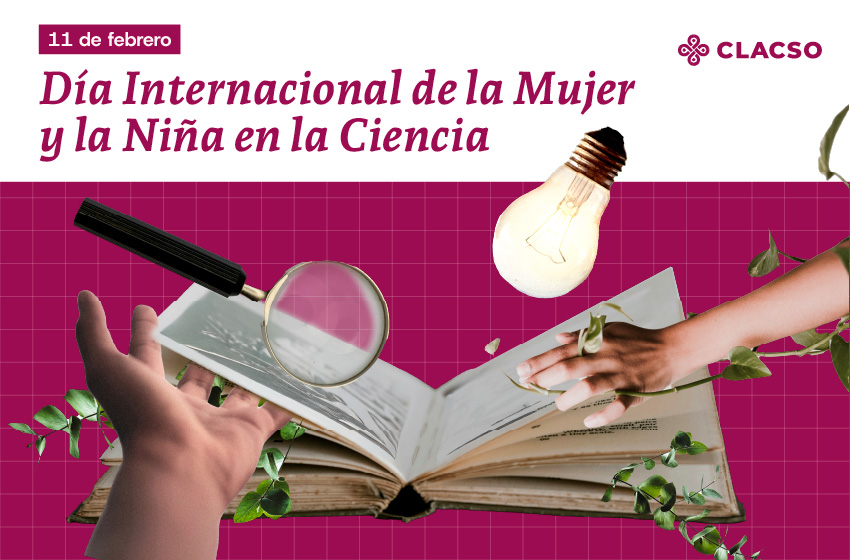
Through its Resolution 70/212, in 2015 the United Nations Educational, Scientific and Cultural Organization (UNESCO) proclaimed on February 11 as International Day of Women and Girls in Sciencehighlighting equality between women and men in the scientific field and the challenges of the 21st century in development, technology, creativity and sociocultural research.
In 2026, UNESCO commemorates this day under the theme: "From vision to impact: Redefining science, technology, engineering and mathematics (STEM) by closing the gender gap".
Inequalities in science and technology are not technical, they are structural. Therefore, we advocate for the fundamental role of the Social Sciences to diagnose cultural barriers, design inclusive public policies, and ensure that scientific development has a real social impact.
We support this initiative by reaffirming that interdisciplinarity is the only way to build fair knowledge systems.
To "redefine" science, we need to understand society. The social sciences have a fundamental role to play in dismantling the structures of inequality that limit women's access to and advancement in technological fields.

Given that the scientific field has historically been configured around patriarchal logics, CLACSO-FOLEC celebrates policies, programs and initiatives that aim to guarantee the full and equitable integration of all marginalized women and gender identities in the academic field.
See FOLEC: International Day of Women and Girls in Science
In the InfoCLACSO of February 10, 2021, Laura Rovelli, then Coordinator of the Latin American Forum on Scientific Evaluation (FOLEC) of CLACSO, referred to the International Day of Women and Girls in Science.
CLACSO TV Archive
Marta González“Women’s contributions to science are made invisible.”
Rodrigo Arocena"Today, knowledge is a factor of inequality."
CLACSO Library Archive
Women intellectuals. Feminisms and liberation in Latin America and the Caribbean
Science, technology and society in Latin America: The perspective of new generations
Essential Anthologies Collection
Alicia Ziccardi
Latin American cities: The social question and local governance
Dora Barrancos
Becoming a Feminist: A Political and Intellectual Trajectory
Elizabeth Jelin
The plots of time: family, gender, memories, rights and social movements
Luz Gabriela Arango
A sociology without borders. Explorations on gender and work
Marta Lamas
Dimensions of difference: Gender and politics
Mercedes Olivera
Popular feminism and revolution: Between militancy and anthropology
Montserrat Sagot
Bodies of Injustice: A Feminist Critique from Central America
Nelly Richard
Zone of tumult: memory, art and feminism
Rosario Aguirre
Care on the agenda: gender, work and time use
Sara María Lara Flores
The forgotten ones of the countryside: agricultural day laborers in Latin America

