
Day for the Elimination of Violence against Women
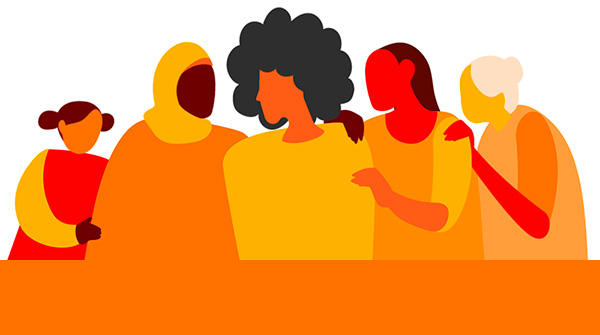

Every November 25th, the International Day for the Elimination of Violence against Women is commemorated, with the aim of making visible the violence against women and girls worldwide, a day that is promoted year after year by the Latin American Council of Social Sciences.
November 25th is the date chosen to put in the foreground what concerns and worries us daily: the violence that is exercised against people, when they are discriminated against because of their gender, and to demand policies for its eradication.
In 2022, InfoCLACSO broadcast a special program featuring Karina Batthyány, Executive Director of CLACSO; Dora Barrancos, sociologist, historian, and feminist from Argentina; Patricia Castañeda Salgado, PhD in Anthropology from the National Autonomous University of Mexico (UNAM), founder of the Feminist Research Program at the Center for Interdisciplinary Research in Sciences and Humanities at UNAM, and member of the Working Group on Feminisms, Resistance, and Emancipation; Alba Carosio, from the Central University of Venezuela, director of the Venezuelan Journal of Women's Studies, researcher at the Rómulo Gallegos Center for Latin American Studies (CELARG) and the Miranda International Center (CIM); Clyde Soto, former member of the CLACSO Steering Committee for Paraguay; and Fernanda Pampín, Director of Publications at CLACSO.
In addition, we remember the interview that Francia Márquez Mina, a Colombian Afro-Colombian social leader and feminist and current vice president of her country, granted us.
In 1981, the First Latin American and Caribbean Feminist Meeting was held in Bogotá, Colombia. It was there that November 25th was designated the International Day for the Elimination of Violence against Women. The date was chosen to commemorate the 1960 femicide of the Mirabal sisters (Las Mariposas) at the hands of the dictatorship of Leónidas Trujillo in the Dominican Republic.

More than a decade later, in 1993, the United Nations General Assembly adopted the Declaration on the Elimination of Violence against Women. It defined violence against women as “any act of gender-based violence that results in, or is likely to result in, physical, sexual or psychological harm or suffering to women, including threats of such acts, coercion or arbitrary deprivation of liberty, whether occurring in public or in private life.”
Finally, on December 17, 1999, the United Nations General Assembly, through resolution 54/134, decreed that from the year 2000 onwards, November 25 would be the date stipulated as the International Day for the Elimination of Violence against Women, a day that marks the beginning of the UN's UNiTE Campaign, 16 days of activism that conclude on December 10, International Human Rights Day.
On this #25N, CLACSO is sharing some of our books by renowned women in the field of Latin American and Caribbean feminism. These are leading authors and researchers from the region, characterized by their political commitment and public interventions in defense of women's rights, particularly in the fight against violence against women.
Dora Barrancos
Becoming feministIt addresses women's rights in all aspects of life.
Mercedes Olivera
Her proposal for participatory defense of women experiencing violence. Defense of collective ownership, the defense arguments for women. Vindication of the right to freedom and justice.
Elizabeth Jelin
Memory and Human RightsGender and work. Social movements. Crucial contributions to understanding the field of social sciences
Manuela D'Avila
#LatinAmericanFeminismsCollection Why do we fight?
Manuela explains contemporary feminism to those who are unfamiliar with it or don't understand it. Feminism is everyone's business.
It was always about us.
Accounts of gender-based political violence in Brazil. Manuela D'Ávila. [Compiler] “This book is dedicated to all the women who raised their voices to denounce gender-based political violence…”.
Women mobilized in Latin America
In various cities and countries across Latin America, we are witnessing expanded forms of feminism, with unprecedented levels of support and the majority participation of young people. This book presents a series of scenarios from the region in the 21st century, characterized by mass mobilizations with demands and rights aimed at achieving more egalitarian societies.

Policy and Action Line Document (PLA) as a result of the call promoted by CLACSO “Multiple violences in Latin America and the Caribbean: genders, dissidences and alterities”.
If you would like to receive more information about CLACSO's training programs:
[widget id=”custom_html-57″]
to our email lists.

