
Social inequalities and the centrality of life
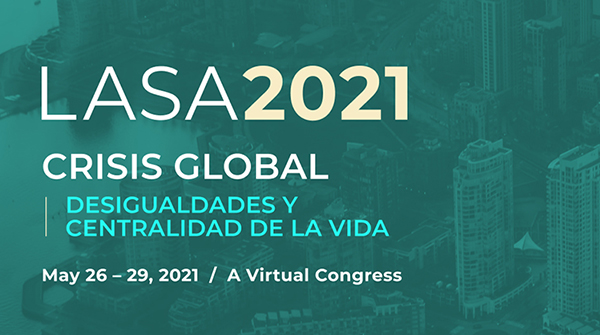

The LASA 2021 Presidential Session: “Social Inequalities and the Centrality of Life” took place after the Welcome Ceremony the previous day.
The virtual congress brought together people who study Latin American and Caribbean societies and cultures to reflect on the logics that inscribe the region in contemporary globalization processes, on the impacts that these processes have had on the lives of its inhabitants, on the institutional architecture of the States and on the cultural dynamics of the continent.
At the Presidential Session on Wednesday, the 26th, CLACSO Executive Secretary Karina Batthyány participated in a panel discussion with Nora Lustig (Tulane University), Juan Pablo Pérez Sáinz (FLACSO Costa Rica), Diego Sánchez-Ancochea (University of Oxford), and Juliana Martínez Franzoni (University of Costa Rica). The session was coordinated and organized by Gioconda Herrera (FLACSO Ecuador).

The Congress includes members from more than 50 CLACSO Working Groups; Among others, the topic of “Poverty and Social Policies” in the Panel: “Inequalities, Rights, and Reconfiguration of Social Protection and Security Systems in Latin America,” on Thursday, May 27, at 13:00 p.m. New York time (UTC-4), with presentations by: Manuel Ignacio Martínez Espinoza: Crisis, State, and Social Policies in Brazil and Argentina: Between Dismantling and Reconfiguration of the Protection System; Flavio A. Gaitán: Between Intentions and Inertia: An Assessment of Social Policy in the 4T Government in Mexico; Cinthia Márquez Moranchel and Alicia Puyana Mutis: Ethnic and Gender Discrimination and Labor Segregation in Mexico; Anete B. Ivo: Basic Income, Work, and Social Rights: Dilemmas of Reproduction in the Context of the Pandemic; Rosa María H. Voghon Hernández: Persistent Inequalities and Management of the Current Global Crisis: The Experiences of Cuba and the United Kingdom in Comparative Perspective. Session Organized by: María del Carmen Midaglia, University of the Republic. Commentary by: Alicia Ziccardi, Institute of Social Research, National Autonomous University of Mexico
In its call, LASA provides a diagnosis of the current situation and the issues under debate:
“The global crisis unleashed by the spread of COVID-19 across the planet has had dramatic consequences in Latin America, testing the capacity of states to protect their citizens. The aftermath of the disease, understood as a social and political phenomenon, has exposed the structural deficiencies of the region's countries and the persistence of dynamics of inequality, exclusion, and authoritarianism.”
The economic consequences have also been devastating in a region already experiencing growth problems and wealth concentration. The pandemic has profoundly affected social reproduction processes and the daily lives of many social sectors across the continent. Furthermore, this crisis has also sparked deep reflections on the centrality of life and care in economic and social models, the urgency of addressing social inequalities, the imperative to act against environmental devastation, and the critical need to guarantee democratic processes.
Furthermore, COVID-19 is unfolding at a historical moment of unprecedented global connectivity. Paradoxically, this context has led to the emergence of restrictive mobility measures and national lockdowns in virtually every country, resulting in policies of control over populations and their bodies. Undoubtedly, these processes will have repercussions on both public and private life.
The LASA Congress in Vancouver 2021 aims to bring together scholars of Latin American and Caribbean societies and cultures to reflect on the dynamics that situate the region within contemporary globalization processes, the impacts these processes have had on the lives of its inhabitants, the institutional architecture of states, and the continent's cultural dynamics. The management of the crisis, and especially its consequences for the most vulnerable groups, underscores the need to reflect on the causes of this vulnerability, both historically and in the current context.
The current crisis, in reality, exacerbates several trends already present in the social, cultural, economic, and political life of the region. We have witnessed dramatic phenomena of human mobility, exemplified by mass migrations and exoduses within the region or toward the societies of the world's economic centers. Certain authoritarian political dynamics have also been reinforced in emergency contexts. Slow economic growth, along with the deepening of structural inequalities, highlights labor market dynamics characterized by informality and precariousness. Finally, the persistent exclusion of Indigenous and Afro-descendant peoples, and various instances of human rights violations, all demonstrate that the need to deliberate on democracy is more pressing than ever in the region.
Latin America and the Caribbean experienced widespread social protests in several countries over the past year. Mass mobilizations unfolded not only around the fundamental issues that fuel these reactions, such as poverty and social injustice, but also demands related to combating gender-based violence and femicide, the legalization of abortion, enforced disappearances, the defense of natural resources and territories, the mobilization for peace and against targeted killings, and, of course, democracy. Social protest becomes a strategic site for understanding political cultures and the limitations of our political systems at different scales: local, national, and global.
The current crisis has generated a series of ruptures that also reveal lingering traces of various expressions and practices of authoritarianism in Latin America. The events of the past year invite us to rethink the current situation without forgetting the past and its legacy, to exercise our collective memory in order to identify the multiple cultural and societal responses that have been formulated in other critical periods. It is necessary, in this sense, to reflect on the different manifestations of power and the responses that societies have constructed throughout history to express their discontent and their proposals for change.
New challenges and obstacles are putting states and societies in Latin America and the Caribbean under strain. This call for the LASA2021 congress is also a call to contribute, from our disciplines and fields of knowledge, to the debate surrounding access to justice, basic rights, and the construction and consolidation of democratic regimes.
Finally, focusing on the global nature of COVID-19 as the central theme of discussion also offers an opportunity to connect debates between the social sciences, the humanities, and other sciences such as biology and health sciences. We hope that this congress will also facilitate these connections.
This call is committed to a hybrid congress that will allow both in-person participation in the city of Vancouver - if the evolution of the global health situation allows it - and virtual participation.
If you would like to receive more information about CLACSO's training programs:
[widget id=”custom_html-57″]
to our email lists.

