
Social inequality in Latin America and the Caribbean: Questions, approaches, and recent trends
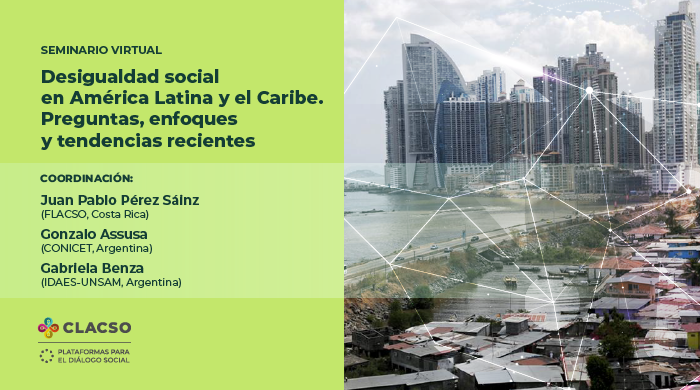
Seminar 2413
Chair: CLACSO
Coordination: Gonzalo Assusa (CONICET – National University of Córdoba, Argentina); Gabriela Benza (National University of San Martín, Argentina) and Juan Pablo Pérez Sáinz (FLACSO Costa Rica)
Teaching team: Gonzalo Assusa (CONICET – National University of Córdoba, Argentina); Gabriela Benza (National University of San Martín, Argentina) and Juan Pablo Pérez Sáinz (FLACSO Costa Rica)
Start: 08/10/2024 | Registration: 22/05/2024 to 07/10/2024
Workload: 12 weeks – 90 hours.
Social inequality is a defining characteristic of Latin America, rooted in long-standing structural processes. In societies marked by high concentrations of property and income, informal employment, dependent integration into the global economy, and the persistence of colonial and post-colonial structures, inequality gaps are not only wide but also persistent.
The seminar proposes an analysis and understanding of social inequalities in Latin America, recovering original theoretical perspectives from the region's social sciences of the mid-20th century and introducing new perspectives and questions that guide current research on inequality. It also reconstructs the main trends and problems observed in this area since the beginning of this century, especially during the so-called "post-neoliberal" period, as well as the transformations that followed. From a multidimensional perspective, it focuses on inequality of income, but also of wealth, health, education, and housing, and on the new inequalities generated by digitalization. It aims to identify inequalities between countries and, within each country, between social classes, as well as their articulation with cleavages of inequality such as gender and ethnic-racial status. It explores the redistributive role of the State and how citizens perceive, legitimize, tolerate, and resist these interventions and transformations.
The persistent gaps in the living conditions and opportunities of the population based on cleavages such as social class, gender, ethnicity and place of residence, have made Latin America and the Caribbean a powerhouse of conceptual elaborations, critical contributions and research on social inequality.
While Latin American social sciences in the mid-20th century made original theoretical contributions on the specific forms inequality takes in the region, the sociopolitical transformations of the early 21st century once again placed inequality at the center of academic and political concerns. Latin America and the Caribbean was simultaneously the region of the world with the greatest income inequality and the one that most reduced its distributive inequity during the first fifteen years of this century, within the context of a political shift that led, for the first time, to the election of left-wing, center-left, or national-populist governments in numerous countries. These intense transformations did not necessarily signify a change in the societal or productive structure, but they repoliticized the Latin American social question and spurred new reflections and analyses on inequality in our region.
The renewed interest of Latin American social sciences in inequality has led to a prolific empirical output that has revisited long-standing perspectives and themes, as well as new questions and approaches. Recent contributions, such as the recognition of the intersectional and multidimensional nature of inequalities, or the elucidation of the dynamics of surplus accumulation and disempowerment specific to the region, have helped to unravel the mechanisms that explain the high and persistent inequality in Latin America, and more specifically, the opposing processes of equality/inequality experienced since the beginning of the century in connection with changes in economic models and forms of state intervention.
Classical concerns about structural inequalities are being enriched by perspectives on the cognitive-narrative dimension of inequality: the positions, principles of distributive justice, and legitimizing narratives that play a key role in the reproduction of inequalities, but also in their generation. This dimension has acquired particular centrality in recent political processes experienced by the region, which are expressed in the emergence of social unrest due to perceived unjust levels of equality, and in the rise of far-right political parties and ideologies that strongly legitimize processes of social inequality. The growth of the Latin American middle class in the first part of the 21st century was accompanied by multiple manifestations and discourses of moral critique and epic narratives, political demands, and collective action. Progressive critiques of middle-class “selfishness,” outrage and moral criticism of “social programs,” echoes of the liberal narrative of “we are all middle class” and “society does not exist,” the contemporary moral hegemony of entrepreneurship and meritocracy: a whole set of political phenomena that can only be understood through the lens of inequality.
Furthermore, citizens construct their own understanding of the social structure. Surveys show that the majority of the region's population considers itself middle class. Does this mean that the liberal dream of a classless society has become a reality?
Does this mean more to the social sciences than simply “misperceptions”? How can social representations of inequality be incorporated into the analysis of this phenomenon? What are the consequences for action and policy aimed at equality?
General objectives
- To contribute to the understanding of social inequalities in Latin America and the Caribbean, through the identification of the theoretical traditions, approaches and questions that guide Latin American research and thought on inequality today.
- To contribute to the reconstruction of some of the main problems and trends that have been recorded in terms of social inequality in the region since the beginning of this century.
- To provide tools for the formulation of diagnoses, public policy proposals and collective action plans committed to reducing social inequalities in the region.
Specific objectives
- Identify the fundamental theoretical and conceptual notions and aspects for the analysis of social inequality.
- To recognize the main approaches, currents, traditions and perspectives of analysis on inequality in contemporary Latin American social sciences, and the privileged questions and techniques for studying it, observing their scope and limitations.
- To analyze the problems and trends that have been recorded since the beginning of the century in Latin America and the Caribbean regarding social inequality from a multidimensional perspective, and to reconstruct the role of state policies in their reduction or accentuation.
- Reconstructing the axes of analysis, methodological approaches and findings regarding the perception, legitimation and tolerance of social inequalities in Latin America and the Caribbean.
- Practice in identifying relevant aspects and problematic areas that contribute to the development of diagnoses, public policies and collective action aimed at reducing social inequality in the region.
- Social inequality as a problem and perspective in the social sciences
- Looking at inequalities from the perspective of the generation and appropriation of surplus in capitalism
- Latin American contributions to the debate on social classes
- Income and wealth inequality in Latin America
- Between inclusion and fragmentation: inequalities in education, health and housing
- The new inequalities generated by digitalization
- Intervention and redistribution: State and inequality in Latin America
- The subjective perception of social inequalities and class identities
- The Robin Hood Paradox: Inequality and Redistributive Preferences in Latin America
- Lines of study, relevant aspects and problematic axes on inequality
- Amarante, V. and Prado, A. (2016). “Inequality in Latin America”, in Bértola, and Williamson, J. (eds.), The fracture. Past and present of the search for social equity in Latin America. Buenos Aires: Fondo de Cultura Económica.
- Approaches to addressing class structure In Assusa, G. and Benza, G. (coord.). Unequal Latin America. Questions, approaches and recent trends. Mexico City: CLACSO/Siglo XXI.
- Assusa, G. and Benza, G. (2024). Unequal Latin America. Questions, approaches and recent trends. Mexico City: CLACSO-Siglo XXI. Introduction.
- Benza, and Kessler, G. (2021). The new? Social structure of Latin America. Changes and continuities after the wave of progressive governments, Buenos Aires: Siglo XXI. Chapter 3 “Education, health and habitat”.
- Citizenships. Journal of Urban Social Policies, 12. Jiménez, P. (2017). “Equity and tax system in Latin America”. New Society, 272, pp. 52-66.
- Costa, S. (2021). “The millionaires, the emerging and the poor. Social structure and political crisis in Brazil”, in Jelin, R. Motta and S. Costa (eds.), Rethinking inequalities. How global asymmetries are produced and intertwined (and what people do about it). Buenos Aires: Siglo XXI.
- Crompton, Rosemary (2013). Class and stratification. An introduction to the debates. Madrid: Tecnos. Chapter 1. Chávez Molina, E. and Rodríguez de la Fuente, J. (2024).
- Di Virgilio, M. (2021). Inequalities, habitat and housing in Latin America, Nueva Sociedad, 293.
- Dubet, (2023). The new regime of solitary inequalities: What to do when social injustice is suffered as an individual problem. Buenos Aires: Siglo XXI. Introduction.
- Elbert, , and Pérez, P. (2018). The identity of class in Latin America: Objective class position and subjective class identification in Argentina and Chile (2009). Current Sociology, no. 66, vol. 5, pp. 724-747.
- Filgueira, (2023). “Lessons from shifts and pandemics: towards a new architecture of the Welfare State in Latin America”.
- Hidalgo, and Scasserra, S. (2022). “Special Report. Platform Workers: Working Conditions and Challenges for Trade Union Organizations, an Analysis from the Perspective of Global Production Chains”. Buenos Aires: Labor Observatory of the Trade Union Confederation of the Americas.
- Holland, A. (2018). "Diminished Expectations. Redistributive Preferences in Truncated Welfare States." World Politics, 70, (4), 555-594.
- IIEP (2021). Educational inequalities in Latin America: trends, policies and challenges. IIEP-CLADE-OXFAM.
- Jelin, E. (2020). Inequalities and differences: gender, ethnicity/race and citizenship in class society (historical realities, analytical approaches), in E. Jelin; R. Motta and S. Costa (eds.) (2020): Rethinking how global asymmetries are produced and intertwined (and what people do about it). Buenos Aires: Siglo XXI.
- Jelin, E., Motta, R., and Costa, S. (eds.) (2020). Rethinking how global asymmetries are produced and intertwined (and what people do about it). Buenos Aires: Siglo XXI. Introduction.
- Kessler, G., Assusa, G., Monti, D. and Moriconi, M. (2022). “Disputes over equality arising from the COVID-19 crisis in Argentina.” In Batthyány, and Vommaro, P. (eds.). Thinking about the pandemic from the social sciences and humanities. Buenos Aires: CLACSO. Pp. 281-346.
- Lavinas, (2014). “Social assistance in the 21st century”. New Left Review, 84, pp.7-48.
- O'Donnell, G. (1984). What the hell do I care? Notes on sociability and politics in Argentina and Brazil. Working Paper. Kellogg 9.
- OXFAM (2015). Privileges that deny rights. Extreme inequality and the hijacking of democracy in Latin America and the Caribbean, Chapter 1: “Extreme concentration, extreme inequality”.
- Pérez Sáinz, JP (2016). A History of Inequality in America: The Barbarity of Markets from the 19th Century to Today. Buenos Aires: Siglo XXI. Chapter I: Perspectives on Inequalities in Latin America.
- Pérez Sáinz, P. (2019). “Inequalities and the repoliticization of the social in Latin America”. Digital Journal Encartes Antropológicos, Vol. 2, No. 4.
- Pérez Sáinz, JP (2023). Rethinking inequalities from the perspective of digital asymmetries: Analytical challenges for Latin America. In G. Asussa and G. Benza (eds.) Unequal Latin America: Questions, approaches, and recent trends. Mexico City: CLACSO/Siglo
- UNDP (2021). Regional Human Development Report 2021. Trapped: High Inequality and Low Growth in Latin America and the Caribbean. New York: UN. Chapter 2.
- Reygadas, L. (2008). Appropriation: unraveling the networks of Mexico City: Anthropos. Introduction and Chapter 1.
- Robinson, L. et al. (2020). “Digital inequalities 2.0: Legacy inequalities in the information age.” First Monday, 25, No. 7. pp. 1-23.
|
Discount for one payment until 01/10 |
In one payment after 01/10 |
|
|
CM Plenos |
$85 |
$150 |
|
CM Associates |
$85 |
$150 |
|
No link |
$105 |
$190 |
FAQ
The basic requirements for taking a seminar are:
- Availability of at least 4 hours per week to dedicate to the seminar course.
- Internet access.
- Reasonable handling of communication and computer tools.
- Language proficiency in the language in which the course will be taught. The official languages are Spanish and Portuguese.
The seminars last 12 weeks, plus the completion of a final project. A total of 90 hours of dedication will be credited.
A course consists of twelve classes, each accompanied by required reading bibliography, supplementary bibliography, discussion forums and training activities proposed by the teaching team, partial deliveries and a final project.
The course is online and asynchronous. Some instructors may propose synchronous activities. In those cases, the time and date will be agreed upon beforehand between the teaching team and the students to ensure everyone's participation.
To pass the seminar, you must participate in at least 80% of the discussion forums and activities proposed by the teachers, have completed the scheduled partial deliveries, and pass the final work.
|
Discount for one payment until 08/08 |
In one payment after 08/08 |
|
|
CM Plenos |
$85 |
$150 |
|
CM Associates |
$85 |
$150 |
|
No link |
$105 |
$190 |
The possible payment methods are credit card, bank transfer and bank deposit.

