
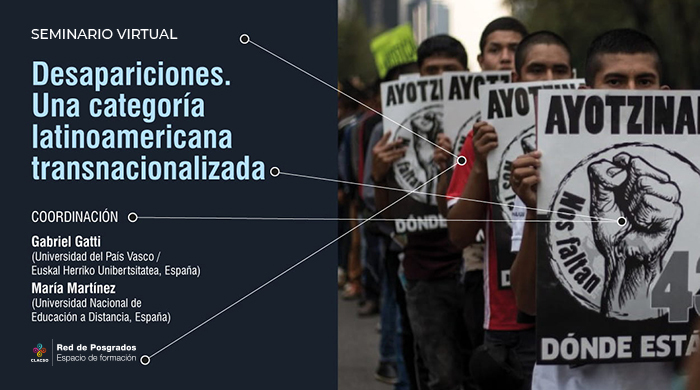
Disappearances. A transnationalized Latin American category
Seminar 2205
Chair: CLACSO
Coordination: Gabriel Gatti (University of the Basque Country / Euskal Herriko Unibertsitatea) and María Martínez (National University of Distance Education, Spain)
Home: 23 / 03 / 2022 | Registration: 15/12/2021 al 22/03/2022
Workload: 12 weeks – 90 hours.
The course reflects on the genealogy, transformation, and analytical possibilities of the category of disappearance. It has been used to describe cases in Argentina, Chile, and Uruguay in the 70s, in Mexico and Colombia today, and, looking further back, in the Spanish Civil War, Nazi Germany in the 40s, Khmer Rouge Cambodia in the 70s, and Bosnia during the war in the 90s. There are hundreds, thousands, millions of cases that are referred to as disappearances and missing persons.
- The disappeared and their transnationalization. A brief introductory genealogy
- The overflow of the legal category "forced disappearance"
- Beyond death and disappearance
- Searches that articulate presences
- The newly disappeared: a living death, bad lives, abandoned lives
- The accounts of the disappearance
- Tales of Disappearance
- Alija, RA (2021). Social disappearance in International Human Rights Law and its relationship with the right to recognition of legal personality. In D. Casado-Neira, G. Gatti, I. Irazuzta, and M. Martínez (Eds.), Social disappearance. Limits and possibilities of a tool to understand lives that do not count (pp. 17-27). Leioa: EhuPress.
- Anstett, E. (2017). Comparison is not reason: on the export of the notions of enforced disappearance and detained-disappeared persons. In G. Gatti (Ed.), Disappearances. Local uses, global circulations (pp. 33-51). Bogotá: Siglo del Hombre-Uniandes.
- Castillejo-Cuéllar, A. (2013). Voices [in the head]: spatiality, confession and the tele-technological mediations of Truth. Papers of the CEIC.
- Dulitzky, A. (2021). Lessons and essays. From enforced disappearance to social disappearance. In D. Casado-Neira, G. Gatti, I. Irazuzta, and M. Martínez (Eds.), Social disappearance. Limits and possibilities of a tool to understand lives that do not count (pp. 29-42). Leioa: EhuPress.
- Edkins, J. (2011). Missing. Person and politics. New York: Cornell University Press
- Fregoso, RL (2017). The living dead of Mexico. In G. Gatti (Ed.), Disappearances. Local uses, global circulations (pp. 119-140). Bogotá: Siglo del Hombre-Uniandes.
- Gatti, G. (2006). The narratives of the detained-disappeared (or the problems of representation in the face of social catastrophes). CONfines of international relations and political science, 2(4), 27-38.
- Gatti, G. (2008). The detained-disappeared. Possible narratives for a catastrophe of identity. Montevideo: Trilce (Introduction and chapter 11).
- Gatti, G. (2017). Prolegomena. Towards a scientific concept of disappearance. In G. Gatti (Ed.), Disappearances. Local uses, global circulations. Bogotá: Siglo del Hombre-Uniandes.
- Gatti, G. (2020). The social disappeared: Genealogy, global circulations, and (possible) uses of a category for the bad life. Public Culture, 32(1), 25-43.
- Heller, Ch., and Pécaud, A. (2019). Counting Migrants' Deaths at the Border: From Civil Society Counterstatistics to (Inter)Governmental Recovery. American Behavioral Scientist, 64(4), 480-500.
- Schindel, E., and Gatti, G. (Eds.) (2020). Social Disappearance. Explorations between Latin America and Eastern Europe. Berlin: Forum Transregionale Studien.
- Tassin, E. (2017). Disappearance in liberal societies. In G. Gatti (ed.), Disappearances. Local uses, global circulations (pp. 99-117). Bogotá: Siglo del Hombre-Uniandes.
- Varela, CI, and González, F. (2015). Trafficking of figures: “Disappeared” and “rescued” in the construction of trafficking as a public problem in Argentina.
|
|
Discount for one payment until 16/03 |
In one payment after 16/03 |
|
CM Plenos |
$75 |
$150 |
|
CM Associates |
$95 |
$190 |
|
No link |
$95 |
$190 |
FAQ

