
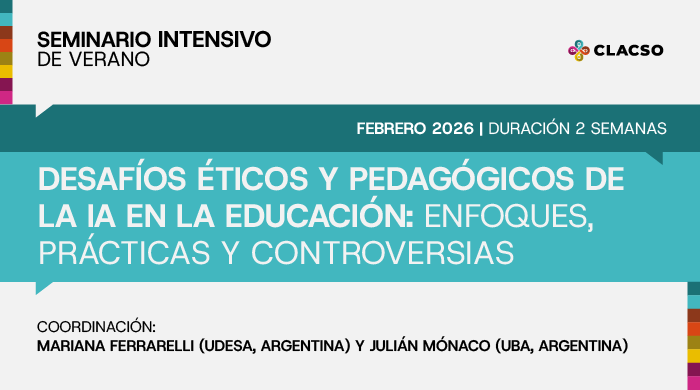
Ethical and pedagogical challenges of AI in education: Approaches, practices and controversies
EXECUTIVE
Mariana Ferrarelli (UdeSA, Argentina) and Julian Monaco (UBA, Argentina)
Home: 23 / 02 / 2026 | Registration: 04/12/2025 al 22/02/2026
Format: Virtual with live classes and exclusive materials
Workload: 90 hours
Duration: 2 weeks
It was especially with the emergence of version 3.5 of ChatGPT (followed by the mass release of other "large language models", such as LaMDA and PaLM) that artificial intelligences took center stage in public discourse, with the certainty that these "metatechnologies" are having a profound impact on the ways in which different countries and societies operate in the areas of politics, economics, work, culture, the arts, health and education.
Within this framework, the overall objective of the seminar ETHICAL AND PEDAGOGICAL CHALLENGES OF AI IN EDUCATION: APPROACHES, PRACTICES, AND CONTROVERSIES is for participants to undertake a deep and intensive immersion in the field of Education+AI . To this end, we will offer training that brings together historical, analytical, and practical elements, enabling them to actively participate in the debates of a complex scenario where challenges are multiplying rapidly and the meaning of our work needs to be redefined.
Throughout the seminar, participants will be invited to critically examine their own practices and assumptions, incorporating a critical perspective that allows them to deconstruct the ways in which technologies generate opportunities, but also constraints. The training program aims to build analytical frameworks that allow participants to recognize the ethical, political, and pedagogical tensions inherent in the integration of AI in education, avoiding both techno-solutionist and apocalyptic views that reduce the complexity of the debate. We believe that this situated perspective is essential to understanding the heterogeneity of realities that characterizes Latin America and the Caribbean, where historical gaps in access, infrastructure, and digital literacy directly impact the appropriation of these technologies.
- Artificial intelligence: history and theoretical-analytical perspective
- Thinking and acting in artificial society: tools for mid-level agents
- Designing bots to support learning
- The contexts of the Education+AI ecosystem
- Creating visual narratives in the age of generative AI
- Human-machine hybridizations in the age of AI
- Alternative uses of AI in education: tensions and perspectives
- Ask / prompt In the age of AI: Is everything the same?
- AI, bodies and places: tensions and biases of AI in education
- Calliope: the AI that accompanies writing without replacing it
The course will be delivered online, combining synchronous and asynchronous sessions. Over the two weeks, a total of ten classes will be taught, eight of which will be live and two will be available as recordings for asynchronous viewing.
Live classes will be held on Mondays and Wednesdays from 2:00 PM to 5:00 PM (MEX/Central America) / 3:00 PM to 6:00 PM (COL/ECU/PERU) / 5:00 PM to 8:00 PM (ARG/URU/BRA/CHI) via the Zoom platform, allowing for direct interaction among participants. In addition, students will have access to exclusive materials, available in the virtual classroom, that will complement the content covered in each session.
|
Early registration (until 19/01) |
General registration (May 6th to May 18st) |
Registration without discount (19/02 to 22/02) |
|
|
Full or Associate Member Center |
$85 |
$100 |
$150 |
|
No link |
$105 |
$120 |
$190 |
Inquiries: [mail protected]

