
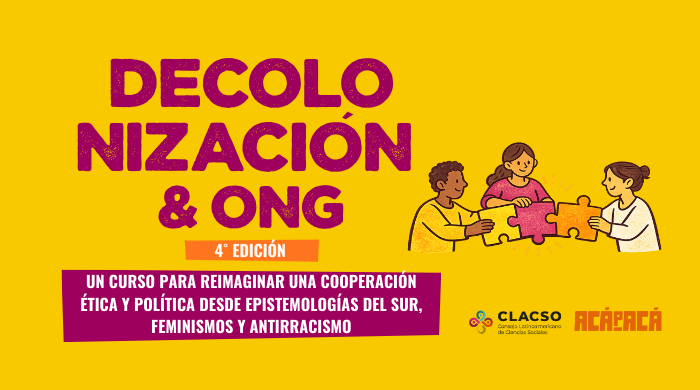
Decolonization and NGOs
COORDINATION: Damaris Ruiz y Claudia Caselli (Here and Here)
TEACHING TEAM: Pablo Vommaro (CLACSO) | Ndir Drum (Association of Sub-Saharan Immigrant Women (ADIS)) | Asier Hernando (Acápacá) | Claudia miranda (Federal University of Rio de Janeiro, Brazil) | Sergio Calundungo (Acápacá) | Adriana Anacona (University of Valle, Colombia) | Ana Silvia Monzón (Flacso Guatemala) | Andrea Villaseñor (Hispanics in Philanthropy) | Marcia Aguiluz Soto (President of the Nicaragua Never Again Human Rights Collective and Director for Latin America at the American Friends Service Committee) | Rafael Henríquez García (Master in Environmental Impact Assessment, Nicaragua) | Damaris Ruiz (We Effect) | Sofia Sprechmann (Pledge for Change) | Carlos Bedoya (Latindadd-Acápacá)
Home: 21/04/2026
Registration: 12/02/2026 al 20/04/2026
Acápacá and CLACSO join forces to offer the fourth edition of the course “Decolonization and NGOs”, a training proposal to address one of the most relevant and urgent debates in current international cooperation.
After three successful editions with over 300 participants, this fourth edition broadens its scope to encompass the entire international cooperation ecosystem. Our goal is to provide an understanding of the origins and fundamental concepts of the debate, along with practical tools to apply in your work. You will have the opportunity to learn from some of the leading thinkers in Latin America and globally, who will be part of the teaching team.
Decolonization is not a new concept. There has been research, debate, and action on this topic from the Global South. This issue has gained renewed visibility following the death of George Floyd and the global impact of the Black Lives Matter movement. The questioning of the Global North has drawn attention to colonial tendencies visible in all spheres, challenging the Eurocentric perspective and demanding a more equitable distribution of knowledge. However, this process cannot rely solely on critical theories from the North. Action needs to be grounded in the voices, ideas, and experiences of the Global South.
Development cooperation is deeply intertwined with colonial history. Its roots lie in the civilizing mission that accompanied colonization and perpetuates a racist logic of Western superiority. This legacy is still reflected in the terms and approaches used in the sector, such as "North-South" or "development cooperation." Therefore, rethinking cooperation from a decolonial perspective is essential for advancing toward true global justice.
Several of the world's leading NGOs and donors, such as Plan International, Care, Open Society, the Ford Foundation, Oxfam, and Doctors Without Borders, are already undertaking this process of change. They are doing so in response to the demands of the organizations they work with. It is a process that cannot be reversed.
Following two events of the Permanent Forum for the Decolonization of Cooperation, held in Lima in December 2024 and in Bogotá in June 2025, this course aims to strengthen the debate and foster concrete changes. Join us in this transformative process that promotes more equitable, feminist, and decolonial cooperation.
It is specially designed for:
- Donors, philanthropic foundations and international cooperation agencies who wish to review their frameworks for action in the face of colonial impositions.
- International NGO teams and transnational networks that accompany social processes and seek to build horizontal and equitable relationships with their partners.
- Allied organizations, consultants and researchers interested in critical, feminist, anti-racist, and decolonial cooperative approaches.
No specific prior experience is required, but a willingness to question conventional modelsListen to social organizations and commit to bolder, more useful and more sustainable forms of cooperation.
The main objective of this course is reimagining international cooperation to be Usefulthat it remains and that accompany with ethical and political awareness.
This training will allow you to learn about the evolution of the international cooperation sector. It will draw on the experience of social movements, academia, and NGOs to provide a broad perspective on how to advance this important agenda.
With a focus critical, feminist, anti-racist and decolonialThis course proposes thinking about and designing viable strategies so that international cooperation does not give up in the face of the current changing and violent context, but rather confronts the transformation with radical solidarity, political imagination and co-responsibility.
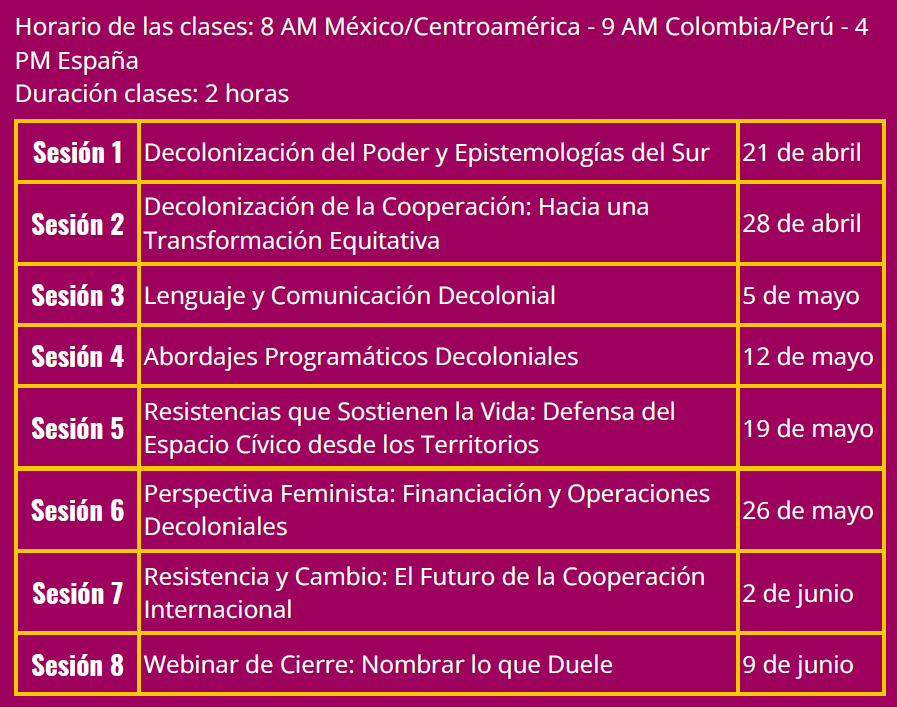
The course will consist of 8 synchronous sessions, combining different formats:
● Short masterclasses
● Peer dialogues
● Spaces for co-creation and debate.
Each session will be facilitated by a different person, selected for their situated experience and its ability to weaving critical analyses with practical tools and real resistance strategies.
In addition to the live events, the following will be promoted asynchronous exchange spaces, with open channels for the collaborative production.
At the beginning we will perform a Political Forum-Debate to situate the aspects we want to delve into in the course from critical readings of diverse countries and perspectives.
Teachers: Claudia Miranda and Adriana Anacona
This opening session introduces and critically frames the course's key themes. Coloniality remains a cross-cutting axis in our social structures, perpetuating inequalities and oppressions. This session delves into the need to recognize and value epistemologies from the Global South, challenging the dominant colonial narratives in international cooperation. Through critical analysis, it reveals how structural racism and the colonial legacy continue to shape the humanitarian system. Drawing on the ideas of Aníbal Quijano and Rita Laura Segato, it analyzes the historical and current impacts of colonial power in Latin America.
Teacher: Sergio Calundundo
This class addresses the importance of decolonizing international cooperation. It explores the concepts of colonialism, coloniality, localization, and decoloniality and their relationship to oppressive dynamics in international cooperation. A transformative approach is proposed to address these issues, aiming to build more equitable and effective relationships in international cooperation practices. Examples of resistance and the recovery of ancestral knowledge are presented, highlighting how these contributions can enrich the work of NGOs toward more just development.
Teachers: Ana Silvia Monzón and Claudia Caselli
Implementing decolonial practices in organizational language and communication is essential for change. This class analyzes the colonial expressions still present in the sector, presenting tools for building more respectful communication and examples that resist oppressive narratives.
Teacher: Andrea Villaseñor
The planning developed in collaboration with partner organizations offers new perspectives and decolonial approaches to international cooperation. This course focuses on how to apply transformative programmatic planning that redefines traditional practices, analyzing the personal, interpersonal, and organizational spheres.
Teachers: Rafael Henríquez García and Marcia Aguiluz
This session critically analyzes the role of cooperation in contexts of shrinking civic space. It addresses the ethical dilemmas faced by NGOs regarding the instrumentalization of aid. The session discusses the minimum commitments to political coherence and support for cooperation that persists within a context of repression. It also explores how to maintain active ties from within resistance movements.
Teachers: Damaris Ruiz
Feminist principles play a fundamental role in the decolonization of NGOs. This session addresses how to integrate feminist perspectives into fundraising and management, challenging traditional power structures. Practical examples are presented of how NGOs can adopt transformative approaches that challenge traditional power and funding structures, fostering systemic change toward more equitable cooperation.
Teachers: Sofía Sprechmann and Carlos Bedoya
In this session, we will address the resistance faced by the transformation processes of international cooperation. Based on internal and external tensions and examples that are already paving the way, we will discuss the conditions that support and hinder systemic change. The session proposes a collective perspective on how to move the system toward a decolonial approach, analyzing initiatives that attempt to build more equitable, just, and inclusive cooperation.
Teachers: Pablo Vommaro, Bombo Ndir and Asier Hernando
This closing session offers a collective space for reflection and reflection on the course's lessons. It proposes an exercise in memory, empathy, and commitment, connecting different territories and struggles. It is a space to consider how to continue providing support without perpetuating violence, sustaining hope and collective action. From diverse perspectives and situated territorial contexts, it will explore global patterns of coloniality and the multiple forms of imposition that permeate international cooperation.
- Pablo Vommaro (CLACSO)
- Ndir Drum (Association of Sub-Saharan Immigrant Women (ADIS))
- Asier Hernando (Acápacá)
- Claudia miranda (Federal University of Rio de Janeiro, Brazil)
- Sergio Calundungo (Acápacá)
- Adriana Anacona (University of Valle, Colombia)
- Ana Silvia Monzón (FLACSO Guatemala)
- Andrea Villaseñor (Hispanics in Philanthropy)
- Marcia Aguiluz Soto (President of the Nicaragua Never Again Human Rights Collective and Director for Latin America at the American Friends Service Committee)
- Rafael Henríquez García (Master in Environmental Impact Assessment, Nicaragua)
- Damaris Ruiz (We Effect)
- Sofia Sprechmann (Pledge for Change)
- Carlos Bedoya (Latindadd-Acápacá)
|
Latin America, Caribbean, Africa or Asia |
$190 |
|
Europe, USA, Canada or Oceania |
$220 |
Download the course brochure here:
Queries: [email protected]

