
Declaration of solidarity with Haiti
From a territory of occupation, rape, death and impunity, to the achievement of dignity, rights, sovereignty and democracy
January 12, 2020, marks the 10th anniversary of the devastating earthquake in the Republic of Haiti. Beyond the staggering number of dead, injured, and orphaned children, as well as the physical and economic destruction, the Haitian people have been further harmed by a series of institutional, political, and geostrategic processes that have exacerbated the already precarious living conditions of the majority of the population. It is clear that the voice and needs of Haitian society have been the least prioritized.

This is a crisis that has accumulated since the various coups d'état promoted by the geopolitics of the Global North, which aborted the first democratic government after the Duvalier tyranny, and worsened when, from June 2004 to October 2017, Haiti became a country under military occupation by the Multinational Provisional Force (MPF) and MINUSTAH (United Nations Stabilization Mission in Haiti).
This supposed stabilization mission, approved by the UN Security Council under the premise that “Haiti poses a risk to international security,” had the stated objective of maintaining peace and public safety in the country within a “safe and stable environment.” Today, it is known that, from its inception, it was implicated in the systematic sexual abuse of children and women. Recently, a new investigation reaffirmed information about the scandalous conduct of the foreign military forces more popularly known as “blue helmets.”
Many women, teenagers and girls who lived near the United Nations bases were victims of the web of hierarchical power relations and the consequent territorial control held by the "peacekeeping" military, which also implied, in practice, control over the bodies of women and girls in those territories, which became zones of occupation and rape.
Due to the "immunity" agreement for troops in humanitarian operations, they had complete freedom to withdraw from the country without repercussions or criminal liability towards the abused and pregnant woman or girl, leaving behind a cycle of children born without resources, support, or any parental responsibility. These children are now known as petit MINUSTAH , bébés casques bleus , or les enfants abandonnés par la MINUSTAH , names that carry a burden of discrimination.
According to the investigation, most of the soldiers involved in this practice of impregnating Haitian women and girls and abandoning them were Brazilian and Uruguayan. Sri Lankan troops had already been reported during the earthquake. Similar practices of abuse and sexual exploitation were also reported last year involving expatriate staff of international NGOs.
A large percentage of the population affected by these sexual control practices were girls at the time of the abusive encounter, leading to multiple negative repercussions based on the exercise of power over their bodies, affecting their mental and physical health, family relationships, the possibility of continuing with formal education, among others.
The profound power imbalances that arise with the presence of expatriate personnel (whether military or civilian) have led to the exploitation of material and financial insecurity, driving women and girls to engage in survival sex in the hope of escaping poverty or obtaining some form of material compensation. In the long run, they only found a deepening of their personal, familial, and community vulnerability.
But the multi-billion dollar MINUSTAH operation (with a budget of over $300 million annually) and its consequences don't end there. This peacekeeping operation was also directly implicated in the importation of the Vibrio cholerae strain from Nepal to Haiti, triggering the worst cholera epidemic in the country's history and the largest in recent times worldwide.
The cholera epidemic, exacerbated by precarious access to water and safe sanitation and the country's fragile health system, led to the deaths of more than 9.000 Haitians, according to official figures; prestigious experts maintain that the actual death toll is over 50. Furthermore, it is estimated that there were between 800 and over 1 million cases of cholera, not counting the psychological, economic, and social consequences of the epidemic. In the Dominican Republic, the death toll exceeded 450.
UN officials directly participated in concealing the origin of the outbreak, as well as its initial impact and lethality; they were key players in its spread and subsequently in the cover-up and impunity of those responsible. They also participated in designing a multitude of response plans that only served to perpetuate a “humanitarian aid” industry for the bureaucracies of agencies, expatriates, and NGOs (Non-Governmental Organizations of the Global North), which failed to resolve the catastrophe and only resulted in the weakening of Haiti's health sovereignty, leaving the Haitian public health system as weak as it was at the beginning of the epidemiological crisis.
All these actions, under the guise of Peacekeeping Operations, have enjoyed absolute impunity in terms of legal sanction and reparation, beyond mere declarations of moral repentance.
What happened in Haiti has laid bare the impunity as an effective consequence of the “immunity” and the authoritarian and colonial character with which the Security Council and UN Peace Operations act, beyond ethics, beyond all limits of Law and their own legality.
Added to this is the Eurocentrism and coloniality of an international system of “development” cooperation that has only reinforced the presence of NGOs from the Global North and transnational aid organizations. The international community has demonstrated its failure under the prevailing rules.
Adding to these dramatic situations is the geopolitical role of the well-known Core Group (the Central Coordination Group in Haiti, composed of Argentina, Brazil, Canada, Chile, Spain, the United States, France, the United Nations, the Organization of American States –OAS–, and the European Union), including the representative of the UN Secretary-General and head of MINUSTAH, Edmund Mulet, as well as Special Envoy Bill Clinton. Not only were they unable to deliver the promised post-earthquake reconstruction, but it also became an industry and a mechanism of interference, diverting resources needed to assist the Haitian people, disrupting the Haitian political transition, and imposing decisions that have alienated citizens from their political sovereignty.
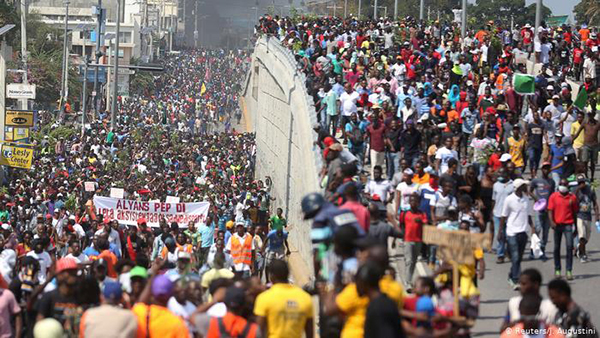
This complex reality and interconnected crises also implicate a part of the Haitian political class, whose complicity is unavoidable in the increase of impunity, false promises of reconstruction, democratic and institutional weakness, the loss of sovereignty in the face of the geopolitics of the Global North and its organizations, as well as corruption, reaching public shock with the Petrocaribe funds scandal, leading to sustained social and popular mobilizations in Haiti.
The Centers and Working Groups that have signed this declaration are committed to the cessation of violations of Haiti's sovereignty; to the genuine commitment that the refounding and reconstruction of Haiti must be undertaken from within Haiti, with the leading participation of its national and popular actors, exercising self-determination and without external interference; to the transformation of the living conditions of the vast majority and their dignified enjoyment of fundamental rights; to reparations and justice for crimes against humanity and abuses against its population; to permanent Latin American and Caribbean solidarity with the country; and to the full functioning of its democracy, its public institutions, and the public's trust in its democratically elected representatives and leaders. For a Haiti that once again becomes a continental example, as it was in 1804, of emancipation, independence, and the struggle for a dignified life free from colonial tutelage.
Member Centers in the Dominican Republic
Latin American Faculty of Social Sciences – FLACSO RD
Alternative City
Juan Bosch Foundation
Multi-thematic School
CLACSO Working Groups
Crisis, responses and alternatives in the Greater Caribbean
International Health and Health Sovereignty
From Haitian organizations
Center for Economic and Social Research and Training for Development (CRESFED)
Association Latino-américaine de Médecine Sociale (ALAMES Haiti)
DECLARATION OF SOLIDARITÉ AVEC HAÏTI
DU TERRITOIRE D'OCCUPATION, DE VIOLATION, DE MORT ET D'IMPUNITÉ, À LA POURSUITE DE LA DIGNITÉ, DES DROITS, DE LA SOUVERAINETÉ ET DE LA DÉMOCRATIE
On January 12, 2020, I marked the 10th anniversary of the earthquake that devastated the Haitian Republic. Outre le nombre de morts, de blessés, d'enfants orphelins, la destruction physique et économique, le peuple haïtien a été lésé par un ensemble de processus institutions, politiques et géostratégiques qui ont aggravé les conditions de vie précaires de la majorité de la population. Il est clair que la voix et les kisses de la société haïtienne ont été les moins prioritaires.
Il s'agit d'une crisis accumulated from the different coups d'État encouragés par la géopolitique du Nord global qui avorter le premier démocratique gouvernement après la tyrannie des Duvalier, et s'est aggravée lorsque, de juin 2004 à octobre 2017, Haïti is now a country occupied by the army under the operations of the Force Multinationale Provisoire (FMP) and the MINUSTAH (United Nations Mission for Stabilization in Haïti).
This mission intended for stabilization voted by the Council of Security of the United Nations is the slogan "Haïti is a risk for international security", available for the purpose of maintaining peace and public security in the country in a "stable and secure environment". Aujourd'hui, on said comment, after sa création, elle a été impliquée dans des abus sexual systématiques sur des mineurs et des femmes. Récemment, une nouvelle recherche a reconfirmé des informations concernant le behavior scandaleux des military forces étrangères plus communément appelées « casques bleus ».
Beaucoup de femmes, d'adolescentes et de chiles qui vivaient à proximité des bases militaires des Nations Unies ont été victims du réseau de relations hiérarchiques de pouvoir et du contrôle territorial qui en résulte détenu par les militaires «pacificateurs», ce qui implicalique également, dans la pratique, un contrôle Sur le corps des femmes et des filles de ces territoires, transformés en zones d'occupation et de viol.
En raison de l'accord « d'immunité » des troupes dans les opérations humanitarians, elles avaient toute liberté de quitter le pays sans répercussions ni responsabilité pénale contre la femme ou la childe maltraitée et tombée enceinte, laissant une spirale d'enfants nés sans ressources, sans soutien et aucune parental responsibility. These creatures are born under the names of « petit MINUSTAH », « bébés casques bleus » or « children laisses par la MINUSTAH », noms qui à leur tour imply a fardeau de discrimination.
Selon l'enquête, dans this pratique les femmes et filles tombaient enceintes et ensuite elles étaient abandonnées; la majorité des militaires pointées étaient des Brésiliens et des Uruguayens. Lors du tremblement de terre, les troupes du Sri Lanka avaient déjà été dénoncées. Des pratiques similaires d'abus et d'exploitation sexuels ont également été signalsées l'année dernière impliquant du personnel expatrié d'ONG internationales.
Un grand pourcentage de la population touchedée par ces pratiques de contrôle sexuel était des children au moment de la rencontre abusive, cédant la place à de multiples répercussions négatives selon l'exercice du pouvoir sur leur corps, affecting leur santé mentale et physique, les relations familiales, la possibilité de poursuivre l'enseignement formel, entre autres.
The deep relations of asymmetric pouvoir that exist with the presence of expatriate personnel (military or civil) are identified as profiters of the insécurité matérielle and financier that lead women and girls to the possibility of sexual relations in the hope of sorting out poverty or obtaining compensation. materielle. In the long term, they do not find that the approval of personnel, family and community protection.
More than the milliardary operation of MINUSTHA (with a budget of more than 300 million dollars per year) and its results do not stop there. Cette opération de maintien de la paix a également été directement impliquée dans l'importation de la souche Vibrio cholerae du Népal en Haïti, déclenchant la pire épidémie de choléra de l'histoire du pays et la plus important de ces dernières années dans le monde.
La maladie du choléra, aggravée par les conditions précaires d'accès à l'eau potable et à l'assainissement et le système de santé fragile du countries, a provoqué la mort de plus de 9 000 haïtiens et haïtiennes, selon des chiffres officiels. Selon des experts prestigieux, le nombre de morts serait supérieur à 50 000. De même, entre 800 000 et plus d'un million de cas de choléra sont estimés, sans compter les conséquences psychologiques, économiques et socials de l'épidémie. In the Dominican Republic, the décès ont dépassé 450.
Les chefs institutionnels de l'ONU ont participated directly à la dissimulation de l'origine de l'épidémie, de son impact et de sa létalité initiale; Ils ont été des acteurs déterminants dans la propagation, la dissimulation et l'impunité des responsibles. Ils ont également I participated in the conception of a multiplicity of response plans with a tendency to reproduce an industry of « l'aide humanitarian » for the bureaucracies of organisms, expatriates and NGOs (NGO du Nord global), which is not the only way to resolve the catastrophe and to enter into the Affaiblissement. de la souveraineté sanitaire d'Haïti, laissant le système de santé public haïtien also faible qu'au début de la crise épidémiologique.
All these actions, sous le couvert des operations de maintien de la paix, jouissent d'une impunité absolue en termes de sanction et de réparation légales, au-delà des simples déclarations de regret.
Ce qui s'est passé en Haïti laisse à nu l'impunité comme une conséquence efficace de « l'immunité » et le caractère authoritaire et colonial avec lequel le Conseil de sécurité des Nations Unies et les opérations de paix agissent, au-delà de l'éthique, au-delà de toute limite du droit et sa propre légalité.
À cela s'ajoute l'eurocentrisme et le colonialisme d'un système international de coopération « au développement » qui ne fait que renforcer la présence des ONG du Nord et des coopérants transnationaux. La communauté internationale a démontré son échec en vertu de la logique et des règles en vigueur.
In these dramatic situations, s'ajoute le rôle géopolitique du célèbre Core Group (Groupe de coordination centrale en Haïti composed of Argentine, du Brésil, du Canada, du Chili, d'Espagne, des États-Unis, de la France, des Nations Unies, de l'Organisation des États américains et de l'Union Européen), The representative of the Secretary General of the United Nations and chef of MINUSTAH, Edmund Mulet, as well as Bill Clinton, Envoyé Spécial. Ceux-ci non seulement ont été incapables de faire de la reconstruction promise après le tremblement de terre une réalité, mais ils ont contribué à this vaste industry et mécanisme d'interférence, détournant les ressources nécessaires pour serve le peuple haïtien, disturbing la transition politique haïtienne et imposant des decisions that ont alienate the citadyenneté of sa souveraineté politique.
This complex réalité et crise concatenée, implicate également une partie de la classe politique haïtienne, dont la compplicité est inévitable pour que l'impunité, les fausses promises de reconstruction, la faiblesse démocratique et institutionnelle, la perte de souveraineté face à la géopolitique du Nord global et ses organismes, ainsi que la Corruption, ont increased, atteignant l'agitation publicavec le scandale des funds de Petrocaribe, conduisant à des mobilizations social et populaires soutenues en Haïti.
Nous, les Centers et Groupes de Travail qui souscrivons à this declaration pour mettre fin à la violation de la souveraineté d'Haïti, nous souscrivons à l'engagement authenticate que la refondation et la reconstruction d'Haïti doivent origine d'Haïti, avec la principale participation de ses acteurs nationaux et popular people with self-determination and without external influence; à la transformation des conditions de vie de la grande majorité et de sa dignité dans la jouissance des droits fondamentaux; à la réparation et à la justice face aux crimes contre l'humanité et aux abuses contre sa population; to the permanent solidarity of Latin America and the Caraïbes with the countries; ainsi que le plein fonctionnement de sa démocratie, de ses public institutions et de la confiance des citayens en ses représentants et leaders démocratiquement elus. Pour un Haïti qui redevient un exemple continental, comme en 1804, d'émancipation, d'indépendance et de lutte pour une vie digne sans tutelle coloniale.
Centers Members of the Dominican Republic
Latin American Faculty of Social Sciences – FLACSO RD
Alternative City
Juan Bosch Foundation
Multi-thematic School
CLACSO Working Groups
Crises, responses and alternatives in Grand Caraïbes
Santé internationale et souveraineté sanitaire
Haitian Organizations
Center for Economic and Social Research and Training for Development (CRESFED)
Association Latino-américaine de Médecine Sociale (ALAMES Haiti)
If you would like to receive more information about CLACSO's training programs:
[widget id=”custom_html-57″]
to our email lists.
DECLARATION OF SOLIDARITY WITH HAITI
FROM A LAND OF OCCUPATION, RAPE, DEATH AND IMPUNITY, TO THE ACHIEVEMENT OF DIGNITY, RIGHTS, SOVEREIGNTY AND DEMOCRACY
January 12, 2020 marks the 10th anniversary of the devastating earthquake in the Republic of Haiti. In addition to the enormous number of deaths, injuries, orphaned children, physical and economic destruction, the people of Haiti have been harmed by a set of institutional, political and geostrategic processes that have exacerbated the precarious living conditions of the majority of the population. It is evident that the voice and needs of Haitian society is not a priority.
This is a crisis that widened as a result of the various coups d'état promoted by the geopolitical application of the global North's foreign policy and that prematurely terminated the first democratic government after the Duvalier tyranny; and it was aggravated when, from June 2004 to October 2017, Haiti became a militarily occupied country under the operations of the Multinational Interim Force (MIF) and MINUSTAH (United Nations Stabilization Mission in Haiti).
This so-called stabilization mission voted by the UN Security Council under the motto that “Haiti is a risk to international security”, had the declared objective of maintaining peace and public security in the country in a “secure and stable environment”. Today we know how, from the beginning, it was involved in the systematic sexual abuse of women and children. Recently, a new investigation reconfirmed data on the outrageous conduct of foreign military forces more popularly known as "blue helmets."
Many women, adolescents and girls who lived in the vicinity of the United Nations bases were victims of the network of hierarchical power relations and the consequent territorial control held by the "pacifying" military, which also implied, in practice, control over the bodies of women and girls in these territories, which had become zones of occupation and rape.
Due to the agreement of "immunity" for troops in humanitarian operations, they were free to leave the country without repercussions or criminal responsibility for the abused and pregnant woman or girl, leaving a spiral of children born without resources, support or parental responsibility. These children are already known as petit MINUSTAH , bébés casques bleus or les enfants abandonednés par la MINUSTAH , names which in turn imply a burden of discrimination.
According to the investigation, in this practice of impregnating Haitian women and girls and leaving them abandoned, the majority of the military involved were Brazilians and Uruguayans. During the earthquake, Sri Lankan troops had already been reported. Similar practices of sexual abuse and exploitation were also reported last year on expatriate staff of international NGOs.
A large percentage of the population affected by these sexual control practices were underaged girls at the time of the abusive encounter, giving way to multiple negative repercussions depending on the exercise of power over their bodies, affecting their mental and physical health, family relationships, the possibility of continuing with formal education, among others.
The profound asymmetrical power relations that exist with the presence of expatriate personnel (whether military or civilian) have become a means of exploiting the material and financial insecurity that led women and girls to have survival sex in the hope of escaping poverty or obtaining some material compensation. In the long term they only found the deepening of their personal, family and community precariousness.
But the multi-million-dollar MINUSTHA operation (with a budget of over $300 million a year) and its results do not end there. This Peacekeeping Operation was also directly involved in the importation of the Vibrio cholerae strain from Nepal into Haiti, triggering the worst cholera epidemic in the country's history and the largest in recent times on a global scale.
The cholera disease, fueled by poor access to safe water and sanitation and the country's fragile health system, led to the deaths of more than 9,000 Haitians, according to official figures. According to prestigious experts, the current deaths would be over 50,000. It is also estimated that between 800,000 and more than 1 million cases of cholera have been reported, not counting the psychological, economic and social consequences of the epidemic. In the Dominican Republic, deaths exceeded 450.
The UN institutional leaders were directly involved in concealing the origin of the outbreak as well as its initial impact and lethality; they were key players in its spread and then in the cover-up and impunity of those responsible. They also participated in the design of a multiplicity of response plans that only tended to reproduce a «humanitarian aid» industry for agency bureaucracies, expatriates and NGOs (Non-Governmental Organizations of the Global North), which did not resolve the catastrophe and only resulted in the weakening of Haiti's health sovereignty, leaving the Haitian public health system as weak as it was at the beginning of the epidemiological crisis.
All these actions, under the mantle of the Peacekeeping Operations, have enjoyed absolute impunity in terms of legal sanction and reparation, beyond simple declarations of moral repentance.
What has happened in Haiti has laid bare impunity as an effective consequence of the "immunity" and the authoritarian and colonial character with which the Security Council and the UN Peace Operations act, beyond ethics, beyond all limits of law and its own legality.
Added to this is the Eurocentrism and coloniality of an international system of «development» cooperation that only strengthened the presence of Northern NGOs and transnational aid workers. The international community has demonstrated its failure under the prevailing logic and rules.
In addition to these dramatic situations, there is the geopolitical role of the well-known Core Group (Central Coordination Group in Haiti composed of Argentina, Brazil, Canada, Chile, Spain, the United States, France, the United Nations, the Organization of American States and the European Union), including the representative of the UN Secretary General and head of MINUSTAH, Edmund Mulet, as well as Bill Clinton, Special Envoy. Not only were they unable to make the promised post-earthquake reconstruction a reality, but it became an industry and a mechanism for interference, diverting the resources needed to serve the Haitian people, disrupting the Haitian political transition and imposing decisions that have alienated the citizenry from its political sovereignty.
This complex reality and concatenated crisis also involves a part of the Haitian political class, whose complicity is unavoidable so that impunity, false promises of reconstruction, democracy and institutional weakness, loss of sovereignty in the face of the geopolitics of the global North and its agencies, as well as corruption, have increased, reaching public shock with the Petrocaribe funds scandal, leading to sustained social and popular mobilizations in Haiti.
The Centers and Working Groups that endorse this declaration advocate for the cessation of the violation of Haiti's sovereignty; for the authentic commitment that the refoundation and reconstruction of Haiti must be from Haiti, with the protagonist participation of its citizens and peoples, with self-determination and without external interference; for the transformation of the living conditions of the great majorities and their dignity in the enjoyment of fundamental rights; for the reparation and justice for crimes against humanity and abuses against its population; for permanent Latin American and Caribbean solidarity with the country; and for the full functioning of its democracy, its public institutions and the public's confidence in its democratically elected representatives and leaders. For a Haiti that is once again a continental example, as in 1804, of emancipation, independence and the struggle for a dignified life without colonial tutelage.
Member Centers in the Dominican Republic
Latin American Faculty of Social Sciences – FLACSO RD
Alternative City
Juan Bosch Foundation
Multi-thematic School
CLACSO Working Groups
Crisis, responses and alternatives in the Greater Caribbean
International health and health sovereignty
From Haitian organizations
Center for Economic and Social Research and Training for Development (CRESFED)
Latin American Association of Social Medicine (ALAMES Haiti)

