
“We must work for knowledge as a public good and a human right”
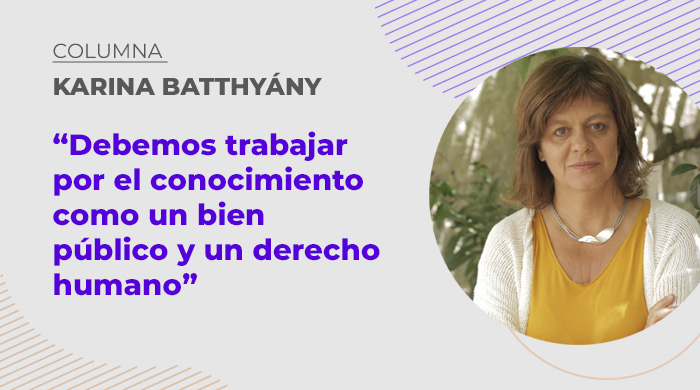
Transcript of Karina Batthyány's column
in InfoCLACSO – October 25
On October 22nd, a very important meeting took place in Chiapas, Mexico, specifically in Palenque. It was attended by a dozen presidents and foreign ministers from Latin America and the Caribbean to discuss migration and migration flows to the United States.
The meeting, chaired by Mexican President Andrés Manuel López Obrador, was titled “For a Fraternal Neighborhood with Well-being.” It was attended by the heads of state of Colombia, Cuba, Haiti, Honduras, and Venezuela. Also present were the vice president of El Salvador and the deputy prime minister of Belize, as well as ministers from Costa Rica, Ecuador, Guatemala, and Panama. The United States, however, was not represented.
This summit of Latin American presidents and foreign ministers concluded with a declaration rejecting coercive measures against migration, reaffirming the commitment to respect the human right to migrate, and calling for more legal alternatives for migration. I want to highlight this declaration because it reflects the approach we at CLACSO have always taken regarding migration and human mobility: understanding it as a human right.
The declaration stated: “We agree to urge countries of origin, transit, and destination to implement comprehensive migration policies that respect the human right to migrate, safeguarding the life and dignity of migrants and their families, including the promotion of permanent regularization options.” This document was read by the current Mexican Foreign Minister, Alicia Bárcena, who also participated in our last CLACSO Conference in Mexico in 2022.
– You're still in Mexico, can you tell us a bit about how this Global Summit on Open Access is progressing? We know it's very important within the framework of one of CLACSO's core policies, along with other participating institutions. What is it about, and what progress has been made in today's meetings?
To put it in language that everyone can understand, the Diamond Open Access Summit, which has been taking place in Toluca, Mexico since Monday, is the summit on non-commercial open access. CLACSO organized it along with several other institutions, including Redalyc and AmeliCA.
This summit brings together representatives from countries in the Global South—Latin America, of course, but also Africa and India—along with countries in the Global North. There are individuals working at the institutional level on this issue, which aims to defend three key elements: the concept of open science, knowledge as a public good, and unrestricted access to the results of that knowledge or open science.
We begin with the understanding that knowledge and science must be able to circulate widely, have social impacts, and improve the living conditions of everyone. In the case of Latin America and the Caribbean, I want to emphasize that it is a region where research and scientific communication, or the results of that research, are funded with public funds; that is, they are carried out primarily in public universities or institutions funded by public funds. Therefore, this idea of science as a common good, and also as part of the right recognized and proclaimed by UNESCO—the human right to science—is very much present.
I want to emphasize that the funding of this knowledge is public, as one of the main arguments for why the results of this knowledge should not be commercialized or become a commodity subject to trade, but rather should circulate openly without any restrictions. For this reason, CLACSO has been committed to the open access policy for over 20 years and practices it directly through its repositories, its bookstore, and its virtual library, which contain a vast catalog of CLACSO's own publications. But it also makes available, without any barriers, the publications of its Member Centers and other Centers.
Furthermore, I want to mention that in this region, where knowledge is primarily funded by public funds, we have a significant number of journals. In Latin America and the Caribbean, more than 500 open access scientific journals are published to disseminate this knowledge. This open access is promoted and supported by CLACSO and Redalyc, which, through its generation of indicators, catalogs, and other resources, makes it a reality.
That's why we are strongly advocating for what in Mexico is called Diamond Open Access, or as we call it, Non-Commercial Open Access, to become a global policy. This discussion is fraught with tension due to differing perspectives across geographical regions. Furthermore, while many institutions in the Global North support these policies, we must also remember that this is where the major commercial industries operate, working with knowledge not as a public good, but as a commodity, charging for publication, reading, or dissemination in their journals.
These journals also gain international recognition, creating a kind of virtuous cycle. Through indexing and their prestige within the academic community, they become the go-to places for researchers. Often, publishing there is practically mandatory if we want to be ranked correctly in our countries' scientific indexes.
This also relates to the discussion we have been promoting since 2019 at CLACSO with great force and with much recognition at the regional level. A few weeks ago, for example, we were discussing in Lima the principles of scientific evaluation for the Social Sciences in Latin America and the Caribbean.
– As I listened to you, I was thinking about how powerful this discourse on open access to science is, especially at a time when many countries are once again facing a very strong attack against scientific communities, and the social sciences in particular, and when some sectors are talking about reducing funding for scientific research. I think about it in two ways: on the one hand, open access, but on the other, how often do we hear the idea that only the private sector is involved in scientific advances? How important it is to see the data you're presenting, showing that most scientific production is funded with public money that ultimately generates scientific knowledge…
– Absolutely. That's the reality in our countries in terms of scientific research. Most of it is funded by public funds and associated with universities. In Mexico, we're discussing this issue. CLACSO has made very clear contributions in this regard through the entire team participating, which includes Pablo Vommaro, Laura Rovelli, and Fernanda Pampín. I also want to highlight the virtual participation of Dominique Babini, a pioneer in these areas for CLACSO and an international authority on the subject.
Several thematic areas are being discussed that relate to this idea of knowledge as a public good and its implementation through non-commercial open access policies in publishing infrastructures and systems. In other words, how, where, when, and under what conditions, particularly for the Global North and South, these infrastructures and publishing systems are implemented.
This is also linked to multilingualism. Today, the imposed and predominant language in the field of science is English. In this sense, at CLACSO we are working towards multilingualism. One challenge is what infrastructure and publishing systems we have in the countries of Latin America and the Caribbean. Another challenge is the development of policies and funding to strengthen this non-commercial model of knowledge dissemination and effectively transform knowledge into a public good. And the next challenge is how to cooperate internationally in contexts that we know are unequal, while ensuring that this cooperation takes place under conditions of equality. This means, at least in terms of participation and representation, ensuring that all voices, both from the Global South and the Global North, are heard on these issues.
We also have an almost urgent need to move forward with implementing changes to scientific evaluation systems. We have a vicious cycle between knowledge production and the channels through which it is disseminated. As long as the idea persists in our countries' evaluation systems that we must publish in the highest-ranked, best-positioned journals—which are usually commercial and in English—we will not be able to advance open access policies.
The discussion is incredibly interesting and intense. We will continue working and supporting the deep conviction we at CLACSO hold regarding knowledge as a human right, science as a human right, knowledge as a public good, and open access without any restrictions and absolutely non-commercial, as the necessary tool and approach for all of this.
If you would like to receive more information about CLACSO's training programs:
[widget id=”custom_html-57″]
to our email lists.

