
We must work from memory to build the present
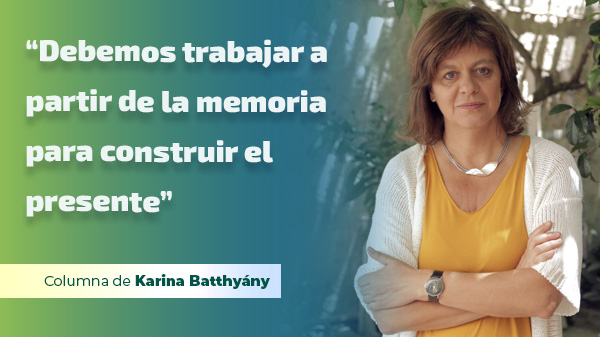
Transcript of Karina Batthyány's column
in InfoCLACSO – September 13, 2023
Today, we find ourselves in a Chile that is working on commemoration in two ways: it remembers the 50th anniversary of the coup, but above all, it revisits the experience of Salvador Allende's thousand days in the Popular Unity government. Fifty years later, it is also asking itself what the challenges are for Chilean society, which was so marked by that neoliberal project that began precisely after the coup.
The coup in Chile was carried out to implement the neoliberal model. Chile became the model for implementing the brutal policies proposed by neoliberalism, which run counter to the concepts of equality, social justice, and well-being for all. Today, we can also analyze, in perspective, how to strengthen democratic processes so that the slogans of Truth, Justice, and Never Again (which we have repeated in the CLACSO 40-50-50 cycle) truly become a reality.
Within the context of Allende's thousand days and the current rise of the new right wing, a central proposal for work on memory has become increasingly relevant. I want to highlight all the work we have been doing in 2023 at CLACSO, related to the 40-50-50 initiative: 40 years of democracy in Argentina, 50 years since the coup in Uruguay, and 50 years since the coup in Chile.
We must work with this memory so that what happened is truly remembered, understood, and so that we don't give rise to the discourses we are seeing emerge in many Latin American and Caribbean countries that seem to glorify what happened during the coup. These are discourses that deny Operation Condor and the massive plan to annihilate popular movements and governments that sought to advance social justice, equality, and well-being for all.
Today, that is the debate. We must work from memory as a way to build the present, so that the slogan "Never Again" truly takes shape. In addition to remembering the tragic events of 50 years ago so that they are never repeated, it is important to recover the experience of those thousand days of Allende's government—that is, the measures taken by a government that offered a different vision of the possibility of development in Chile.
This must be analyzed within the current historical context, the moment we are living through. Currently, right-wing discourses are emerging that not only seek to deny what has happened, but also to continue establishing neoliberal models, where the market occupies the central place and the various measures aimed at the development and well-being of the people who live in these territories are relegated to a secondary position.
Let's revisit the analysis of Allende's thousand days and bring it to the present day. Clearly, some things have changed, such as the issues arising from feminist movements in Chile and the region, which were not present 50 years ago.
Let's take those experiences, place them in the present context, enrich them with content, and consider future alternatives. It's quite clear that these alternatives won't be driven by market logic, but rather by putting people and life at the center.
States play a fundamental role in guaranteeing the well-being of every individual. They must also guarantee democracy in a broad sense, extending beyond political democracy to encompass its social, cultural, and economic dimensions. This is the challenge facing Chile and other countries in our region today: to work with a historical perspective on current challenges. That is why CLACSO is promoting the Platform for Social Dialogue on Democracy, Memory, and Human Rights.
In 2023, in Argentina, Uruguay, and Chile, we are commemorating and working to remember what happened, demonstrating that Operation Condor was a coordinated effort to suppress the popular movements taking place in all our countries and replace them with the neoliberal model. Operation Condor was implemented in the region with external support, both from the northern part of Latin America and from governments outside the region.
If you would like to receive more information about CLACSO's training programs:
[widget id=”custom_html-57″]
to our email lists.

