
“We must guarantee respect for the human rights of migrants.”
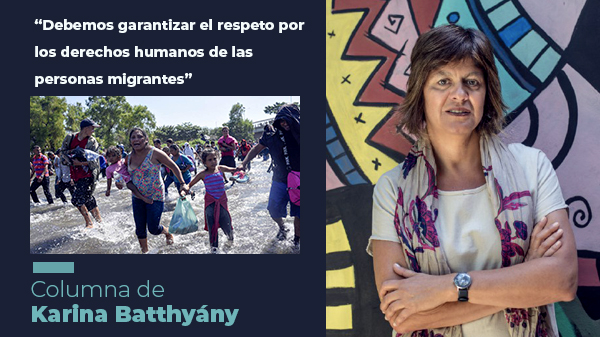
(Transcription of Karina Batthyány's Column)
in InfoCLACSO – 28 October 2020)
To the Ninth CLACSO Conference 2021
Last Thursday and Friday, we held our Steering Committee meeting virtually. This meeting, which takes place twice a year, brings together all the representatives elected by the CLACSO Assembly from the eight regions that currently comprise it. It's an important moment because, firstly, it's a time to present what has been accomplished in the last six months, to receive feedback and comments, but also—perhaps most importantly—to plan for the next steps: the work plans for 2021 in this case. 2021 is a very particular year because it is marked (towards the end of the year) by our assemblies, which are held every three years at CLACSO, and by the Regional Conference on Social Sciences (the Ninth in this case). So, we worked on planning for all of 2021 and how to organize both the assembly and the conference. This conference is also a premier forum for the Social Sciences and Humanities at the Latin American and Caribbean level, but also globally, because we always have the participation of other regions. We will most likely meet again in March or April of 2021. And it's always very interesting to exchange information about what's happening in the social sciences and, ultimately, in life in each of these CLACSO countries and regions. We can now announce what the Steering Committee has decided: the Ninth CLACSO Conference 2021 will indeed take place in Mexico City, at the UNAM (National Autonomous University of Mexico), one of the largest public universities in our region, between November 7 and 11 of next year. Of course, everyone is invited, both to attend in person—we hope this health situation improves and that will be possible—and to participate in the programs that are always broadcast on CLACSO.tv, CLACSO Radio, and the various channels that CLACSO uses to disseminate its activities.
Regional situation: Chile and the plebiscite for a New Constitution
Just as last week we highlighted the importance of what happened in Bolivia, it is now fitting to emphasize the importance and significance for the entire region of what happened in Chile last weekend, where practically 80% of those who voted opted for a New Constitution. A New Constitution doesn't mean just anything in this case, but rather finally dismantling the Pinochet-era Constitution, the Pinochet Constitution, and the Constitution that, in many of its articles and components, enshrined the neoliberal measures that have governed Chile so extensively in recent years and that undoubtedly stemmed from the protests and social mobilizations of a year ago. This plebiscite is, in part, I believe, a response to those social mobilizations, and now, of course, a path of work and discussion opens up, but with the second decision made by the Chilean people last Sunday: to create a constituent assembly that allows for the direct election of those who will draft this Constitution. What happened in Chile is significant. This is significant when we also consider what we experienced in Bolivia a week ago. Perhaps we are beginning to see some glimmers of hope on this path for Latin America and the Caribbean in these very complex situations we are facing.
Today I've touched on various current events, but I don't want to neglect the topics you usually cover in this column. Where did you plan to go with this mapping we're doing?
Indeed, as we have been doing for some weeks now, trying to identify some of the key areas that CLACSO wants to promote in order to organize spaces for reflection, exchange, and building new consensus in the search for alternatives within the framework of the crisis we are currently experiencing in our region, it seemed appropriate to also consider the alternatives or opportunities that this crisis (Covid-21) presents for rethinking migration and human mobility. As we discussed a few weeks ago, we know, of course, that before the pandemic we already had a very severe migration crisis in our region. Let's consider, for example, the population movements in the cases of Colombia and Venezuela, which have intensified with the arrival of the pandemic and the health crisis we are experiencing.
Clearly, border closures, the reinforcement of security measures, and the effects of security policies—whether implemented within the health framework or justified in many cases by the health crisis—have an impact on the migrant population that compels us to reflect on the issue of migration and, more generally, on human mobility. And not only to reflect, but also to take concrete measures to protect migrants in this context.
If we consider that in some countries at least the opening of borders seems unfeasible, what we must at least guarantee is universal access to health and respect for the human rights of migrants, and that they can access health coverage (even obviously when they are not in their countries) and also the aid programs that the different governments and countries are making available to the general population in the face of the pandemic situation.
We must be clear that this is particularly important in the case of the millions of people on the move: migrants, refugees, and internally displaced persons, even within their own countries, who were forced to leave their homes for various reasons, often due to violence, environmental and climate disasters, or political and social situations. We must also remember what we said a few weeks ago: these people generally find themselves in more precarious situations and are particularly affected by the socioeconomic crisis because many of them work in sectors of the economy in our countries (the informal sector, as we commonly call it) that lack access to any kind of social protection. Furthermore, this is exacerbated by the protection crisis caused by the border restrictions being implemented in many countries globally, not just in Latin America and the Caribbean. The latest United Nations data says that 150 countries have installed these types of border restrictions to contain the spread of the virus, and that at least 99 countries make no exceptions in the case of people seeking asylum for reasons such as political persecution.
Let us also remember how the pandemic, Covid-19, the Coronavirus (which we mentioned in another column), has exacerbated xenophobia, racism, and stigmatization of the migrant population. And we must not forget the particular case of women and girls (which we discussed in our Migration column), where their already precarious situation is made even worse by the increased risk of violence, abuse, and exploitation based on gender.
So, what are we talking about? We're talking about an opportunity to rethink human mobility, upholding human dignity in the face of the pandemic, defending the human rights of everyone. And perhaps learning from a few countries that have shown how it's possible to have some control over movement during this pandemic, while fully respecting the human rights of all people, and particularly those of refugees.
In terms of socioeconomic measures, we reiterate the need for this migrant population to be able to access the benefits that different states are providing within the framework of the health crisis, and also to have access to the policies or benefits that may be provided by some international organizations in this regard.
It is therefore important that we rethink the phenomenon of migration in the long term. Rethinking migration means abandoning the stigmatization of migrants and focusing on the real causes of migration—the economic, political, and social causes—that compel many to migrate in search of better living conditions. It also implies the future recognition of migration and mobility as a fundamental human right. For this, it is necessary to have all the necessary planning and cooperation measures in place among different countries to respect this human right to mobility. The challenge that remains is to guarantee that migration occurs within the framework of respect for human rights, in a just and mutually beneficial way, and setting aside (I reiterate) all the stigmas that are so prevalent in our region associated with the migrant population.
Regarding migration and the records we have in Latin America and the Caribbean, I recall a talk given by Manuel Rivera, a member of the CLACSO Steering Committee, along with people from COLEF, and they mentioned a very interesting detail: that...The migration processes from Central America to Mexico and the United States had almost a consistency over time that was sustained. But at times the media picked that up as a fact to show, to focus on, and at other times they didn't. But the misfortunes they went through, the difficulties they faced...s that they were going through, the lack of containment on the part of those states that They went through those migration processes, those people moving from one place to another; sometimes they were visible, and other times they weren't. It's important to put these issues at the forefront of discussions, even when they're not on the agenda. a The media doesn't pay them any attention.
Absolutely. And these phenomena, let's say, of migrant contingents, are often exploited. Clearly, this is the case in Central America. Let's remember the famous caravans that the media were talking about last year, for example; they are used in the sense of the stigmatization I mentioned earlier. It's a constant phenomenon, but it's brought into sharp focus when there's a desire to shift the responsibility for some of the social processes being faced onto that sector of the population. So, whose fault is it? The migrants are to blame; it's the migrants who come to cause problems for societies that are supposed to function in an integrated way. Absolutely false, of course. But, as you rightly say, the focus is placed on them when it's convenient, and always in a stigmatizing way. There are few approaches that address migration and mobility as a right that we all have to seek what we consider best for our daily lives, for our personal and family development, and so on.
https://www.instagram.com/tv/CHDdbE-BvM9/?utm_source=ig_web_copy_link
If you would like to receive more information about CLACSO's training programs:
[widget id=”custom_html-57″]
to our email lists.

