
Theoretical debates and practical challenges for communication and human rights in Latin America in the digital age
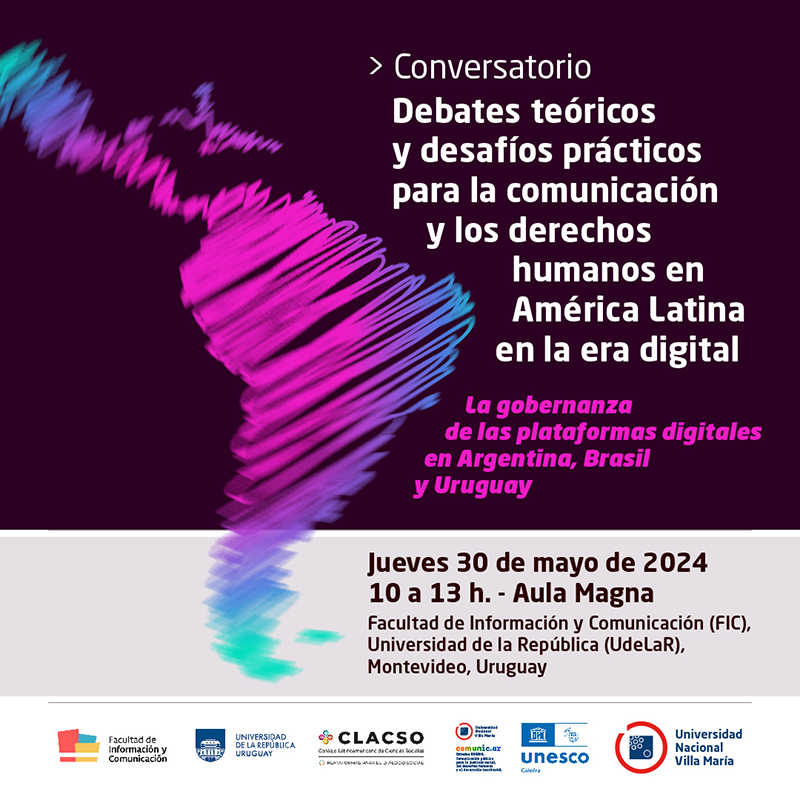
On Thursday, May 30, the University of the Republic, in Montevideo, Uruguay, hosted the Conversation “Theoretical debates and practical challenges for communication and human rights in Latin America in the digital age. The governance of digital platforms in Argentina, Brazil, and Uruguay.”, which is sponsored by CLACSO.
Starting from the question: How to apply the guidelines for the governance of digital platforms in order to safeguard freedom of expression and access to information with a multi-stakeholder approach?, the following topics are proposed to be addressed: UNESCO recommendations on regulations for social networks and artificial intelligence; Regulatory debates in Latin America; Disinformation and hate speech in Latin America; and The proposal for responsible communication.
From 10 a.m. to 13 p.m. in the Aula Magna of the Faculty of Information and Communication (FIC) of the University of the Republic (UdeLaR), Montevideo, Uruguay.
10.00-10:20. Opening
Ernesto Fernández PolcuchDirector of the UNESCO Regional Office. Presentation of the Guidelines for the governance of digital platforms with the aim of safeguarding Freedom of expression and access to information with a multi-stakeholder approach interested.
Gustavo Lema, Director of Communication and Information of the Latin American Council of Social Sciences (CLACSO).
10:20-12:20 Panel
Presented and moderated by: Carmen Rico. Uruguay. Honorary Professor. Université du Québec à Montréal, Canada.
They expose:
Natalia Uval. Teacher, researcher and journalist. University of the Republic (UdeLaR), Uruguay. Uruguay is not an island: disinformation in election campaigns and its risks to democracy.
Magela Cabrera Castiglioni. Professor and researcher. University of the Republic (UdeLaR), Uruguay. Combatting hate speech: a training perspective citizenry in terms of human rights.
Eleonora Mesquita Ceia. Teacher and researcher. Federal University of Rio de Janeiro (UFRJ), Brazil. Disinformation and elections in Brazil: regulation by power judicial.
Aimé Aminahuel. Teacher and researcher. CCONFINES CONICET UNVM. Blas Pascal University. National University of Río Cuarto, Argentina. Public policies and regulations in platform capitalism in Latin America: Regional challenges for regulation of the big tech companies in communications.
Malvina Rodríguez. Teacher and researcher. National University of Villa María (UNVM), Argentina. Towards responsible communication. UNESCO recommendations on regulations for digital platforms and artificial intelligence.
Organized by:
Academic Section Journalism. Faculty of Information and Communication (FIC). University of the Republic (UdeLaR), Uruguay.
UNESCO Chair in Public Communication for Social Justice, Human Rights and Territorial Development (COMUNIC.AR). National University of Villa María, Argentina.
Research program: Communication, politics, and democracy in digital capitalism. Analysis of public and private actors, discourses, narratives, social processes, and public policies in Latin America. AP Institute of Social Sciences. National University of Villa María, Argentina.
Research project: Public policies and regulations against disinformation in platform capitalism: debates, tensions and challenges in Latin America. The cases of Argentina, Brazil, Chile and Mexico (2016-2022). AP Institute of Social Sciences. National University of Villa María, Argentina.
Sponsors: Latin American Council of Social Sciences (CLACSO).
If you would like to receive more information about CLACSO's training programs:
[widget id=”custom_html-57″]
to our email lists.

