
Conceptual and methodological debates on care
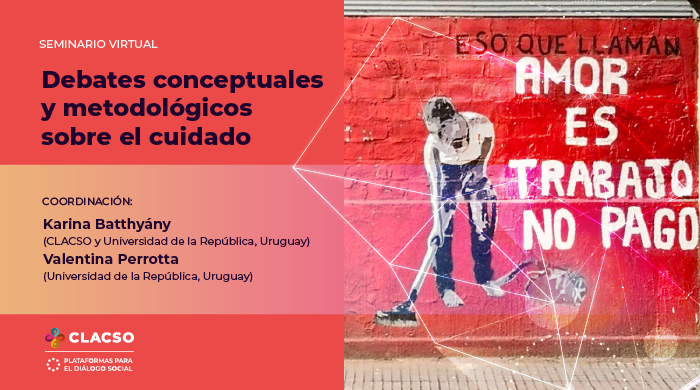
Seminar 2422
Chair: CLACSO
Coordination: Karina Batthyány (CLACSO and University of the Republic, Uruguay) and Valentina Perrotta (University of the Republic, Uruguay)
Start: 25/09/2024 | Registration: 16/05/2024 to 24/09/2024
Workload: 12 weeks – 90 hours.
This course will introduce students to the various definitions of care and will explore reflections on the ethics of care; the links between gender theory and care; and different dimensions of care, among other topics. It will address perspectives that recognize care as work associated with love and female identity, as well as those that define it as work, both paid and unpaid, and whether or not it can be considered equivalent to other types of work. The course will also examine the methodological challenges and considerations for measuring care. It will cover qualitative and quantitative methodological approaches to care in different countries of the region. Finally, it will explore the challenges of quantitatively measuring care based on the contributions of the region's Time Use Surveys and their main challenges.
GENERAL PURPOSE
The overall objective of the course is the introduction and discussion of different conceptions of care and their empirical implications.
SPECIFIC OBJECTIVES
● Reflect on the various definitions of care: perspective of the ethics of care; links between gender theory and care, different dimensions of care, etc.
● To present the challenges and methodological reflections for the measurement of care.
● Discuss the tensions between care, capitalism and democracy.
● To provide analytical tools on the link between care and social well-being.
- Care as a concept
- Understanding care as a power relationship
- Care as a political concept
- The patriarchy of wages
- Methodological approaches to care
- Care pathways in Latin America
- Care and wellness regimen
- Aguirre, Rosario, Batthyány, Karina, Genta, Natalia, Perrotta, Valentina (2014). Care in the research agenda and in public policies in Uruguay.
- Batthyány, Karina (2015) Policies and Care in Latin America: A Look at Regional Experiences. Gender Issues Series No. 124. ECLAC. Santiago
- Batthyány, Karina and Genta, Natalia (2018) Sociology of gender and care in Uruguay: the path traveled In Cantero, Garrido, Martínez, Salinas, Pizarro and Muñoz-Saavedra (eds) Public Policies for social equity. Initial page 127, final page 136. Publisher: Public Policies Collection Editor, University of Santiago de Chile
- Bozalek, Vivienne. 2014. “Privileged Irresponsibility.” In Moral Boundaries Redrawn: The Significance of Joan Tronto's Argument for Political Theory, Professional Ethics, and Care as Practice. eds. Gert Olthuis, Helen Kohlen, Jorma Heier. Ethics of Care Vol 3. Pp. 51-72
- Carrasco, C., Borderías C., Torns, T. (2011) Care work, history, theory and policies. Introduction.
- Esquivel, Valeria, and Andrea Kaufmann. 2017. "Innovations in Care: New Concepts, New Actors, New Policies." Berlin: Friedrich Ebert Stiftung.
- Frederici, Silvia (2018) The Patriarchy of Wages. Traficantes de Sueños Publishing House. Madrid.
- Held, Virginia. The Ethics of Care: Personal, Political, and Global. NY: Oxford University Press, 2006.Chapter 4
- Icons. No. 50, pp. 43-60. Quito: Latin American Faculty of Social Sciences-Ecuador Academic Headquarters.
- Kittay, Eva Feder. Love's Labor: Essays on Women, Equality and Dependency. NY: Routledge, 1999, intro, chapter 4
- Noddings, Nel. Caring: A Feminine Approach to Ethics and Moral Education. Berkeley: University of California Press, 1984, pp. 1-29
- Parreñas, Rhacel Salazar. 2001. Servants of Globalization: Women, Migration, and Domestic Work. Stanford, CA: Stanford University Press. pp. 1-36
- Raghuram, Parvati. 2016. “Locating Care Ethics Beyond the Global North” Acme: An International Journal for Critical Geographies 15 (3):511-33.
- Robinson, Fiona. 2011. The Ethics of Care and Global Politics. Philadelphia: Temple University Press. chapter 3.
- Robinson, Fiona. 2018. "Care ethics and International Relations: challenging rationalism in global ethics." International Journal of Care and Caring 2 (3):319-32.
- Ruddick, Sara. 1995. Maternal Thinking: Toward a Politics of Peace. Rev. ed. Boston: Beacon, Preface
- Tronto, Joan 2013. Caring Democracy, (already assigned for international course)
- Tronto, Joan C. 2010. "Creating Caring Institutions: Politics, Plurality, and Purpose." Ethics and Social Welfare 4 (2):158-71
|
|
Discount for one payment until 18/09 |
In one payment after 18/09 |
|
CM Plenos |
$85 |
$150 |
|
CM Associates |
$85 |
$150 |
|
No link |
$105 |
$190 |
FAQ
The basic requirements for taking a seminar are:
- Availability of at least 4 hours per week to dedicate to the seminar course.
- Internet access.
- Reasonable handling of communication and computer tools.
- Language proficiency in the language in which the course will be taught. The official languages are Spanish and Portuguese.
The seminars last 10 weeks, plus the completion of a final project. A total of 90 hours of dedication will be credited.
A course consists of 10 classes, each accompanied by required reading bibliography, supplementary bibliography, discussion forums and training activities proposed by the teaching team, partial deliveries and a final project.
The course is online and asynchronous. Some instructors may propose synchronous activities. In those cases, the time and date will be agreed upon beforehand between the teaching team and the students to ensure everyone's participation.
To pass the seminar, you must participate in at least 80% of the discussion forums and activities proposed by the teachers, have completed the scheduled partial deliveries, and pass the final work.
|
|
Discount for one payment until 18/09 |
In one payment after 18/09 |
|
CM Plenos |
$85 |
$150 |
|
CM Associates |
$85 |
$150 |
|
No link |
$105 |
$190 |
Inquiries: [email protected]

