
Under the Bridge
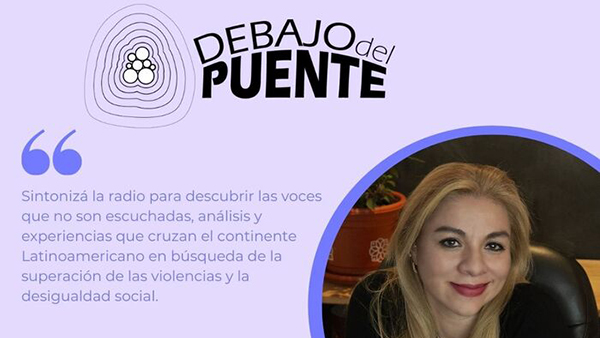

“Under the Bridge,” the unheard voices: analyses and experiences from across Latin America in the search for ways to overcome violence and social inequality. A weekly radio program produced by the CLACSO Working Group “Violence, Security Policies, and Resistance.”
Production and hosting: Carolina Duque
Episode #1 Is the problem with drugs the drugs themselves?
Interviewees:
Marian Cuesta (Panama). A young community leader from Curundú, she graduated from the Marie Poussepin Educational Center. Today she is studying architecture.
Gilmer Mesa (Colombia). Writer, author of the novel “La Cuadra” with which he won the XII novel and short story contest of the Medellín Chamber of Commerce for Antioquia 2015. Professor at the Pontifical Bolivarian University and EAFIT University.
Roberto Ríos Sanjinés. Vice Minister of Citizen Security of the Plurinational State of Bolivia. Economist from the Universidad Mayor de San Andrés, Master's degree in Management and Public Policy from the Universidad Católica Boliviana. Fellow of the Universidad de Los Andes in Colombia in Drug and Narcotics Trafficking Policy and of the Korean Cooperation Agency (KOICA) in Public Policy Innovation.
Juan Martens (Paraguay). PhD from the University of Barcelona. His research focuses on criminology, security, and the criminal justice and prison systems, primarily secondary criminalization processes, border economies (especially along the Paraguayan-Brazilian and Paraguayan-Argentine borders), and organized crime. He teaches at several universities and is the director of the National Institute of Criminal Sciences (INECIP). He previously chaired the Institute for the Regulation and Control of Cannabis (IRCCA) in Uruguay.
Episode #2 Realistically, how do we imagine Colombia in the coming years?
This program is a tribute to the young people who have died in social protests for demanding their rights.
We spoke with:
Nolan López, «El Nolan», rapper, cultural manager, event organizer, social activist, announcer;
Katherine Aguirre. Colombian economist with a master's degree in development studies from the Graduate Institute of Geneva (Switzerland), researcher at the Igarapé Institute of Brazil and one of the coordinators of AMASSURU, the Network of Women on Security and Defense in Latin America and the Caribbean;
Pablo Angarita. PhD in Human Rights and Development, Full Professor at the Faculty of Law and Political Science of the University of Antioquia;
Alejo Vargas. PhD in Political Science from the Catholic University of Louvain (Belgium), Vice Dean of Research and Extension at the National University of Colombia.
Episode #3 What has happened to Venezuela? A before and after.
We spoke with:
Mariángel Monterrey. Social worker from the Central University of Venezuela. Member of the Leftist Cultural Front and the feminist collective Tejiéndonos Mujeres (Weaving Ourselves Women). Currently, she works with children and adolescents experiencing homelessness and women in prostitution.
Roberto Briceño-León. Professor of Sociology at the Central University of Venezuela, director of the Laboratory of Social Sciences (LACSO) and coordinator of the Venezuelan Observatory of Violence.
Gilberto Dan. Carpenter by trade, community activist, believer and advocate for the neighborhood physical rehabilitation program, and promoter of the SAT (Solid Waste Management) program in high-risk communities. Founder of the "Anauco Solid Waste Management Association."
Episode #4 Are they taking care of us or watching us?
What has been the social impact of videos documenting police abuse in Latin America? Have they contributed to reducing police discretion? Who are the electronic watchdogs? Everyday stories from behind the monitor. Institutional challenges posed by new technologies for security and violence prevention.
We spoke with:
Carmina Jasso. Researcher at the Institute of Social Research of the National Autonomous University of Mexico. PhD in Public Policy. Her main research areas are public safety and public policies for crime reduction and prevention. She is currently researching Surveillance Technologies and Society in Mexico and Latin America.
Martín Urtasun is a sociologist and holds a PhD in Social Sciences from the National University of La Plata. He has focused his research on municipal video surveillance systems, employing an ethnographic approach that pays close attention to their daily operation. He currently serves as an advisor to the National and Buenos Aires Province Ministries of Security of Argentina.
Stalin Basantes. A communications professional with a postgraduate degree in Public Policy and Development from FLACSO. He served as Deputy Minister Coordinator of Security, Technical Undersecretary for Disabilities, Technical Secretary of the National System of Professional Qualifications, and Director General of the ECU-911 Integrated Security Service of Ecuador.
Episode #5 Extortion: A Silenced Reality.
In collaboration with the Global Initiative against Transnational Organized Crime.
How do communities organize to prevent extortion? Why do women participate in extortion? Between protection and extortion: social meanings and everyday experiences.
We spoke with:
I'm Conchita. I'm a former inmate in Central America. I currently live with my dad, work, and am studying to be a computer technician. I also continue to play sports.
Vania Pigeonutt. Mexico. She is a journalist. She co-founded mataranadie.com, a memorial for murdered and disappeared journalists, and Amapola, a website based in Guerrero. Transgressive journalism. She is currently a fellow with the Global Initiative Against Transnational Organized Crime. She analyzes and investigates the crime of extortion and its effects in cities like Acapulco and Chilpancingo, in Guerrero, a state in southern Mexico. Local communities have had to organize to prevent the crime.
Arturo Díaz. Postdoctoral Fellow at the Institute of Social Research, UNAM. PhD in Social Science from El Colegio de México.
Andrea Barrios. Guatemalan, feminist, human rights defender. I work for the rights of incarcerated women and children and adolescents with family members who have been incarcerated for 15 years. I am the founder and coordinator of Colectivo Artesana, the only Guatemalan organization working for the rights of this population.
Episode #6 How do we consume news about crime, violence, and security? Or does it consume us?
How did police reporting originate, what do people do with police news in their daily lives, the citizenry caught between the media and fear, and why Pedro Navaja is a police report
We spoke with:
Brenda Focás. PhD in social sciences, researcher at the National Research Council
Scientific and Technical Research Council of Argentina (Conicet), specialist in media, insecurity and audience issues.
Omar Rincón. Director of the Latin American Media Program at the Friedrich Ebert Foundation. Professor at the University of the Andes (Colombia). TV critic for El Tiempo and cultural essayist for 070, Anfibia, and Altair Magazine. Current artistic project: Narcolombia.com. Current journalistic project: #thebestjournalismisyettocome.
Episode #7 “Being a woman” in the dictatorships of Chile and Uruguay.
How was gender discipline implemented? Pinochet's wife had a personal vision of what Chile should be like, which she implemented through the Mothers' Centers - CEMA, her own army.
We spoke with:
Alejandra Matus. Chile. Journalist and writer. Author of Doña Lucía (The Unauthorized Biography).
Malena Zunino Folle. Uruguay. Bachelor's degree in Sociology. Master's thesis student in Latin American Social Studies at the University of Buenos Aires. Professor at the Institute of Education of the Faculty of Humanities and Education Sciences of the University of the Republic (Udelar).
María Angélica Cruz, Chile. PhD in Sociology from the Complutense University of Madrid and degree in the same discipline from the University of Chile. Full Professor at the School of Sociology of the University of Valparaíso since 2007. Currently, she is the Academic Secretary of the Faculty of Social Sciences.
Episode #8 What do we mean by crime prevention?
How crime prevention becomes a tool of governance.
We spoke with:
Luciana Ginga. Argentina. PhD in Political Science, Master's in Criminology, Bachelor's in Political Science. Postdoctoral Fellow of CONICET. My area of expertise is the study of neoliberalism, its development and evolution in Latin American contexts.
Amadeu Recasens i Brunet. Catalonia. • Doctor of Law from the University of Barcelona (1989). Advanced Diploma in Criminology from the Institute of Criminology of the University of Barcelona (1981-1982). Advisor in the Office of the Minister of Foreign Affairs of the Government of Catalonia (2019-present).
Camilo Torres. Paraguay. Lawyer and Notary Public from the National University of Asunción, graduate of the Judicial School of Paraguay, Advanced Studies in Juvenile Justice at the University of Geneva. Currently a Juvenile Criminal Judge in the City of Lambaré.
Episode #9 A look at violence against women in Argentina.
We will be speaking with the Federal Network for Studies on Femicides, which represents 30% of the national territory and 53% of the population of Argentina. This network is comprised of the National University of Córdoba, the National University of Misiones, the National University of Villa María, the National University of Santiago del Estero, the National University of La Rioja, the National University of Lanús, and the National University of Tucumán, in collaboration with the Observatory of Crime and Violence and the Security and Justice Institute of Río Negro – Institute of Criminalistics and Criminology of the National University of the Northeast.
Olga Camaño from the National University of Córdoba.
Rosaura Barrios from the National University of Misiones.
Roberto González from the National University of Villa María.
Gustavo García from the National University of the Northeast.
Episode #10 The street and its rules
We spoke with:
María Paula Molina, bookseller at Wilborada 1047, leads the book club "Strong Women of History." She is an Industrial Engineer from the National University and a student of Cultural Management at EAN University in Bogotá.
Andrés Saavedra is one of the founders and creators of the Breaking Borders project; the opportunity changes the educational problems that affect 100% of my country.
Javier Copa Uyuni. Professor and researcher in the sociology department at the Universidad Mayor de San Andrés - Bolivia.
Luis Amaya. Bachelor's degree in Psychology from the Central American University José Simeón Cañas (UCA). Researcher and specialist in citizen security policies and projects in Central America.
Episode #11 Thanks to music! A log of social transformation and freedom.
This program is a tribute to the mothers and fathers who sing with their children. For you, son Iván Francisco Montalvo Duque.
Music revolutionizes us and has been a driving force behind social change throughout history. A living portrait of memory, it liberates the spirit and transports us to magical places.
We meet under the bridge to listen to the songs and compositions that have contributed to social change and freedom in Latin America. A journey through rock and classical music.
We spoke with:
Andrea Guzmán was born in Santiago, Chile, but lives in Buenos Aires. She works as a writer for Radar at Página/12 and has contributed to publications such as Vice Magazine, Rolling Stone, SOY, The Clinic, and La Nación of Chile, among others. She is a programmer for Asterisco, the Buenos Aires International LGBTIQ+ Film Festival.
Camilo Monterrosa, a Master of Music from the Francisco José de Caldas District University, began his violin studies at the age of 7. Since 2005, he has been a member of the National Symphony Orchestra of Colombia.
Pablo Plotkin began his journalistic career at Página/12 in 1997. In 2003, he worked at the Berlin office of the EFE news agency and, upon returning to Argentina, joined the staff of Rolling Stone magazine, which he edited for two periods and for which he wrote more than thirty cover stories. He is the author of the novels A Radiant Future (Literatura Random House, 2016) and South Brazil, which will be published by Planeta in early 2022. He currently also works as a screenwriter.
Episode #12 Firearms control: towards the disarmament of hegemonic masculinity.
Alejandra Otamendi. PhD in Social Sciences (jointly awarded by the University of Buenos Aires and the School for Advanced Studies in the Social Sciences in Paris). Master's degree from the University of Oxford and Bachelor's degree in Sociology from the University of Buenos Aires. Director of the UBACYT project: Firearms in Argentina: Armed Violence, Social Reactions, and Public Policies in the 21st Century. Focal point for the GENSAC network on gender and disarmament.
Daisy Tourne. President of the Parliamentary Forum on Small Arms and Light Weapons. Former Senator of Uruguay. Social Psychologist. Professor
María Pía Devoto, Director of the Association for Public Policies (APP), specializes in international security and non-proliferation, disarmament, arms control, and gender issues. She is a founding member of the Argentine Network for Disarmament (RAD) and coordinator of the Latin American and Caribbean Human Security Network (SEHLAC).
Episode #13 Brazil: narratives or realities?
Contradictions between the discourses and realities of violence and security policies. The reality of violence in peripheral areas and favelas.
We spoke with:
Neiva Vieira da Cunha. Anthropologist, professor at the Universidade do Estado do Rio de Janeiro and the Postgraduate Program in Education, Culture and Communication in Urban Peripheries. Researcher at the Metropolitan Ethnography Laboratory (Federal University of Rio de Janeiro).
Alenisa Gregis Estivalet. Consultant to the Ministry of Women, Family and Human Rights. Professor - University of Brasilia. PhD from the University of Vale do Rio dos Sinos/University of Paris Descartes - Sorbonne.
Lívio Silva de Oliveira. Postdoctoral fellow, PhD and Master's in Sociology from the Federal University of Rio Grande do Sul. Scientific researcher and visiting professor at CLACSO. Affiliated with the research group Violence and Citizenship, GEP-Catholic University of Pelotas. Member of IECET (National University of Córdoba and CONICET – Argentina).
Episode #14 How to think about drug use prevention in the face of the imminence of regulated markets?
We spoke with:
Joaquín Chacin. Law graduate with studies in Governance, Crime Prevention, and Drug Policy. He is a university professor at both the undergraduate and graduate levels, a researcher, and a master's candidate in Governance and Public Policy at CESU-Universidad Mayor de San Simón in Bolivia.
Ernesto Cortés. Bachelor's degree in social anthropology, Master's degree in mental health, and Master's degree in criminology with an emphasis on human security. Secretary of the Latin American and Caribbean Network of People Who Use Drugs (LANPUD). Director of the Costa Rican Association for the Study and Intervention of Drugs (ACEID).
Eduardo Vélez. Colombia. Promoter and co-founder of the collective "Yes to the personal dose," a group that since 2002 has resisted prohibitionism and vindicates the sphere of individuals' private lives as a universal expression of freedom.
Episode #15 How do we view Central America?
An analysis from the perspective of the territories, communities, and public policies of powerful women who have contributed to a Central America free from violence, discrimination, and social inequality. Differences and similarities in the history of violence in Central American countries. Social and cultural potential of each country for development and the reduction of violence and/or crime.
We spoke with:
Celia Medrano. El Salvador. Journalist specializing in human rights and peace education.
Cristina Araya. Costa Rica. Advisor to the Vice Ministry of Peace on public policies for violence prevention and citizen security. Master's degree in Design, Management and Direction of International Cooperation Projects, Bachelor's degree in Political Science.
Aracelis Camacho. Panama. She worked for 33 years in the Ministry of Government and Justice and in the Ministry of Security as Director of Statistics and Criminal Information Analysis. She holds a Doctorate and Master's degree from the University of Rosario, Argentina, and a Bachelor's degree from the University of Panama.
Ana Castro. Guatemala. Central America Coordinator for the Global Initiative Against Transnational Organized Crime. Lawyer with over 13 years of experience in development projects focused on transparency and anti-corruption, access to public information, and human rights. She is part of the Coalitions for Resilience project and the Resilience Fund against Organized Crime.
Elvira Cuadra. Nicaragua. Master's degree in sociology from FLACSO, Ecuador, Bachelor's degree in sociology from UCA. Researcher on peacebuilding and pacification processes; conflict analysis; security and human rights; youth and political culture. Her studies focus on Nicaragua and Central America.
Rosa González. Honduras. Researcher, consultant, feminist, writer, with more than 20 years of experience in human rights of key populations and vulnerable populations in the face of HIV, in prevention and care of violence against women, sexual and reproductive rights of women with HIV.
Episode #16 How are young people governed in Argentina?
Genealogy of a failed reform of a juvenile justice system with a rights-based approach for adolescents and young people. Reconfiguration of police practices and the daily criminal prosecution of young people in low-income neighborhoods.
We spoke with:
Silvia Guemureman. Sociologist, specialist in social issues affecting children and adolescents, and PhD in Social Sciences from the University of Buenos Aires. Researcher at CONICET, Gino Germani Institute of the Faculty of Social Sciences, UBA. She coordinates the Observatory on Adolescents and Young People in Relation to Penal and Social Control Agencies http://observatoriojovenesiigg.sociales.uba.ar
Joaquín Zajac. Bachelor's degree in Sociology (University of Buenos Aires). Master's degree in Social Anthropology (IDES/IDAES). Doctoral candidate in Social Sciences (University of Buenos Aires). Associate Professor of Research Methodology at the University of Salvador. His research interests include security forces and the penal system, violence, and urban inequality.
Melina Ghione. Lawyer and professor at the University of Buenos Aires. President of the Small Scale Civil Association. Co-host of "Aires de Justicia," the program of the Buenos Aires Bar Association on Radio UBA. Founding Partner at Fernández Ghione De Souza Vieira & Associates.
Episode #17 Security in Mexico: a puzzle to unravel.
We interacted in a classroom in Mexico with students from the Ibero-American University of León. How are civil-military relations understood in Mexico? A hug of love and solidarity for the families of the disappeared in Mexico.
We spoke with:
Othón Partido. Coordinator of the Master's Program in Politics and Public Management, Ibero-American University of León. PhD in Latin American Studies (UNAM), international relations specialist and sociologist. Scholar of violence prevention policies.
Pavel Díaz. PhD in Social Sciences from El Colegio de México. Professor in the postgraduate program in public security at UNAM. Member of the National System of Researchers-CONACyT. Director General of Strategic Management at the C5 of Mexico City.
Fabrizio Lorusso holds a degree in Latin American Studies from the National Autonomous University of Mexico and is an academic in the Department of Social Sciences and Humanities at the Ibero-American University of León. His research focuses on enforced disappearances and search collectives in Mexico. He is a member of the Platform for Peace and Justice in Guanajuato, a project that strengthens victims' collectives and movements in Guanajuato.
Episode # 18 Feminist pedagogies as a form of resistance in Uruguay.
What are the debates between pedagogies? The issue of sex education in Uruguay, the resistance and debates brought into play within the educational field.
We spoke with:
Nilia Viscardi. PhD in Sociology from UFRGS, Brazil; Associate Professor in the Department of Political Pedagogy and Society at the Institute of Education of the FHCE; Adjunct Professor in the Department of Sociology at the FCS, UdelaR. Member of the SNI.
Lilian Celiberti. Teacher, feminist activist, Coordinator of Cotidiano Mujer.
Leonel Rivero. PhD candidate in Sociology at the University of the Republic (UdelaR), Master's and Diploma in Education from ORT University Uruguay, Bachelor's degree in Sociology and Diploma in Youth and Public Policy from UdelaR. Professor and researcher in the Department of Sociology (DS-FCS-UdelaR) in the area of teacher work and school coexistence. Member of the National System of Researchers (SNI).
Verónica Habiaga. Doctoral candidate in Education at the Faculty of Humanities and Education Sciences, University of the Republic (UdelaR), Uruguay. Professor in the Department of History and Philosophy of Education at the Institute of Education of the FHCE.
Episode #19 To publish or not to publish, that is the question.
An analytical and critical look at the free circulation of literature and the usefulness of academic production for public policy and the community. Publish for whom?
We spoke with:
Fredy Rivera. Director of the Latin American Journal of Security Studies (URVIO) and of the Latin American Network of Security Studies (URVIO). Visiting Professor at the University of Santiago de Compostela, member of the Scientific Committee of the Center for Security Studies (CESEG) at the same university. PhD in Social Sciences from the University of Cuyo (Argentina).
Aldana Perazzo. Journalist and bookseller at the Galerna bookstore in Buenos Aires. She organizes interview series with writers for the magazine Continuidad de los Libros (Continuity of Books).
Manuel Moreno. Director of the magazine Cultura y Droga (Culture and Drugs). Sociologist. Master's in Cultures and Drugs. Director of the Master's Program in Cultures and Drugs at the University of Caldas (Colombia).
Episode #20 How does the prison system work in Latin America?
We spoke with:
Different perspectives on prison: from analysis and research to the experiences each person has within the prison context. Prison does not separate the offender from the outside world. The idea that incarcerating a person prevents further crime is a fallacy.
Olga Espinoza. Lawyer. Master of Laws (University of Sao Paulo, Brazil) and PhD candidate in Social Sciences (University of Chile). She was Director of the Center for Studies in Citizen Security (CESC) and is currently a professor at the University of Chile, where she also coordinates the Master's Program in Criminology and Citizen Security Management.
Marcelo Bergman holds a PhD in Sociology from the University of California, San Diego. He is a professor and director of the Center for Latin American Studies on Insecurity and Violence (CELIV) and the Master's Program in Criminology and Citizen Security at the National University of Tres de Febrero in Argentina. He has taught at universities in the United States and Mexico, consulted for international organizations, and conducted research and surveys in more than 14 countries in the region. His most recent books are: More Money, More Crime: Prosperity and Rising Crime in Latin America (Oxford 2018), Drugs, Drug Trafficking and Power in Latin America (Fondo de Cultura Económica 2016), and Prisons and Crimes in Latin America, co-authored with G. Fondevila (Cambridge 2021).
Episode #21 What are the inequalities in Latin America and the Caribbean?
Heading towards the 9th Latin American and Caribbean Conference on Social Sciences. How can academia forge changes to overcome inequality?
We spoke with:
Karina Batthyány. Executive Secretary CLACSO
Pablo Vommaro. Director of Research at CLACSO
Gustavo Lema, Director of Communications, CLACSO
Episode #22 What is the purpose of micro-trafficking of drugs in drug policies?
Is micro-trafficking of drugs a mechanism for social regulation and control? Different perspectives and approaches, from street observation to statistical analysis.
We spoke with:
Laura Guzmán. Human rights activist and NGO leader with 30 years of experience in the health and harm reduction movements, immigrant rights, homelessness, and housing justice in the San Francisco Bay Area, California, USA. Senior Director of Capacity Building and Community Mobilization for the National Harm Reduction Coalition in California. Juris Doctor (Attorney) from New College of California School of Law and Bachelor of Arts in Linguistics from the University of California, Berkeley. Chair of the Alameda County Homeless Healthcare Commission and board member of Just Cause.
José Manuel Ugarte. Argentina. Lawyer, specialist in Administrative Law and Public Administration and Doctor of Law from the University of Buenos Aires (UBA), professor at UBA and Catholic University of Santiago del Estero, Inter-American Open University and National Defense School.
William Álvarez. Colombia. Urban ethnographer with experience in studies on drug use, trafficking, illegal activities, and gangs in Latin America. He holds a PhD in sociology.
Daniel Pontón. Ecuador. Dean of the School of Security and Defense of the Institute of Higher National Studies (IAEN). Doctor of Social Sciences and Master in Public Policy.
Jérôme Mangelinckx. Peru. Researcher and consultant in human rights, criminal and prison reform, and drug policy. Co-founder of the Center for Research on Drugs and Human Rights (CIDDH). Coordinator of the CIDDH Legal Clinic. Focal point in Peru for the Latin American and Caribbean Network of People Who Use Drugs (LANPUD).
Rafael Paternain. Uruguay. Sociologist. Professor and researcher in the Department of Sociology at the Faculty of Social Sciences (University of the Republic-Uruguay). Former director of the Observatory on Violence and Crime of the Ministry of the Interior (Uruguay).
Episode #23 The right to health and the hidden consequences of the pandemic.
Claudia Marcela Vargas. Pharmaceutical Chemist, Pharmacologist and PhD in Pharmacy. She is the director of the IFARMA Foundation and a professor in the Department of Pharmacy at the National University of Colombia.
Francisco Rossi. Medical epidemiologist with extensive experience in international public health, particularly in pharmaceutical policy and intellectual property in the pharmaceutical sector. He has worked as a consultant for international organizations such as the Pan American Health Organization (PAHO) and the United Nations Development Programme (UNDP).
Melissa Córdoba. Bacteriologist, specialist in Epidemiology, with a master's degree in Crisis, Risk and Disaster Management from the University of Leicester, United Kingdom. Candidate for a master's degree in Health Policy from Imperial College London. Coordinator in Colombia of the Data Impact Program for the Bloomberg Data for Health Initiative and Manager for Latin America of the Healthy Cities Alliance.
Episode #24 Violence in Mexico today
What is the dynamic of violence? State responses and new types of anti-violence movements.
María Eugenia Suárez De Garay. Master's in Applied Anthropology and PhD in Social and Cultural Anthropology from the Autonomous University of Barcelona. Professor and researcher at the University Center for Social Sciences and Humanities of the University of Guadalajara. I specialize in gender studies and police studies, specifically in topics related to police cultures, transformation of police organizations, police reform processes, citizen security, and violence prevention.
Dr. Hugo Almada Mireles. Professor at the Autonomous University of Ciudad Juárez. Master in Gestalt Psychotherapy and PhD in Humanistic Psychotherapy. Author of The Social Reality of Ciudad Juárez (2008) and coordinator of The Social Reality and Violence in Ciudad Juárez (2012) in coordination with Clara Jusidman, Theory and Method in Gestalt Therapy (Mexico: Pax, 2017), and of Gestalt Therapy with Women Victims of Violence (Mexico: Pax, 2019).
José Alfredo Zavaleta. Sociologist. PhD in Sociology. Researcher at the Institute of Historical and Social Research IIHS SNI-II. Professor of the Doctoral Program in Social Sciences at the University of Veracruz. Co-coordinator of the Working Group: Violence, Security Policies and Resistance of the Latin American Council of Social Sciences (CLACSO).
Episode #25 The detective novel and social conflicts
José Vicente Tavares. Full Professor of Sociology, UFRGS – Federal University of Rio Grande do Sul, Porto Alegre, Brazil; Researcher at CNPq – National Council for Scientific and Technological Development. Sociologist, UFRGS; Master's, University of São Paulo; State Doctor, University of Paris Nanterre; Postdoctoral Fellow, University of Cambridge, UK
Author of Romance da Violência: sociology of the metamorphoses of police romance. 2020. Violências e Conflitualidades, 2009; Matuchos: Exclusão e Luta (Sul a Amazônia), VOZES, 1993; Colonos do Vinho (a subordinação do trabalho camponês ao capital), HUCITEC, 1978.
Luis Miguel Rivas. Writer. Social communicator from the Pontifical Bolivarian University. Author of Los amigos míos se viven muriendo (short stories) and Tareas no hechas (chronicles), ¿Nos vamos a ir como estamos pasando de bueno? (short stories) and Era más grande el muerto (novel) with Planeta-Seix Barral, and Hoy no quiero metáforas (poetry) with Angosta Editores.
Carlos Fong. Panamanian writer, researcher, essayist, and storyteller. Author of *Aviones dentro de la casa*, *Desde el otro lado* (2003), *Fragmentos de un naufragio* (2005), and *Para narrar la identidad* (2006). Winner of the Sagitario Ediciones Short Novel Prize. Since 2010, he has dedicated himself to researching reading and sociocultural animation as a sociocultural practice in working with young people from marginalized and vulnerable sectors.
Episode #26 How to decipher organized crime?
Is it criminal governance? Political power of drug traffickers? Mafia power?
Analysis of the Global Organized Crime and Resilience Index.
Gustavo Duncan. Professor in the Department of Government and Political Science at EAFIT University in Medellín. PhD in Political Science from Northwestern University. Author of the books 'More Than Silver or Lead', 'The Lords of War', 'Fierce Democracy' and 'Operation Sodom'.
Gerardo Bazante. Social researcher, Master's degree from the Central Institute of Pedagogical Sciences (ICCP) in Havana, Cuba. Author of 'Dreams Were Not Moderated by Death', 'Short Stories for a Long Night', and 'We Will Never Forget Them'. Professor at the District University (Bogotá) and researcher at Punto de Encuentro, a political think tank.
Felipe Botero. Political scientist and Master in Public Policy, with an emphasis on Governance and Development. He currently serves as the national coordinator for Colombia of the Global Initiative Against Transnational Organized Crime (GI-TOC).
Episode #27 What do children and teenagers like to read?
"So that new generations do not read or write any more stories of violence."
Cecilia Samanes. Activist, Sociologist and popular educator in Argentina.
María Osorio has been dedicated to children's books since 1986. In April 2001, she founded Babel, a project that replicates the functions of the book industry—distributor, specialized bookstore, library, and publisher—all in a small space. Babel received the BOP Award for Best Publisher of the Year in Central and South America at the Bologna Children's Book Fair. Additionally, in 2018, she received the Tribute to Editorial Merit from the Guadalajara International Book Fair (FIL).
Juliana Muñoz is a Colombian writer and journalist. Her novel "24 Signs to Spot an Alien" won the Tragaluz International Prize for Children's and Young Adult Literature in 2016 and 2017. She is the author of "The Last Days of Hunger" (Planeta, 2017), "The Sorrow-Remover" (Vicens Vives, 2020), "The Flight of the Humpbacks" (Lazo, 2020), and the papyrus scroll "In the Shade of an Orange Tree" (Tragaluz, 2020). She teaches in the Master's Program in Creative Writing at Universidad Central. She is also an embroiderer.
Nini González and Líah Avila González. Mother and daughter, both avid readers. Nini is a human rights advocate and works with the Pueblos en Movimiento (Peoples in Motion) project, which uses art as a tool for psychosocial intervention with children who are victims of the armed conflict. Líah enjoys skating, reading, and conversation.
Episode #28 Untold Stories About Drugs in Colombia
Episode #30 Untold Stories about Mexico.
Carlos Flores-CIESAS Why is history important in drug research?
Mexico City. He holds a PhD in Political and Social Sciences, a Master's degree in Political and Social Studies, and a Bachelor's degree in Political Science and Public Administration. He earned these degrees from the National Autonomous University of Mexico (UNAM), all with honors. He is the author of *Shadow Businesses: Hegemonic Power Network, Smuggling, Drug Trafficking, and Money Laundering in Nuevo León* and *Stories of Dust and Blood: Genesis and Evolution of Drug Trafficking in the State of Tamaulipas*.
He has been an associate research professor at the University of Oslo and a visiting professor at the University of Connecticut. He is a tenured research professor at CIESAS. His research focuses on corruption associated with drug trafficking and organized crime.
Alejandra and Liliana García de Loera: How is fentanyl detected?
Liliana García de Loera holds a Bachelor's degree in Political Science and Public Administration from the Autonomous University of Aguascalientes. She is a candidate for a Master's degree in Social and Humanistic Research, where her thesis focuses on local knowledge, self-care practices, and crystal meth use—one of the illicit substances with the greatest impact worldwide in recent years. Her research interests include drug policy, harm reduction, horizontal methodologies, sociocultural studies, epistemology, and community-based and community-led research. She is an activist with the Latin America Network for a Sensible Drug Policy (Red Latinoamérica por una Política Sensata de Drogas Mx).
Alejandra García de Loera holds a degree in history and a master's degree in social research from the Autonomous University of Aguascalientes. Her research interests focus on illicit substances, such as methamphetamine and fentanyl, harm reduction, substance use and crime, sociocultural epidemiology, and fieldwork with hidden populations. She is a member of Latinoamérica por una Política Sensata de Drogas Mx (Latin America for a Sensible Drug Policy Mx) and has collaborated as a research fellow for the Drug Policy Program, developing the project "Testing Stimulants: Fentanyl Detection and Harm Reduction in Four Mexican Cities. A Pilot Intervention."
Edgar Guerra-CIDE How to promote drug research?
He holds a PhD in Sociology from the University of Bielefeld, Germany (Summa Cum Laude) and a Master's degree in Political Sociology from the Mora Institute (Honorable Mention). He studied sociology at the Metropolitan Autonomous University (UAM), Azcapotzalco Campus (Research Diploma).
His research focuses on the sociology of armed groups, social movements, and drug policy. He is a Research Professor in the Drug Policy Program at CIDE's Central Region campus in Aguascalientes.
Episode #31 What is it like to be a peasant woman in Colombia?
Rural women in Colombia: a political commitment and a social debt for the country/region agenda.
A tribute to Ángela Salazar, Commissioner of the Truth Commission. A thousand thanks to you in the next dimension!
– María Leonor Yonda : Vice President of the Indigenous Social, Popular, and Community Minga (CNA), National Spokesperson for the substitution of coca crops with families who were unable to participate in the PNIS program under point 4 of the peace accords. Our commitment is to the defense and recovery of the countryside, and to remaining and surviving in our territory.
– Ana Trujillo : political scientist, Master in International Affairs. Professor and researcher. – Ana María González : Women's Movement for Life.
Episode #32 How are rights defended in the United States?
How are rights defended in the United States? What does the Roe v. Wade case mean regarding illegal abortion? What rights do Latin American people and organizations claim? What do public defenders in Massachusetts advocate for?
Erica Scott-Puopolo is an activist and nonprofit professional in the U.S. She works in fundraising to support the important work of community organizations such as RAICES, which provides free legal and social services to the immigrant community in Texas; Presente.org, which manages digital campaigns for civil rights and environmental protection; and organizations against domestic and sexual violence. Her master's thesis at Harvard was on Indigenous medicine. She is of Indigenous and Italian descent and is proudly an aunt to her nephews and nieces from Guatemala. She lives in Boston, USA.
Adrián Velázquez is a legislative and public policy attorney for CPCS, the Public Defenders Agency in Massachusetts. His work focuses on criminal justice reform. As an activist, Adrián co-founded the Harvard-MIT Puerto Rican Caucus, the Massachusetts Latino Democratic Caucus, and the Alliance for Puerto Rico (PR). He is a member of the Massachusetts Democratic State Committee and the Mass-United advisory committee for the Puerto Rico recovery fund. A native of San Juan, Puerto Rico, he holds a Master of Liberal Arts degree with a concentration in Government from Harvard University and a Juris Doctor degree from Suffolk University School of Law.
Episode #36 What future do we want for Brazil?
We spoke with leading researchers about the urgent changes needed to strengthen democracy in Brazil: Letícia Shabach, José Vicente Tavares Do Santos, Ligia Madeira and Paulo Peres.
What are the urgent changes needed for an agenda to combat corruption, the justice system, and security policies?
An analysis of the military takeover of the state, a new type of political coup affecting Brazil. The difficulties of rebuilding democratic institutions and the risks in Brazil if change is not implemented.
Broadcast by Radio Trilce: https://trilceradio.com.ar/
Wednesday 17:00 PM Colombia time / 19:00 PM Argentina and Uruguay time
Invite and organize the CLACSO Working Group "Violence, security policies and resistance"
If you would like to receive more information about CLACSO's training programs:
[widget id=”custom_html-57″]
to our email lists.

