
“To provide coverage to all Argentinians who need the protection of the Social Security system”
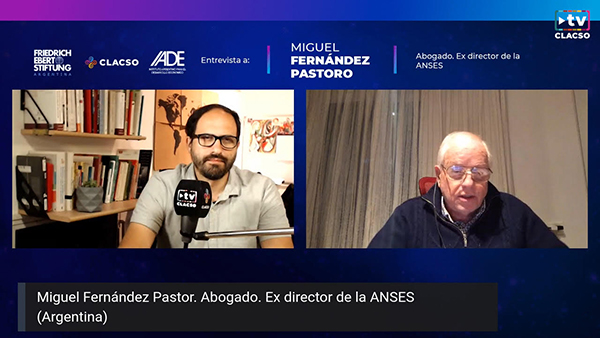
Miguel Fernández Pastor, a lawyer and former director of ANSES (Argentina's National Social Security Administration) and the Inter-American Center for Social Security Studies, was one of the speakers on Monday, September 14, at the 4th meeting of the virtual discussion on social security and pension system: What does the Argentine pension system need to change?, organized by CLACSO, the Friedrich Ebert Foundation, the Argentine Institute for Economic Development (IADE) and the CLACSO Working Group on Social Security and Pension Systems.
Interviewed by Gustavo Lema
When asked what is meant by a pension system in Argentina, Miguel Fernández Pastor replied that “There’s actually a terminological confusion that leads to a series of major misunderstandings. What is pension planning? I put money in an account and when I need it, I withdraw it. In this case, the person contributes part of their salary, and when they lose their ability to work, they get it back. This works perfectly as long as it acts like insurance, like car insurance, life insurance, or any other type of insurance. But the economic and social realities of countries are constantly changing, so there comes a point when the contributions made by that person aren’t enough to pay them the pension they would be entitled to. Then the natural course of action for the State is to take money from the Treasury and incorporate it into the pension system. When that money from the Treasury isn’t enough, it has to resort to what’s called a earmarked tax, that is, a tax where a portion goes to the pension system; the most significant one today is the VAT, part of which goes to the pension system. And then these measures start to weaken. Because political decisions are also made regarding the funds of…” Social Security. For example, the most typical example is that in the face of any crisis, regardless of its nature, employer contributions to the pension or Social Security system are reduced. The consequence of this is that more resources are needed, therefore more taxes, therefore more Argentinians contribute to the system, and increasingly more. So what was once a benefit for a few has become a benefit for everyone. All Argentinians contribute so that some can receive benefits—I am included among them. Therefore, today, defining the specific scope of social security is not so clear because, in reality, all Argentinians are beneficiaries of Social Security. Because Social Security encompasses everything from before birth, with prenatal benefits, for example, to a universal child allowance or a family allowance for an active worker, and includes workers' compensation, and disability pensions if necessary for active workers, and culminates in the retirement and pension system. And I would add, it continues after death because if we die while retired, our relatives are entitled to... pension. That is, it covers the entire period. So there isn't one group that is the sole holder of that right when all this happens; in the end, all Argentinians are the holders of that right. That's why the formula that must be sought is to encompass and provide coverage to all Argentinians who need the protection of the Social Security system.”
They also presented at the discussion:
Fernanda Vallejos. Member of the Argentine National Congress.
Argentine researcher Claudia Danani, from the National University of General Sarmiento and the Faculty of Social Sciences of the University of Buenos Aires
Elsa Rodríguez Romero. Lawyer and professor. She heads the Social Security Commission at the Argentine Federation of Bar Associations.
If you would like to receive more information about CLACSO's training programs:
[widget id=”custom_html-57″]
to our email lists.

