
Online course: Feminisms, resistance and the Global South
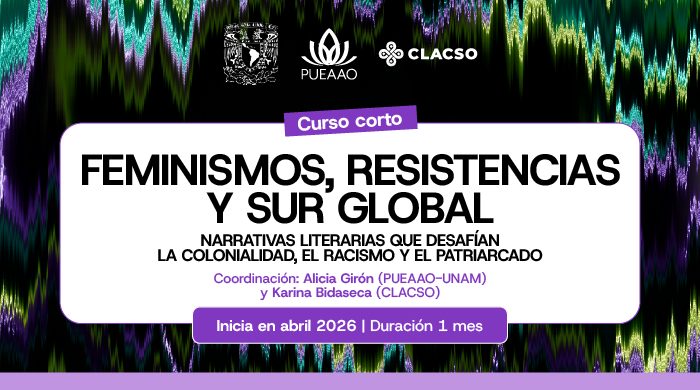
COORDINATION: Alicia Girón (PUEAAO-UNAM) and Karina Bidaseca (CLACSO)
TEACHING TEAM: Adriana Franco (IIEc-UNAM)| Nayelli López (PUEAAO-UNAM) | Radina Dimitrova (ENALLT-UNAM) | Celina Bortolloto (Massey University) | Shekoufeh Mohammadi (IIFL-UNAM)| Karina Bidaseca (CLACSO)
Home: 06 / 04 / 2026 | Registration: 18/02/2026 al 05/04/2026
Modality: On-line
Workload: 50 hours total
Duration: 1 month
The course Feminisms, Resistance, and the Global South is conceived as a space for critical reflection that examines how women and gender dissidents in the Global South have produced knowledge, political practices, and strategies of resistance against historical systems of domination. Literary narratives serve as the epistemological axis that allows for problematizing the regimes of colonial, patriarchal, and capitalist violence that structure contemporary realities.
The proposal is based on an interdisciplinary approach that combines literary studies with decolonial feminisms, Black feminisms, epistemologies of the Global South, and postcolonial criticism. It begins with the recognition that literatures from the Global South not only represent marginalized realities but also produce knowledge that challenges hegemonic paradigms.
Through South-South dialogue, the aim is to foster encounters between disparate geographies to identify affinities, bridges, and points of dialogue in their struggles, challenging the divisions imposed by North-South geopolitics. Likewise, it seeks to analyze the literary strategies (voice, structure, symbolism) through which the body becomes an archive, territory a witness, and fiction a testimony.
Methodologically, the course will be developed through comparative analysis of readings, discussions, and reflections. The selection of texts allows for a contrast between symbolic and embodied resistance and situated and narrative resistance, making literature the central space for recognizing situated connections between colonialism, racism, and patriarchy, and exploring how women have generated their own forms of struggle.
GENERAL PURPOSE
To analyze and understand the diversity of feminisms, and the resistance strategies represented in the literatures of the Global South, in order to understand how women confront, reconfigure and subvert the historical, cultural and political oppressions that permeate their territories and their bodies.
SPECIFIC OBJECTIVES
That the students:
- Deconstruct and problematize the central axes of oppression: coloniality, racism, patriarchy and epistemic violence as a category of analysis that are articulated in the narratives and discourses of the Global South.
- Analyze the forms of resistance—bodily, communal, symbolic, and epistemic—represented in the selected texts.
- Critically situate regional literary and narrative productions as emerging epistemologies and not as mere objects of study, recognizing their capacity to question Western canons.
- Reflect critically on your own position of enunciation in the face of narratives that decentralize and challenge the Eurocentric and hegemonic view.
CLASS 1: COLONIALITY AND EPISTEMIC RESISTANCES
Prof. Adriana Franco
Modality: synchronous
Conceptual summary of the class
This session introduces the richness and complexity of contemporary African literary production and its critical contributions to colonialism, its legacies, and the structures of patriarchy. It will analyze how this literature, from a decolonial perspective, challenges colonial and patriarchal discourses, denounces epistemic forms of violence, and recovers historical memories silenced by hegemonic narratives.
Analysis: "Our Sister Spoilsport. Or reflections from an anti-Western neurosis” by Ama Ata Aido.
CLASS 2: BODY, TERRITORY AND RESISTANCE
Prof. Nayelli López
Modality: asynchronous
Conceptual summary of the class
It examines patriarchal violence in the contemporary Korean context, as well as the relationship between body, desire, and beauty. Through the text The vegetarianAllows This analysis examines how Korean feminist writing challenges family structures, nationalist ideologies, and models of modernity. It reflects on the transformation of the body as an act of resistance and on the political implications of silence, madness, and the negotiation of social mandates.
Analysis: “The Vegetarian” by Han Kang.
CLASS 3: BODY, MIGRATION AND RESISTANCE
Prof. Radina Dimitrova
Modality: synchronous
Conceptual summary of the class
This session explores how Chinese literature uses narrative to address historical traumas and denounce state violence. It examines how these texts reconfigure the relationship between the individual, the state, and memory. The analysis will be conducted through the prose of Yan Xiu, whose writing reveals how subjective experience becomes a space of symbolic resistance against official discourses.
Analysis: “The Rebirth of Secrets”, by Yan Xiu.
CLASS 4: COSMOVISIONS AND RESISTANCE IN OCEANIA
Prof. Celina Bortolotto
Modality: asynchronous
Conceptual summary of the class
This study examines the literary production of Oceania as a space for territorial defense and the rearticulation of community memories. The narratives of this region integrate Indigenous worldviews, oral traditions, myths, and political denunciations of persistent colonialism. It explores how literature challenges Western notions of territory, sovereignty, and humanity.
Analysis: “Potiki” by Patricia Grace.
CLASS 5: ISLAM, COLONIALITY AND FEMINIST RESISTANCE
Prof. Shekoufeh Mohammadi
Modality: synchronous
Conceptual summary of the class
This session delves into literary representations that reveal the multiple ways in which women confront patriarchal practices, neocolonial structures, and tensions between tradition, modernity, and Islam. It will discuss how these narratives break with Orientalist perspectives that diminish the diversity of Islamic contexts. Strategies of female agency, everyday forms of resistance, and critical reinterpretations of the role of religion will be examined.
Analysis: Persepolis, by Marjane Satrapi.
CLASS 6: BODIES-TERRITORY, MEMORY AND RESISTANCE: AFRO-CARIBBEAN AND LATIN AMERICAN WRITING
Prof. Karina Bidaseca
Modality: synchronous
Conceptual summary of the class
This exhibition explores how Afro-Caribbean and Latin American literature articulates the body as a political territory and an archive of violence. Both Dolores Reyes and Maryse Condé construct narratives that denounce colonial, racial, patriarchal, and state violence, while also deploying strategies of resistance linked to memory, spirituality, and female agency. It examines how both authors rewrite history from marginalized voices, transforming fiction into counter-history.
Analysis: “Cometierra” by Dolores Reyes and “Yo, Tituba, la bruja negra de Salem” by Maryse Condé.
- Adriana Franco (IIEc-UNAM)
- Nayelli López (PUEAAO-UNAM)
- Radina Dimitrova (ENALLT-UNAM)
- Celina Bortolloto (Massey University)
- Shekoufeh Mohammadi (IIFL-UNAM)
- Karina Bidaseca (CLACSO)
- Alicia Girón (PUEAAO-UNAM)
- Chimamanda Ngozi Adichie, 2014. Half of a Yellow Sun. Random House.
- Chimamanda Ngozi Adichie, 2019. The Danger of a Single Story, Random House Literature.
- Condé Maryse, 1986. I, Tituba, the Black Witch of Salem. Titivillus.
- Grace Patricia, 1999. Potiki, Editorial Txlalaparta.
- Haddad Joumana, 2020. I Killed Scheherazade: Confessions of an Angry Arab Woman, Debate
- Han Kang, 2024. The Vegetarian. Random House.
- Hilme Keri, 1985. The Sea Around. Editorial Automatic.
- Reyes Dolores, 2019, Cometierra. Sigil.
- Satrapi, Marjane, 2020. Persepolis, Penguin Random House
|
Early registration (until 10/03) |
General registration (May 6th to May 02st) |
Registration without discount |
|
|
Full or Associate Member Center |
$100 |
USD 150 |
$200 |
|
No link |
$150 |
USD 225 |
$300 |
Queries: [email protected]

