
Course on measuring gender-based violence against women and femicide-feminicide
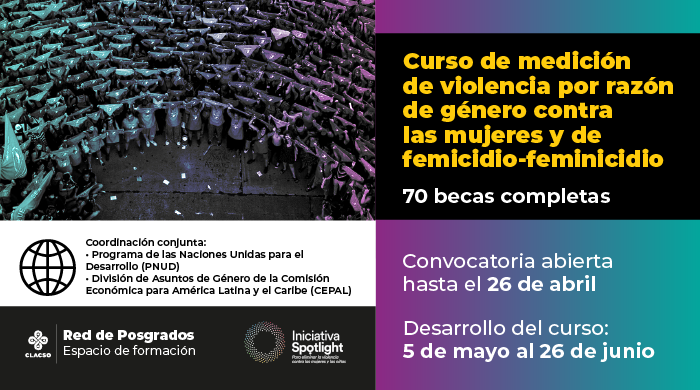
The Latin American Council of Social Sciences (CLACSO), the Gender Affairs Division of the Economic Commission for Latin America and the Caribbean (ECLAC), the United Nations Development Programme (UNDP) and the Regional Spotlight Programme will award 70 full scholarships to perform the course on measuring gender-based violence against women and of femicide-feminicide.
ACADEMIC COORDINATION: Alejandra Valdés (Gender Affairs Division, Economic Commission for Latin America and the Caribbean, ECLAC)
Home: 05/05/2021 | Submissions: 13/04/2021 to 26/04/2021
Tuition scholarships – Free course
CLACSO, ECLAC, UNDP and the Regional Spotlight Programme will grant 70 scholarships to public officials of state institutions and/or civil society organizations responsible for the production of socio-statistical information on violence against women and femicide-feminicide
The scholarships cover 100% of the tuition cost.
Application requirements:
- The participants will be selected by an evaluation committee appointed by the convening organizations.
- Applications will be submitted through the CLACSO website.
- The candidates must:
- Complete your personal details
- To prove their institutional affiliation as public officials and/or professionals dedicated to the subject.
- The available scholarships will be allocated respecting regional diversity and gender equity.
- An Academic Committee will review the applications and award the scholarships; the decision cannot be appealed. The results will be announced by CLACSO.
- This call for applications will remain open. until April 26.
Gender-based violence against women is a fundamental human rights violation and a major obstacle to development in Latin America and the Caribbean. It violates and restricts women's enjoyment of their fundamental rights and freedoms, with serious consequences for the health, economic opportunities, rights, and well-being of between 30% and 70% of women in the region. Its consequences not only profoundly affect the lives of women victims but also threaten the stability, security, and well-being of their families and communities. For more than three decades, this scourge has been one of the most pressing issues on the international and regional human rights agenda.
The challenge of measuring the prevalence and incidence of gender-based violence against women has been a concern of international instruments. In Latin America, the Declaration on the Elimination of Violence against Women (1993), the Beijing Declaration and Platform for Action (1995), the Convention on the Elimination of All Forms of Discrimination against Women (CEDAW), the Belém do Pará Convention, the Regional Gender Agenda, and the 2030 Agenda have all established that efforts to end violence against women must be accompanied by rigorous and reliable statistics.
The duty of due diligence of States, enshrined in CEDAW, obliges them to adopt all appropriate measures to prevent, investigate, prosecute, punish, and provide redress for acts or omissions by non-State actors that result in gender-based violence against women. This obligates State actors to investigate and record the various services provided by the State to victims and survivors, and consequently, to produce and disseminate statistical data derived from State efforts in prevention, support, redress, and protection of victims, as well as from judicial proceedings. Along with implementing strategies to end gender-based violence against women, these efforts must be accompanied by reliable statistics on the various manifestations, characteristics, causes, and consequences of gender-based violence experienced by women in all their diverse contexts and situations.
The accumulated analysis of the processes of measuring and investigating gender-based violence against women has been built thanks to the consensus of international, state, academic and civil society actors, which has allowed progress in strengthening a socio-statistical analytical field of great importance for the social sciences and its implications in different areas of knowledge.
The proposal of this course consists of generating a virtual training space, with expository classes and discussion forums, taught by professionals and academics with extensive experience in the formulation, analysis of public policies and the measurement of gender-based violence against women in countries of Latin America and the Caribbean.
The course contains a proposal that will allow its participants to advance in the theoretical analysis of gender-based violence against women and in the characteristics of confronting it, mainly with a perspective of measuring its prevalence and incidence, as well as processes and results in the application of public policies.
GENERAL PURPOSE
Participants in the course will learn about the processes for measuring gender-based violence against women in Latin America. They will consider the differences between official statistics on the prevalence and incidence of gender-based violence against women and quantitative information, derived from administrative records, on the actions taken by the public sector to address and combat the violence experienced by women.
SPECIFIC OBJECTIVES
- To understand the characteristics of gender-based violence against women, in relation to the international and regional regulatory framework, particularly its mandates and recommendations on measuring its prevalence and incidence.
- To describe the analytical framework for the production of information on gender-based violence against women and the necessary ethical parameters for the collection and dissemination of information.
- Identify the main sources, procedures and indicators for measuring gender-based violence against women.
- Analyze the progress of surveys on gender-based violence against women and their methodological challenges.
- Developing capacities to generate statistics from administrative records and their usefulness in accounting for state and civil responses to gender-based violence against women.
- Sources and procedures used to measure gender-based violence against women
- Monitoring the Belem do Pará Convention. Compliance process indicators
- Administrative records on violence against women, standardization for the generation of statistics on violence against women in general, and on femicide
- The quality of the measurement of femicide/feminicide and violent deaths due to gender
- Proposal for standardization. The Single Registry of Femicide for Latin America and the Caribbean
- New dimensions of analysis in violence against women, disappearances, trafficking and femicide. Challenges of information gathering.
- The challenges of intersectionality for measuring extreme violence against women
- Measuring violence against women and girls during the COVID-19 crisis: Old measurement problems versus new and urgent responses.
- Lessons learned and challenges in measuring gender-based violence against women.
The seminar will be developed in 15 sessions led by the teaching team.
Once a week, at the beginning of each class, participants will have a synchronous virtual meeting and watch an explanatory video on the topic covered in the session, along with required and optional reading materials. Participants will be able to review the materials and participate in the proposed activities (for one week after their publication). Afterward, the instructor for each class will answer participants' questions.
Selected applications
| Ana Gabriela | García Sierra | Argentina | Gov. Justice | National Directorate of Gender Policies Ministry of Security of the Nation |
| Aimee Sabrina | Zambrano Ortiz | Venezuela | osc | Utopix Femicide Monitor |
| Alejandra | Egido | Argentina | CSO | Everything in Sepia - Association of Afro-descendant Women in Argentina |
| Alejandro | Cano Galicia | Mexico | Gov. Mam | National Institute for Women |
| Ana Gabriela | Zàrate | Panama | Government Security | Ministry of Public Security |
| Ana Ivett | López Gutiérrez | Mexico | Government Security | Public security |
| Ana Karen | Aguilar Pérez | Mexico | Gov. Mam | National Institute for Women of the Federal Government |
| Ana Laura | López | Argentina | Gov. Justice | Specialized Prosecutor's Unit for Violence Against Women – Ufem |
| Ana Laura | Reyes Millán | Mexico | Gov. Ones | National Institute of Statistics and Geography (Inegi) |
| Asterius | Lamb | Brazil | Government Security | Federal police |
| Assumption | Sticky | Paraguay | CSO | Purple Magnifying Glass Observatory |
| Beatriz | Condori Quispe | Bolivia | CSO | Gregoria Apaza Women's Promotion Center |
| Emerald Belgium | Rodríguez García | Guatemala | Gov. Justice | Judicial system |
| Blanca Maria | Velasquez | Honduras | osc | Bar Association |
| Bridget | Decrease | Peru | Gov. MAM | Ministry of Women and Vulnerable Populations |
| Carlos Eduardo | Revoredo Mendieta | Peru | Gov. Mam | Regional Observatory of Violence Against Women and Members of the Family Group – La L |
| Carolina | flycatcher | Colombia | CSO | Sisma Mujer Corporation |
| Carolina | Herrera | Mexico | Gov. MAM | Ministry of the Interior/CONAVIM |
| Catalina | Rufs | Chile | CSO | Gender and Intersectionality Observatory (ODEGI Chile) |
| Catalina | Reyes | Mexico | CSO | Plural Network of Women |
| Cecilia | Mena | Ecuador | Gov. Other | Secretary of Human Rights |
| Cecilia | Erhardt Ayala | Uruguay | Gov. Other | Home Office |
| Cecilia Andrea | Capozzoli Barretto | Uruguay | Gov. Justice | Attorney General's Office |
| Caesar | Pinzón-Medina | Colombia | Gov. MAM | Presidential Advisory Council for Women's Equity |
| Cinthia Marcela | López | Honduras | Gov. Mam | National Institute for Women |
| Claudia | González | Chile | Gov. MAM | Ministry of Women and Gender Equity |
| dahiana | Cañete | Paraguay | CSO | CEPEP – Paraguayan Center for Population Studies (NGO) and Family Clinics (Social Rate) |
| Damaris Mery | Hervacio Lermo | Peru | Gov. Mam | Ministry of Women and Vulnerable Populations |
| Dania Maria | Bustamante Castillo | Guatemala | Gov. Mam | Secretariat Against Sexual Violence, Exploitation and Trafficking in Persons |
| Danielly | Queiros | Brazil | Gov. Justice | National Council of Justice |
| David | Moreira | Uruguay | Gov. MAM | Ministry of Social Development/Inmujeres |
| Delia Rosa | Suárez Socarrás | Cuba | Gov. Other | National Center for Sex Education |
| Diana Paola | Montealegre Angarita | Colombia | Gov. Other | Presidency of the Republic |
| dinor | Cents | Guatemala | CSO | Trans Queens of the Night Organization-OTRANS-RN/USAC, Guatemala |
| Elder Carmenza | Vasquez Mejia | Colombia | Gov. Justice | Attorney General's Office |
| Elenita Alexandra | Enriquez Montenegro | Ecuador | Gov. Justice | Judicial Council |
| Eliana Lorena | Copse | Argentina | Gov. Mam | Ministry of Women, Gender and Diversity |
| Elizabeth | Lugo | Paraguay | Gov. Ones | National Institute of Statistics |
| Eloy | Jimenez | Panama | Gov. Justice | Judicial Body |
| Elsa Esperanza | López | Venezuela | Gov. Other | Ministry of Popular Power for Education |
| Stephanie | Rivera Guzmán | Colombia | CSO | Feminist Antimilitarist Network – Observatory of Femicides in Colombia |
| Evany Gicela | Cente Garcia | El Salvador | Gov. Justice | Supreme Court of Justice |
| Evelyn Viviana | Colantes Villacis | Ecuador | Gov. Justice | Judicial Council |
| Fabiana | Mautone | Uruguay | Gov. Ones | NATIONAL DIRECTORATE OF CIVIL IDENTIFICATION |
| Fergie Alexandra | Ubeda Obando | Nicaragua | Gov. Justice | Supreme Court of Justice. Legak Institute of Medicine |
| Fernanda | Gutierrez | Costa Rica | CSO | ACCEDER Citizens' Association (Strategic Actions for Human Rights) |
| Francisca | Rusque | Chile | CSO | Feminist Memorial on Femicide Violence |
| Gabriela | Delgado Hidalgo | Costa Rica | Gov. MAM | National Institute for Women |
| Gem | Manzanares | Nicaragua | CSO | Observatory for the Life of Women |
| Giovanna Gabriela | De Leon Fernandez | Uruguay | osc | Red Woman Afro-Latin American, Afro-Caribbean (Rmaad), Colectivamuj (Uy), Comunamujer, Col. Pitanga and Mua |
| Gladys Zulema | Galo Valladares | Honduras | Gov. Mam | National Institute for Women |
| Gretel | Arrowroot | Cuba | CSO | Federation of Cuban Women |
| Henry | Marques Ribeiro | Brazil | Gov. Other | Federal Senate – Women's Observatory Against Violence |
| Hulda Maria | Zorrilla Rodriguez | Dominican Republic | Gov. Mam | Ministry of Women |
| Indhira Libertad | Rodríguez Mendoza | Venezuela | osc | Collective Network The Feminist Spider |
| Inés Erandi | Arce Hernández | Mexico | Gov. Ones | National Institute of Statistics and Geography (Inegi) |
| ingri | Vasquez | Venezuela | Gov. MAM | National Institute for Women |
| Isabela | Collected | Brazil | CSO | Brazilian Public Security Forum (FBSP) |
| Isis | Araujo | Brazil | CSO | Igarapé Institute |
| Janeth | Arveras | Bolivia | Gov. Justice | MINISTRY OF JUSTICE |
| Jessanin Diosmery | Frías Peña | Dominican Republic | Gov. Ones | National Statistics Office |
| Jorge Nolberto | Herrarte García | Guatemala | Gov. Justice | Office of the Ombudsman for Indigenous Women |
| Jose Alberto | Bogantes Camacho | Costa Rica | Gov. Other | National Children's Welfare Board |
| Jose Alejandro | Rivero Linares | Venezuela | osc | Center for Justice and Peace |
| Joseph Ricardo | Martinez Zegarra | Peru | Gov. Justice | public ministry |
| Joselyn | kung | Costa Rica | Gov. Justice | Judiciary |
| Julia | By Miranda Goromar | Brazil | Gov. Other | Municipal Government of the City of Niterói – Coordination of Rights and Policies for Women |
| Karen Edith | Morataya López | El Salvador | osc | Iris Foundation of Central America |
| Karina Alexandra | Garcia Garcia | Ecuador | Gov. Mam | National Council for Gender Equality |
| Karla | Farmlands | Guatemala | CSO | Mutual Support Group (GAM) |
| Karla Susana | Peña Vasquez | El Salvador | Gov. Justice | Office of the Human Rights Ombudsman |
| Katherine | Mendoza | Mexico | CSO | Justicia Pro Persona.AC Member of the National Citizen Observatory of Femicide in Mexico |
| Kimberly | araya | Costa Rica | Education Sector | CIT Educational Complex |
| Krissia Guadalupe | Aquino Cordova | El Salvador | osc | Ixchel Women's Association |
| Lara | Andrés | Argentina | CSO | Observatory of Gender Violence Now That They See Us |
| Laura | triaca | Uruguay | Gov. Other | Ministry of Labor and Social Security |
| Laura Elizabeth | Rodriguez Ruiz | Mexico | Government Security | National Antikidnapping Coordination |
| Leoncia | PARIONA TARQUI | Peru | CSO | Center of Indigenous Cultures of Peru-CHIRAPAQ |
| Lersy G. | Boria Vizcarrondo | Puerto Rico | Gov. MAM | Office of the Women's Advocate |
| Lilian Karina | Xinico Xiquitá | Guatemala | Gov. Justice | Indigenous Women's Advocacy Office, Demi |
| Liliana | Segura | Colombia | Gov. Justice | Attorney General's Office |
| Linda Loaiza | Lopez Soto | Venezuela | osc | Civil Association Women Online |
| Lourdes Marcela | Flores Solíz | Bolivia | Gov. Justice | Ministry of Justice and Institutional Transparency |
| Lucrecia | Aguilar | Guatemala | Gov. Justice | Constitutional Court |
| Madeline | Bermúdez Sanabria | Puerto Rico | Gov. MAM | Office of the Women's Advocate |
| Marcela | arroyave | Costa Rica | Gov. MAM | National Institute for Women |
| María | Gonzales | Honduras | Gov. MAM | National Institute for Women |
| María | Morales | Nicaragua | CSO | Nicaraguan Foundation for Economic and Social Development (FUNIDES) |
| Maria Alejandra | Lara | Colombia | Gov. Ones | National Administrative Department of Statistics – DANE |
| Maria Del Rosario | go up | Argentina | Gov. Justice | National Directorate of Gender Policies Ministry of Security of the Nation |
| Maria Ximena | Fiallo | Ecuador | Gov. Justice | Secretary of Human Rights |
| Marisol | Iglesias Rodríguez | Cuba | CSO | Center for Women's Studies (CEM) /FMC, Mechanism for the Advancement of Women |
| Martha Delia | Leiva Welchez | Honduras | Gov. Ones | National Institute of Statistics (INE) |
| Mary Isabel | Olivera Gutierrez | Bolivia | osc | September 28 Campaign of Bolivia; Sorority Articulation Bolivia; Platform for the Fight Against Violence |
| Matias | Gurevich | Argentina | Gov. Justice | Specialized Prosecutor's Unit for Violence Against Women – UFEM |
| Michael | Diaz Mendoza | Venezuela | Gov. Justice | Public ministry |
| Michael Ignatius | Piana | Argentina | osc | Mundosur (Civil Society Organization) |
| Milenka | Sarmiento Marquez | Bolivia | Gov. Justice | Ministry of Justice and Institutional Transparency |
| Miriam Edith | Figueroa Quijada | Honduras | Gov. Justice | Public Prosecutor's Office, Special Prosecutor's Office for Human Rights |
| Mirna Guadalupe | henriquez | El Salvador | Gov. Mam | Salvadoran Institute for the Development of Women |
| Monica | García Barco | Colombia | Gov. MAM | Line 123 Metropolitan Women – Secretariat for Women |
| Monica | Benson | Panama | CSO | Clara González Foundation for Legal and Social Studies and Comprehensive Support for Survivors of Violence |
| Nadia Leticia | Rivarola Barrios | Paraguay | Gov. Mam | Ministry of Women |
| Nairoby | Chalas | Dominican Republic | Gov. MAM | Ministry of Women |
| Natalia | Obregón Sepúlveda | Chile | Government Security | Institute of Criminology of the Chilean Investigative Police (CAVAS). |
| Nicolasa Marisol | Chavajay Ortiz | Guatemala | Gov. Justice | Public ministry |
| Norah Antonieta | Quispe Chipana | Bolivia | Gov. Mam | General Directorate for the Prevention and Elimination of All Forms of Gender-Based Violence |
| Norma | Medina | Paraguay | Gov. Ones | National Institute of Statistics |
| Bride | Neighborhoods | Panama | Gov. MAM | National Institute for Women |
| Paola | Moreira | Ecuador | Gov. Justice | State Attorney General's Office |
| Paola Fernanda | Maldonado Tobar | Ecuador | osc | Village Foundation |
| Ramon | eraser | Dominican Republic | Gov. MAM | Ministry of Women |
| Rachel | Vivanco | Argentina | Gov. MAM | Ministry of Women, Gender and Diversity of the Nation |
| Rachel | carcamo | Honduras | CSO | Ecumenical for the Right to Decide |
| Pink | Ixcol Mus | Guatemala | CSO | AJKAWB'IL |
| Rosario | Gomez | Ecuador | CSO | Matilde Refuge House Foundation www.Fundacionmatilde.Org |
| Salma Sabina | Martinez Franco | Paraguay | Gov. Justice | Public ministry |
| Santiago | Ipial | Ecuador | Gov. Justice | Judicial Council |
| Would | Rodriguez Alamo | Puerto Rico | Health sector | Puerto Rico Department of Health |
| Sofia | Harley | Uruguay | Gov. Justice | Attorney General's Office |
| Soledad | González | Uruguay | CSO | Everyday Woman |
| Sonia Irma | Chia Lopez | Peru | osc | Chirapaq Center of Indigenous Cultures of Peru |
| Sue Helen Nayarit | Ocampo Padilla | Honduras | osc | Women's Rights Center (Cdm) |
| Thomas | Barrier | Chile | Education Sector | Museum of Memory and Human Rights |
| Vanesa | Friedman | Argentina | Gov. Justice | Specialized Prosecutor's Unit for Violence Against Women – UFEM |
| Vera Aparecida | Dos Santos | Brazil | osc | Promotoras Legais – Plps -Grupo Mariele Franco/Pimentas- Guarulhos E Educafro |
| Veronica | Gonzalez De Alba | Mexico | CSO | CESUP, Center for Urban Security and Prevention, SC |
| Victoria | Gallo Llorente | Argentina | Gov. Mam | Ministry of Women, Gender and Diversity of the Nation |
| Victoria Elvira | Neuta Sanchez | Colombia | osc | National Indigenous Organization of Colombia – ONIC |
| Victoria Jetzabeth | Sequera Salas | Venezuela | Gov. Justice | Public Ministry (General Directorate for the Protection of the Family and Women) |
| Vivian | Palacios | Chile | CSO | Abofem |
| Viviana | War | Ecuador | Gov. Justice | State Attorney General's Office |
| Willy Ney | Otañez Reyes | Dominican Republic | Gov. Ones | National Statistics Office |
| xadani | Arvizu | Mexico | Gov. Mam | National Institute for Women |
| Xenia Yanira | Moroccan | El Salvador | osc | Salvadoran Women's Movement (MSM) |
| Ximena Pilar | Cabrera Montufar | Ecuador | Gov. Justice | Ombudsman's Office of Ecuador Directorate for the Prevention of Violence Against Women and LGBTQ+ People |

