
Short course: The invisible tasks. Gender, social organization and community networks of care
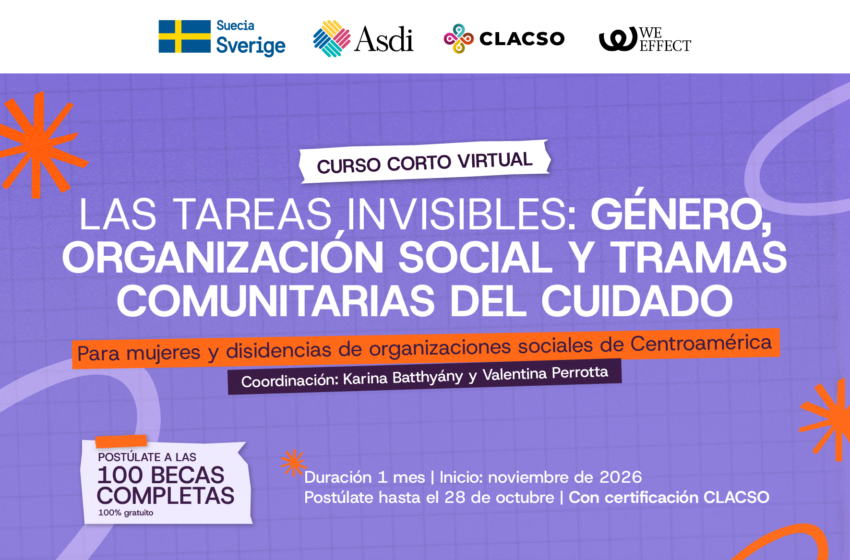
The Latin American Council of Social Sciences (CLACSO) and We Effect invite you to participate in the course "The Invisible Tasks: Gender, Social Organization, and Community Networks of Care ," an initiative aimed at women members and leaders of We Effect partner social organizations in Central America. No prior studies are required.
ACADEMIC COORDINATION: Karina Batthyány (University of the Republic, Uruguay) and Valentina Perrotta (University of the Republic, Uruguay)
TEACHING TEAM: Karina Batthyány (UDELAR, Uruguay), Valentina Perrotta (UDELAR, Uruguay), Laura Pautassi (UBA, Argentina) and Suellen Castiblanco (La Salle, Colombia)
TUTORING TEAM: Magela Romero Almodovar (University of Havana, Cuba), Ana María Agredo (Colombia), Mariana Rulli (UBA, Argentina) and Karina Brovelli (UBA, Argentina)
Duration: November 9, 2026 to December 4, 2026 | Scholarship applications: October 16, 2026 to October 28, 2026
CLACSO and We Effect will award 100 full tuition scholarships, primarily to women members and leaders of We Effect's partner social organizations in Central America. People of other gender identities and men committed to this agenda are also welcome to apply.
Participants must have the time to dedicate to attending the classes planned in this program in both synchronous and asynchronous formats.
Inquiries: [mail protected]
Caring for children, the elderly, people with disabilities, or the sick. Cooking, cleaning, companionship, and looking after others. All of this is work, even though it's unpaid and almost no one sees it. In Latin America, this work is done primarily by women, in our homes and also in our communities: in soup kitchens, community kitchens, neighborhood networks, and organizations.
That women bear the brunt of caregiving is not natural. It depends on how roles have been historically divided between men and women within families, and between families, the state, the market, and the community. And this unfair distribution can be changed. In recent years, thanks to the struggle of feminist movements and social organizations, many countries and cities have begun to implement care policies to make this distribution of caregiving tasks fairer, and today it is recognized that caring and being cared for is a right.
This course is a space for us to think together, based on our experiences and work within our organizations. We want to share tools to understand how care work and to demand better responses from the government in our communities.
GENERAL PURPOSE
To provide tools to understand care and to have an impact, so that leaders of social organizations can demand better responses from the State in matters of care in their territories.SPECIFIC OBJECTIVES :
- Recognize care work as a life-sustaining job that all people need.
- Understanding how care is distributed today between men and women, and between families, the State, the market and the community, and why that distribution is unfair.
- Understanding why care is a right.
- Analyzing how racism, migration, and poverty cause some women to bear an even greater burden of caregiving.
- To learn about the achievements of feminism in the region and the care policies and systems that exist today.
- Think about what organizations can demand and how to participate in care policies.
Teacher: Karina Batthyány
- What do we mean by caring: feeding, bathing, accompanying, cleaning, organizing the house, being attentive.
- Everyone needs care at some point in their life.
- Why is this work unseen, unpaid, and almost never recognized?
- Why it falls mainly on women and how that affects us: less time, less income, more tiredness.
Teacher: Karina Batthyány
- Care is distributed among families, the state, the market, and the community. We call this the social organization of care.
- Today that distribution is unequal: families, and within them women, bear almost everything.
- What community organizations do: soup kitchens, dining halls, daycare centers, neighborhood networks.
- Not all families can afford care: differences between those with more and fewer resources, and between rural and urban areas.
Teacher: Laura Pautassi
- From care as an obligation of women to care as a right of all people.
- The three dimensions of the right: the right to care, the right to receive care, and the right to self-care.
- If care is a right, the State has to guarantee it and the responsibility is shared.
- Care is already recognized as a right in Latin America.
Teacher: Suellen Castiblanco
- Women who leave their country or town to care for other families, and who care for their own families.
- Paid domestic work: low wages, informality and lack of rights.
- Why do indigenous, Afro-descendant, and migrant women provide more care and under worse conditions?
- How do inequalities of gender, origin, skin color, and poverty add up?
Teacher: Valentina Perrotta
- How feminist and women's movements ensured that caregiving was no longer solely a domestic issue.
- What they proposed: national and local care policies and systems.
- What makes a care policy truly change women's lives: recognizing care work, reducing its burden and distributing it better between men and women, and between families, the State, the market and the community.
Teacher: Valentina Perrotta
- What are different countries and cities in the region doing in terms of care?
- What they have in common and what problems they face: lack of money, services that do not reach everyone, changes of government.
- How social organizations have participated: proposing, monitoring and giving opinions on how they work.
- What can we demand to truly participate: spaces, information, clear rules, and that our voice counts in decisions.
The course follows the principles of popular education. We begin with what participants experience and do in their homes, communities, and organizations, and revisit those experiences with new tools to reflect and collectively build knowledge. The classes use simple language and relatable examples. The program combines a recorded class with a weekly virtual tutoring session, integrating coursework with the content and group discussion.
Recorded classes. Each class is published as a video so it can be viewed at any time, according to each participant's schedule. It is accompanied by the presentation used and supplementary readings for those who wish to delve deeper.
Virtual tutoring sessions. Each group meets online with its tutor to discuss the course content, ask questions, and share experiences. Each tutor has a fixed day and time, and the four groups have different schedules so that each participant can choose the one that best suits their availability.
Tutorial support. The tutor accompanies her group throughout the course, guides the process, answers questions, and promotes exchange and collective learning.
CLACSO and We Effect will award 100 full tuition scholarships, primarily to women members and leaders of We Effect's partner social organizations in Central America. People of other gender identities and men committed to this agenda are also welcome to apply.
Participants must have the time to dedicate to attending the classes planned in this program in both synchronous and asynchronous formats.
Inquiries: [mail protected]

