
Digital culture and counter-hegemony in the age of Artificial Intelligence
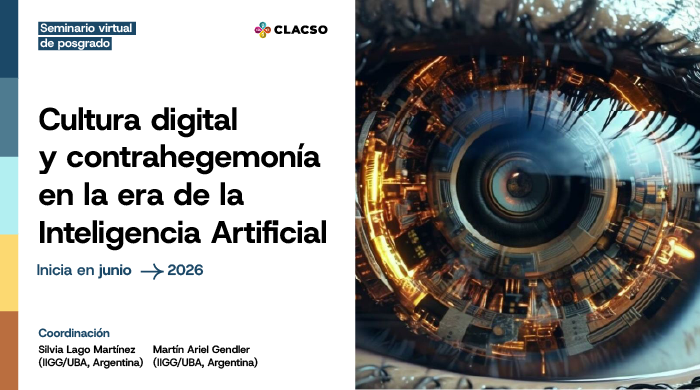
Seminar 2602
Chair: CLACSO
Coordination: Silvia Lago Martínez and Martín Ariel Gendler (University of Buenos Aires, Argentina)
Teaching team: Francisco Javier Moreno Gálvez, Macarena Hernández Conde, Manuel Jesús Sabariego Gómez (University of Seville, Spain), Romina Paola Gala (University of Buenos Aires, Argentina), Silvia Lago Martínez and Martín Ariel Gendler (University of Buenos Aires, Argentina)
Start: 18/06/2026 | Registration: 14/04/2026 to 17/06/2026
Workload: 10 weeks – 90 hours.
The seminar addresses the main debates surrounding the relationship between social, political, economic, and cultural changes and technological change, analyzing the state of the art and the various theoretical frameworks, concepts, and categories. It examines the diverse notions that have been established to define contemporary societies during the stages of informationalism. Furthermore, it introduces the controversies surrounding the reconfiguration of the spheres of cultural creation, the notion of digital culture, and its interpretations in light of the evolution of technologies and business models in the cultural industries. Meanwhile, new modes of appropriation of technologies by citizens and struggles for access to them are emerging. This leads us to the incorporation of the technological dimension into studies of social organizations and movements, and to the digital space as a field of action for social and political struggle. Moreover, the recent landscape introduces a series of problems marked by the centrality of social media platforms, such as political polarization, fake news, hate speech, and so on. Finally, it is analyzed how the proliferation of digital technologies brings with it the extraction of data from individuals and how through these data control and surveillance logics are deployed, as well as the management of behaviors, especially with platforms and artificial intelligence systems.
The mode, nature, and context in which individuals and societies connect, construct, and transform themselves through technologies form the core of this proposed seminar. Beginning in the 1970s, with the emergence of digital technologies, a series of concepts were proposed to account for the socio-technical and organizational transformations that were taking place. Since then, much of the theoretical and academic debate has been approached from diverse interpretive perspectives, constantly being updated to meet the challenge of rethinking new categories and models of analysis. Therefore, it is relevant to briefly reconstruct the background of theoretical perspectives on post-industrial society, postmodern society, the information and knowledge society, and the network society during the period 1970–2008, and then review the most recent positions based on the omnipresence of platforms and, consequently, algorithms.
Similarly, it is necessary to examine the processes of incorporating digital technologies into 20th-century culture to understand how, well into the 21st century, contemporary culture cannot be understood without considering technology, digitization, and platforms. Among these processes, the free culture movements of the 2000s stand out. Inspired by the principles of free software, these movements challenged public and private intellectual property rights on the internet, thereby highlighting the antagonism between copyleft and copyright. In this worldview, the internet constitutes a horizon of equality and a democratic space associated with the notion of the public good and based on the collaborative production of culture and the collective construction of digital knowledge. Currently, the growing centrality of the platform model associated with digital circulation and reproduction is the gateway to new economic and cultural configurations, as well as the notion of "algorithmic governance," which undermines the horizon of internet democratization and freedom. Today, social media platforms are spaces where hate speech, fake news, disinformation, racism, polarization, etc., thrive, in the hands of conservative and authoritarian currents of thought.
However, social organizations and movements, along with emerging forms of digital activism, are using the internet and digital technologies for political purposes, resistance, and to make demands (technopolitics) in response to various social, economic, and political problems. This process became evident around 2010/2011 with the Indignados movement and the so-called "springtime of social movements," but its roots can be traced back to the end of the last century with the Zapatista movement in Mexico. The extensive and intensive use of social media by movements and activists has become a defining characteristic of digital culture due to the impact of their demands and campaigns on citizens and the institutional agenda.
Artificial intelligence, especially generative intelligence, is presented as a cross-cutting theme throughout the seminar. It involves a debate on a recent and developing process deeply linked to the processes of social datafication; the development of algorithmic systems that aim to modulate behavior and subjectivity, primarily those found on digital platforms; and its interconnection with other disruptive technologies such as the Internet of Things, virtual reality, and cyber-physical systems, among others.
Finally, the seminar will present case studies from Latin America and Spain on the program's themes. These are expected to contribute to the participants' research and the development of their final seminar papers.
GENERAL PURPOSE
Analyze the main problems, challenges and opportunities surrounding digital culture and cultural industries; technopolitics; digital platforms, algorithmic systems and artificial intelligence developments, observing in detail their genealogy, particularities and changes presented in each of the stages of informationalism.
SPECIFIC OBJECTIVES
That the students:
- Develop critical thinking skills regarding the theoretical concepts of social and cultural change in contemporary society based on the presence of digital technologies.
- Differentiate the characteristics, particularities, main technologies, central actors and problems of each of the stages of informationalism.
- Address the incorporation of the technological dimension into studies on counter-hegemonic practices in the context of globalization and with the technological basis of the Internet and other digital technologies.
- Critically delve into the issues of social datafication, algorithmic governmentality, and their links to the algorithmic systems of digital platforms and new developments in artificial intelligence, especially generative intelligence.
- Concepts and theoretical perspectives in the first stage of informationalism
- digital culture
- Cultural industries
- Culture of connectivity and digital social networks
- New technologies and political participation. New forms of digital citizenship
- Technologies, control, algorithms and Artificial Intelligence
- Aruguete, and Calvo Ernesto. (2023) It is true that this is an introduction and chapter 10. In Us Against Them. How Networks Work to Confirm Our Beliefs and Reject Those of Others, Madrid: Siglo XXI.
- Berti, Agustín. (2020). The end of the unappropriable: The algorithmic administration of culture. In Technology, politics and algorithms in Latin America, Santiago de Chile, CENALTES.
- Cabello, Roxana (2023) Friendship Century: Meanings and Trends in Digital Culture. In R. Cabello and S. Lago Martínez (Eds.) Culture, Citizenships and Education in the Digital Environment. Buenos Aires: CLACSO-RIAT.
- Castells, Manuel (2006). Chapter 1 “The Information Technology Revolution”. In The Information Age: Economy, Society and Culture. The Network Society. Madrid: Alianza.
- Crawford, (2023). Chapter 4 “The classification” in Atlas of Artificial Intelligence. Power, politics and planetary costs of artificial intelligence. FCE.
- Galliano, Alejandro (2024). Chapter 4: Capitalism 4.0. In The Ungovernable Machine: History of Four The Cat and The Box: Buenos Aires.
- Gendler, Martín (2017). Control Societies: readings, dialogues and (some) updates. Hypertexts, 5(8), 60–87.
- Gendler, Martín (2024). Social Dataification and Artificial Intelligence: towards a new “leap of scale”? Journal of Philosophy, (17), 121–141.
- Harvey, David (1998). Chapter 17 “Space-Time Compression and the Postmodern Condition”. In The Condition of Postmodernity. Buenos Aires:
- Himanen, Pekka (2001). Part Three: Netics or Network Ethics. Epilogue by Manuel Castells: Informationalism and Society in The Hacker Ethic and the Spirit of the Information Age.
- Lago Martínez, Silvia (2012). “Communication, art and culture in the digital age”. In Cyberspace and resistances. Exploration in digital culture. Buenos Aires: Hekht Libros.
- Lago, Silvia, Gendler, Martín, and Méndez, Anahí (2021). “Social movements, appropriation of digital technologies, and transformations in collective action processes.” In Unfinished Democracy: Social Movements, Public Sphere, and Digital Networks. UNAM
- Laudano, Claudia and Sued, Gabriela (2023). “Between the streets and the networks: public expression and digital feminist activism”. Zona Franca Magazine (31).
- Levy, Pierre (2007). Chapter I Do Technologies Have an Impact? and Chapter VII “The Social Movement of Cyberculture”. In Cyberculture: The Culture of Digital Society. Mexico: Anthropos
- López, Sara, Roig, Gustavo, and Sádaba, Igor (2003). New technologies and political participation in times of globalization. HEGOA. Section 3: Examples of activism/intervention in
- Martel, Frederic (2015). Chapter 9 “From culture to content” in Smart: Internet(s), the research. Buenos Aires: Taurus.
- Audiovisual material: Documentary “Digital Culture: New forms of political intervention” (2010). Production of the Society, Internet and Culture Research Team (ESIC) of the Gino Germani Institute (UBA).
- Mattelart, (2002). Chapter 4 “Post-industrial scenarios”. In History of the Information Society. Barcelona: Paidós.
- Rodríguez, Pablo (2019). Chapter 9: “On Control Societies”. In Words in Things: knowledge, power and subjectivation between algorithms and biomolecules. Buenos Aires: Cactus.
- Rouvroy, Antoinette. and Berns, Thomas. (2016). Algorithmic governmentality and perspectives of emancipation. Disparity as a condition of individuation through relationship?, Philosophical Addendum, (1), 88-116.
- Rovira, Giomar (2017). Networked activism and connected crowds: communication and action in the age of Icaria. Introduction and chapter 1: Capture networks: technology and capitalism.
- Sadin, Éric. (2020). Artificial Intelligence or the Challenge of the Century. Part 2, Chapter 1 “The emergence of a new regime of truth”. Buenos Aires: Caja Negra
- Srnicek, Nick (2018). Introduction and Chapter 1 “The Long Recession”. In Platform Capitalism. Caja Negra Editora: Buenos Aires.
- Tremblay, Gaëtan (2011). Cultural Industries, Creative Economy and Information Society. In Power, Media, Culture. A Critical Look from the Political Economy of Communication. Buenos Aires: Paidós.
- Van Dijck, José (2016) Chapter 1 “The production of sociability within the framework of a culture of connectivity” in The culture of connectivity: a critical history of networks Buenos Aires: Siglo XXI.
- Varoufakis, Yanis (2023). Introduction and Chapter 5 “What does a word contain? In Technofeudalism: the stealthy successor of Buenos Aires: Planeta.
|
Early registration (until 05/05) |
General registration (May 6th to May 11st) |
Registration without discount |
|
|
Full or Associate Member Center |
$100 |
USD 150 |
$200 |
|
No link |
$150 |
USD 225 |
$300 |
FAQ
The basic requirements for taking a seminar are:
- Availability of at least 4 hours per week to dedicate to the seminar course.
- Internet access.
- Reasonable handling of communication and computer tools.
- Language proficiency in the language in which the course will be taught. The official languages are Spanish and Portuguese.
The seminars last 10 weeks, plus the completion of a final project. A total of 90 hours of dedication will be credited.
A course consists of ten classes, each accompanied by required reading bibliography, supplementary bibliography, discussion forums and training activities proposed by the teaching team, partial deliveries and a final project.
The course is online and asynchronous. Some instructors may propose synchronous activities. In those cases, the time and date will be agreed upon beforehand between the instructors and the students to ensure everyone's participation. Attendance at synchronous sessions is not mandatory.
To pass the seminar, you must participate in at least 80% of the discussion forums and activities proposed by the teachers, have completed the scheduled partial deliveries, and pass the final work.
| Early registration (until 10/08) | General registration (11/08 to 10/09) | Registration without discount (11/09 to 16/09) | |
| Full or Associate Member Center | $100 | USD 150 | $200 |
| No link | $150 | USD 225 | $300 |
The possible payment methods are by credit card or bank transfer.
Inquiries: [mail protected]

