
Community Care in Latin America and the Caribbean
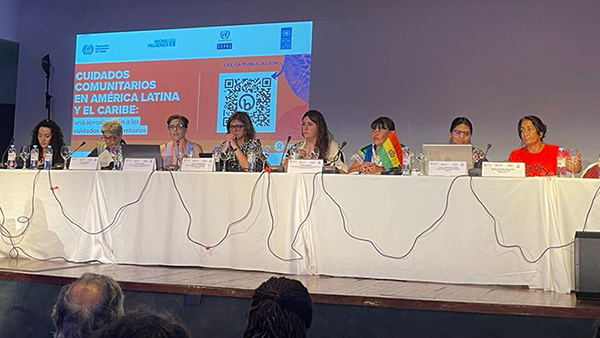

Within the framework of the XV Regional Conference on Women in Latin America and the Caribbean, which is being held in Buenos Aires from November 7 to 11, the Executive Director of CLACSO, Karina Batthyány, was part of the panel “ Community Care in Latin America and the Caribbean: an approach to care in the territories ”, with the participation of the Government of Bolivia, UNDP, ECLAC, UN Women, ILO and OXFAM.
The opening session included speeches by María Lucía Scuro, Social Affairs Officer of the Gender Affairs Division of ECLAC; Nasheli Noriega of OXFAM; María Noel Vaeza, Regional Director of UN Women for the Americas and the Caribbean; Wendy Pérez Salinas, Director of the Plurinational Service for Women and Depatriarchalization “Ana María Romero” of the Plurinational State of Bolivia; Linda Maguire, Regional Director of UNDP for Latin America and the Caribbean; Yukiko Arai, ILO Reader in Argentina; and Guillermina Martin, Leader of the Gender Area of UNDP for Latin America and the Caribbean.
Then, Uruguayan teacher and feminist Lilian Celiberti presented the panel “ Community Care in Latin America and the Caribbean: An Approach to Care in the Territories .” Participants included: Argentine sociologist Cecilia Fraga, a care specialist and author of the document; Eliana Aguirre, Secretary of Institutional Relations for the Central Union of Workers of Argentina (CTA) La Plata Regional; Lusbey Méndez Santiz, from the Maya-Yzoteil Unit of Chiapas, Mexico; and María Claudia Albornoz from La Garganta Poderosa of Argentina.
In her remarks, Karina Batthyány thanked the other panelists for their contributions to the deeper understanding of the challenges facing rural life in the region and presented the CLACSO-UN Women research project, “ State of the Art on Rural Care in Latin America and the Caribbean, ” which advocates for “a Latin American research agenda on care in rural contexts.” Within this framework, she highlighted six key points:
1. What justifies the work itself is the “context that has fewer services and less infrastructure (in general and care services in particular), that is often more isolated or where distances are greater, and where 'daily life' is more burdensome. Caring for others/oneself requires greater effort, and the burden of care falls even more heavily on families and women.” She advocated for a closer connection with the environment, which is also part of care work.
2. More comprehensive conceptions of care: “Caring is caring for others, the environment, and the community. There is a strong interdependence between people as well as with the inhabited environment, which is why caring for nature and animals is vital for social well-being.”
3. More traditional social representations of care: “They reinforce the role of women as mothers and caregivers and 'penalize' the men they care for.”
4. Studies in Indigenous communities: “We must critique conceptualizations of care based on a hegemonic vision of 'a' urban white-mestizo woman without considering the diversity of meanings and practices that women and communities have regarding care.” She also highlighted “the role of women as guardians and caretakers of the body and the territory (…) The construction of childhood is different in Indigenous communities and in rural areas.”
5. Public policies: “They are scarcer and generally do not incorporate a rural perspective. Furthermore, public policies aimed at rural/agricultural areas generally do not mainstream care. Different conceptions of care—interculturality—create tensions when designing public policies and considering their use by the population. (…) The role of the community and territorial networks in caregiving within rural contexts must be considered. However, this should not romanticize community, which can also perpetuate multiple gender inequalities.”
6. Agenda under construction: “There is a lag in relation to urban studies and in particular in certain more invisible groups.”

The team working on the report “ State of the Art on Rural Care in Latin America and the Caribbean ” included Paola Mascheroni (coordinator), Alfonsina Alberti, and Sofía Angulo. Director: Karina Batthyány; General Coordination: Pablo Vommnaro; Collaboration and Review: Cecilia Gofman; Graphic Design: Marcelo Giardino.

XV Regional Conference on Women in Latin America and the Caribbean
If you would like to receive more information about CLACSO's training programs:
[widget id=”custom_html-57″]
to our email lists.

