
Cuba resists. Support Cuba.
María Isabel Domínguez[1]
Havana Cuba
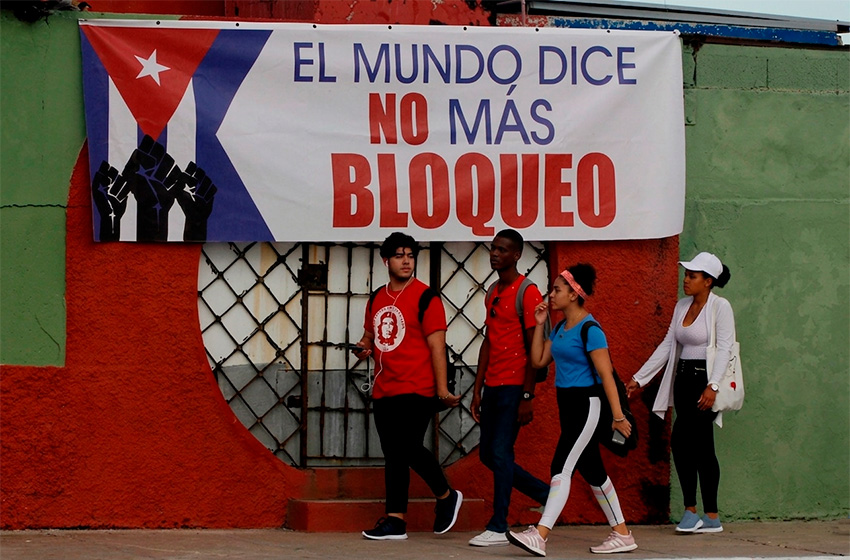
Today Cuba is experiencing a critical moment in its history, facing a war without bombs that exacerbates to an unsustainable extreme the more than six decades of economic, commercial and financial blockade and covert aggression by the United States, aimed at forcing a change of political system and regaining its control over the Island.
Treating Cuba as a neocolonial appendage of the United States has been a goal since the 19th century. Its intervention in the Spanish-Cuban-American War robbed the Cuban rebels of victory and imposed the ominous Platt Amendment, which inaugurated a neocolonial republic that lasted for more than half a century. Today, we see numerous Western historians discussing the Spanish-American War while erasing Cuban participation in the conflict.
The popular, democratic, and anti-imperialist revolution that triumphed in 1959, later proclaimed socialist, located ninety miles from the United States and sustained for almost seven decades despite all manner of maneuvers to defeat it, has been the thorn in the side of the longest-standing attempts to turn the entire Latin American and Caribbean region into its backyard. For Cuba has not been an isolated case, but rather an example that it has been possible to build a society with equity and social justice, while maintaining sovereignty, without exploitation or discrimination.
The Cuban Revolution has not been without its errors, many stemming from the conditions of a “besieged stronghold” under which it has had to develop, and others from its own internal dynamics, fear of change, bureaucratic tendencies, and reduced participation. At various points throughout the revolutionary process, there has been no shortage of critical analyses and attempts to rectify “negative tendencies” or “distortions,” which have often come too late. Much could have been done differently, but Cuba has lacked the leeway to pursue the project it might have desired and has instead pursued the one it could, given the circumstances. These circumstances, from the very beginning, were marked by the declared intention of stifling the revolutionary project.
At the risk of repeating widely known information, I cannot fail to mention that, as early as April 1960, the then Assistant Secretary of State for Inter-American Affairs of the United States, Lester D. Mallory, drafted a Memorandum that has become known as the Mallory Memorandum, in which he advised:
To promptly employ all possible means to weaken the Cuban economy. If such a policy is adopted, it must be the result of a firm decision that triggers a course of action which, while as discreet and skillful as possible, achieves the greatest impact in denying funds and supplies to Cuba, reducing monetary and real wages, and consequently causing famine, desperation, and the overthrow of the government.
Two years later, President John F. Kennedy signed the Executive Order that formalized the economic, commercial, and financial blockade against Cuba, the longest-lasting economic war against any sovereign state, which at different times has been strengthened with new measures to achieve the purpose of starving the Cuban people: the Torricelli Act in 1982, the Helms-Burton Act in 1996 with its marked extraterritorial character, the 242 measures of the first Trump Administration, and the placement of Cuba on the list of countries that supposedly sponsor terrorism.
That policy reached its peak in 2026. On January 29, President Donald Trump declared an energy blockade, described as a blockade within a blockade, which has plunged the country into prolonged blackouts. So far this year, only one ship has arrived in Cuban ports, carrying 730 tons of oil as humanitarian aid from Russia.
Fuel shortages are causing prolonged blackouts for the population, lasting more than 20 hours, exacerbating the already complex situation of the national power grid due to the obsolescence of thermoelectric plants and the difficulty in accessing spare parts. This is compounded by the drastic reduction of transportation options and limitations on the functioning of all activities, both in the country's economy and in the daily lives of its inhabitants: water pumping is restricted, cooking options are limited, industry grinds to a halt, crop irrigation is disrupted, and the transportation of goods to markets is halted, leading to price increases. The operation of hospitals is also affected, including operating rooms, ventilators in intensive care units, and incubators for babies.
The objective of this policy is to make life unsustainable and incite an uprising against the government, paving the way for a US intervention. But if the intensification of the economic blockade with the energy blockade has not been enough, on May 1st, President Trump issued another Executive Order with new sanctions against Cuban entities, with direct extraterritorial implications, under the pretext that Cuba constituted a threat to US national security.
In response to the measure, numerous foreign companies based in Cuba have withdrawn, particularly those linked to tourism (Iberostar, Aston, Meliá, Royalton), dealing a fatal blow to a tourism sector already weakened by the country's difficulties, the withdrawal of several airlines that have suspended their flights, and the intense media campaign, which I will address separately. Also as a result of the Executive Order of May 1st, the international bank that allowed the use of international bank cards such as Visa and Mastercard has severed its ties with Cuba, further restricting access to foreign currency and goods and services in the country.
But the economic war doesn't operate in isolation. It's accompanied by media warfare: the constant dissemination of fake news, hate speech, and smear campaigns using the "failed state" narrative; the discouragement of international tourism; the distortion of the significance of medical brigades; the exaggeration of protests; the incitement of popular uprisings and calls for foreign intervention; and the spread of falsehoods about Cuba's threat to U.S. security. This is the backdrop for the third link in this staged scenario: psychological warfare with the threat of military aggression to instill fear, create instability, and ultimately force surrender.
It is a war without missiles, bombings or invasions, with four components: economic destruction, communication confusion, international isolation and psychological destabilization.
All of this unfolds against an international backdrop marked by the genocide in Gaza, the kidnapping of Venezuelan President Nicolás Maduro and his wife, activist and congresswoman Cilia Flores, the aggression against Iran, the attacks on Lebanon, and the rise of the far right in much of the world, including our region, which has been claimed as US territory in the Trump Corollary to the Monroe Doctrine. Within this context, finally subduing Cuba seems like an easy objective.
Moving forward under these conditions is only possible thanks to the daily heroism of an entire people who resist. Of course, the Cuban people are exhausted; they want to live in peace, to live their lives in tranquility, and to leave so much hardship behind. They want to stop being suffocated and threatened, but they want this to be achieved with respect for their sovereignty and dignity, through dialogue with the United States without impositions. Cuba does not want conflict, it does not want war, but it is prepared to defend itself and not to compromise its principles. And in the meantime, it resists, creates, works, and continues to resist—this is how to confront this war.
Cuba is a peaceful nation that has extended its solidarity to every continent, teaching so many to read and write that several countries were able to declare illiteracy eradicated. It has sent its doctors to areas affected by earthquakes and other natural disasters, to combat the Ebola epidemic in Africa, the Covid-19 pandemic in several countries, restored sight to tens of thousands of Latin Americans, brought healthcare to remote areas whose inhabitants had never seen a doctor, and trained and continues to train doctors at the Latin American School of Medicine with young people from all over the world, including the United States.
That is why Cuba is grateful for the expressions of support and solidarity from so many friends around the world. Every statement, every petition, every ship carrying humanitarian aid is an incentive to continue resisting because it is a sign that Cuba is not alone. The decisive support of those who can is also needed to break the energy blockade and bring in oil before the ventilators are completely exhausted and those manually administering oxygen are overcome by fatigue.
Therefore, we say to the international community, and as part of it to the academic community:
Cuba resists. Support Cuba.
Long live free Cuba.
[1] Former member of the CLACSO Steering Committee. Member of the CLACSO Working Group “Youth and Childhood”.

