
"When we talk about care, we are talking about building equality."
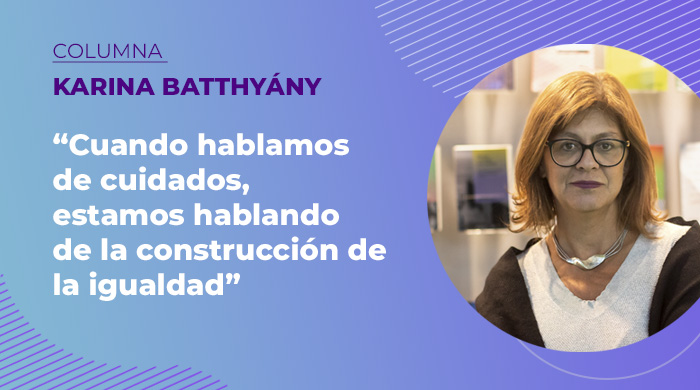
Transcript of Karina Batthyány's column
in InfoCLACSO – October 23, 2024
We are in the Month of Care, from Montevideo, Uruguay, and on the eve of International Care Day, which is coming up on October 29. This year, CLACSO joined the Global Care Alliance to focus attention on this important issue.
Since 2019, CLACSO has been promoting research, training, and advocacy on public policy related to care work, because we understand that this issue is a critical nexus of gender and social inequalities. Recently, CLACSO has become a leading organization in Latin America and the Caribbean in research, training, and public policy advocacy on this topic. We have trained a significant number of people in this area, which was relatively unknown a few years ago in the fields of social sciences, humanities, public policy, and public discourse in Latin America and the Caribbean.
Our region is moving towards building care societies, which are registering various advances such as the approval of the Care Law in Cuba. The topic of care societies emerged, on the one hand, as an academic concern, and on the other, from the feminist movements of Latin America and the Caribbean, where many transformations have taken place and care has become one of the most dynamic fields in terms of studies and public policy in recent years.
It is important to ask ourselves why care has emerged as a central social issue in our societies, particularly in Latin American and Caribbean countries. This leads us to consider why the term "care" has begun to appear prominently in public policies related to gender, health, social protection, and education. It is because care has become a key dimension of analysis, research, and advocacy in the field of social protection policies.
In terms of regulations and legislation, progress has been made in recognizing care as a public issue, no longer a private matter where each individual had to manage their own needs and care demands as best they could. The pandemic, in our region, highlighted the importance of care for the sustainability of life and the unjust social organization of care in Latin America and the Caribbean, where it continues to be considered an externality rather than a core component of development.
Gender studies from our region have conclusively demonstrated how the tasks performed in the private, domestic sphere are absolutely essential for the functioning of the economic system and for the social well-being of our countries. Therefore, the concept of care work emerges to represent the entire range of tasks that encompass the affective and relational aspects of life-sustaining activities and social reproduction.
In this sense, we can define care as the act of helping a child or dependent person in their daily life and well-being. Here, we are placing central emphasis on that dimension of daily life that we all have and organize in our day-to-day activities. This implies taking charge of material care, that is, the concrete activities involved in caring for a person. That is why we speak of care activities or work. But it also represents an economic dimension because caring for someone has a direct or indirect cost when assuming these care tasks.
Furthermore, there is an affective dimension to any caregiving relationship, that is, a relationship between a caregiver and a person being cared for. This definition includes the daily provision of physical, emotional, and affective well-being throughout a person's entire life cycle. Because we often tend to think that caregiving is only relevant to childhood or while children are young and gaining independence.
Care has two central elements to understand. First, the idea that it is a relationship. And second, that we are all interdependent and that throughout our lives we have both been recipients of care and provided care. Caregiving relationships are not a fixed element associated with our identity. That is, I am not a caregiver permanently, but rather at times I am a caregiver and at other times I am a person who requires care, and this will be the case throughout my entire life cycle.
Care has become an object of study in Latin America and the Caribbean since 2000, as well as a subject of research for those of us dedicated to this topic. It is a constantly evolving concept, relatively new in the field of social theory, and undergoing a very fruitful process of theoretical development in Latin America and the Caribbean.
Our region presents a great heterogeneity in terms of the social organization of care, derived from family dynamics, demographics, labor markets and very differentiated economic structures within it, as well as traditions from the point of view of the Latin American states that are quite dissimilar with strengths and traditions linked to the discussion of well-being.
Despite this great heterogeneity, we find some common elements when we talk about the social organization of care. Above all, it remains a family function, but not of families in general, but particularly of women in different types of families. It is always women who assume caregiving tasks, and this takes place behind closed doors, within the context of households or families in the private sphere. Moreover, these women perform this work without pay.
When caregiving takes place outside the family and in the paid sector—that is, in childcare centers or services for dependent elderly people—we also find that overwhelmingly it is women who provide care. What is consistent across our region is that women are the primary caregivers.
Time-use surveys show that women, on average, dedicate almost three times as much time as men to unpaid care work. Therefore, if we spend three times more time on average than men on caregiving, we are surely dedicating less time to other activities such as paid work, education, and social and political participation. If I have to provide care for many hours a day, I will likely be unable to enter the labor market, lack income and social protection, and fall into poverty.
Some care policies have been implemented in our region to alleviate or counteract these inequalities, but this has not yet transformed the sexual division of labor in terms of the inclusion and participation of men and women in care activities.
We need to keep updating the figures so that we can truly make progress in overcoming what we call the care crisis. This crisis arises from the mismatch between the transformations that have occurred in the public and productive spheres, which have not been accompanied by the necessary transformations in the private sphere. In our countries, political sectors often continue to reason as if there were always a woman available in every home to care for anyone who needs it at any time and to respond to all the needs of daily life and the well-being of each and every one of us.
There is also a mismatch in the correlation between the transformation of women's lives in the productive sphere and the transformation in terms of men's participation. Perhaps we wouldn't be talking about a care crisis if there had been a similar transformation in the reproductive sphere, that is, a redistribution of labor within households between men and women. Time-use surveys clearly show that this did not happen.
Furthermore, this isn't just a micro-level issue, affecting interactions within households, but also a macro-level one, because in our countries, states haven't assumed their share of responsibility for care work. There's a lack of public policy formulation to address this care crisis. Of course, there has been progress in the last 10 years, with the emergence of care systems (like in Uruguay), national and local care policies (like in Colombia and Chile), and the drafting of a Care Law in Argentina, which unfortunately wasn't approved in the previous term and has been forgotten in the current one.
One of the major advances is that many countries in the region recognize the right to care. But we continue to see that deep gap, so familiar to feminists, between the formal declaration of a right and the actual possibility of exercising it.
In Uruguay, for example, care is a right. However, the cuts implemented in the last five years to the care system prevent all Uruguayans from exercising this right. Therefore, we face challenges in terms of the redistribution, recognition, and revaluation of these tasks, which are central to the daily lives of each and every person, but also to the production of collective social well-being.
Everyone has the right to receive the care they need at different stages of their life cycle. The right to care must be guaranteed by the state. And everyone also has the right to provide care when they want to do so, for which there must be public policies that guarantee this right, such as maternity and paternity leave.
During Care Month and on International Care Day, it is important, first, to consider raising awareness of this issue. And second, to consider policies that can address this need. Because the challenge ahead is how to move towards societies where individuals and society as a whole recognize and value the importance of care, but without reinforcing the gendered division of labor and the idea that only girls and women can do it.
– What is happening in other parts of the world with the care debate?
– The issue of care is a global debate. Of course, there are differences depending on the region. For example, there is a tradition in Europe of highly developed welfare policies that incorporate these issues. This is not the case in the United States, where the discussion is more recent, even in Asian countries.
In short, the issue of care is being discussed worldwide and in regional contexts. What I want to emphasize is the particularity of the debate in Latin America, because it has a level of theoretical and conceptual output, as well as innovation in public policy, that is being observed in other regions.
When we talk about care and social welfare, we are talking about building equality between men and women. As we know, the discussion about equality is also about political orientations and ideological shifts, which we so frequently observe in our Latin American and Caribbean countries. Another important element is the role of the State and how it should or should not intervene at the social level. This is a long-standing debate in the social sciences about the roles of the State and the market, and the construction of equality. And when we talk about social welfare, we are essentially talking about States that guarantee it.
If you would like to receive more information about CLACSO's training programs:
[widget id=”custom_html-57″]
to our email lists.

