
Marxist critique of the world economy
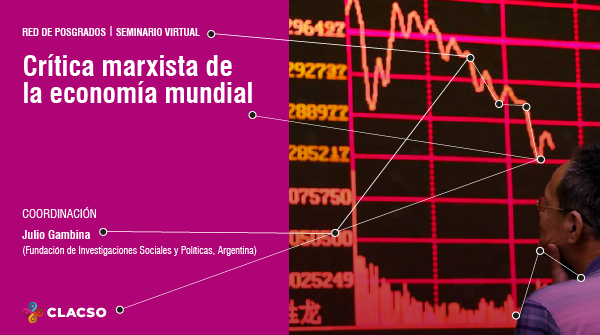
Seminar 2039
Coordination : Julio C. Gambina (Foundation for Social and Political Research, Argentina).
Teaching team: Enrique Elorza (National University of San Luis, Argentina), Germán Pinazola (National University of General Sarmiento, Argentina), Gabriela Roffinelli (University of Buenos Aires, Argentina), Lucas Castiglioni (National University of the Center of the Province of Buenos Aires. Tandil, Argentina).
Start date : 17/06/2020 | Registration : 20/04/2020 to 16/06/2020
Workload: 12 weeks – 90 hours.
This course proposes a critical analysis of contemporary capitalism and its global civilizational crisis. Among its most pressing manifestations are: the increase in social inequality, forced migrations, unemployment, job insecurity, the feminization of poverty, the loss of social rights, the widespread deterioration of living conditions for the majority of the working population globally, the imminent ecological catastrophe, and the ongoing imperialist wars for control of the natural resources of countries in the Global South. Added to this is the global and regional rise of dangerous racist, xenophobic, patriarchal, and neocolonial ideologies. The analysis proposed to the students involves introducing the fundamental theoretical elements of Marxism to the concrete confrontation of the theoretical and practical problems presented by the development of the global capitalist economy, and particularly in the forms it takes in Latin America and the Caribbean.
- The Marxist critique of classical political economy
- Classical Marxists: Imperialism, the colonial problem, the socio-economic formations of Our America and the emancipatory struggles
- Marxist dependency theory and the problem of (under)development in Latin America and the Caribbean
- Latin America in the new world stage
- global civilizational crisis
- Work, flexibility, precariousness, unemployment
- Capitalism and environmental destruction
- Capitalism and patriarchy: the double oppression of women
- Advance of the global and Latin American right wing
- Political economy in transition
- Alejandro Alvarez Béjar (2019): Global message from climate activists: “change is coming, whether you like it or not…”, in Bulletin No. 36. Our America XXI. Challenges and Alternatives. CLACSO Working Group. Crisis and World Economy
- Antonio Gramsci (1999) Prison Notebooks, Notebook 13. Brief Notes on Machiavelli's Politics. Mexico. Era Publishing House.
- Armando Negrete (2020): IMPACT OF THE TRADE WAR ON EXPORTS, in Bulletin No. 39. Our America XXI. Challenges and Alternatives. CLACSO Working Group. Crisis and World Economy
- Atilio A. Boron (2012) Latin America in the Geopolitics of Imperialism. Luxeburg Publishing House. Argentina
- Carlos Eduardo Martins (2015) “The capitalist world-system and the new geopolitical alignments in the 21st century: a prospective vision”, in Sovereignty, hegemony and integration, Marco Gandásegui, Carlos Martins and Pablo Vommaro, coordinators. — 1st ed. — Quito: IAEN Publishing House. p. 19-51
- Claudio Katz (2019): THE DISPUTE IN LATIN AMERICA, in Bulletin No. 38. Our America XXI. Challenges and Alternatives. CLACSO Working Group. Crisis and World Economy.
- Crisis and World Economy (Enzo Traverso (2018) The new faces of the right. Argentina. 21st Century.
- Eduardo Martins. Colombia. Century of Man - CLACSO
- Elorza, Enrique (2019): Political Economy in Transition. Moving Towards a Table Set for All in Our America. Ed. Foundation for Social and Political Research (FISYP) Second edition, enlarged and corrected. Argentina. Pg. 376 to 414
- Erika Barzola and Paola Andrea Baroni. (2018) "China's approach to South America. Deepening of neo-extractivism and increase in socio-environmental conflicts and resistance." Colombia Internacional 93 (2018).
- Gambina, Julio. (2008) Introductory Study to Karl Marx [1857] Introduction to the Critique of Political Economy. Buenos Aires. Luxembourg Publishing House. (Pages 9 to 50)
- Jorge Hernández Martínez (2020): THE EMPIRE IN ITS LABYRINTH, in Bulletin No. 39. Our America XXI. Challenges and Alternatives. CLACSO Working Group. Crisis and World Economy
- José Carlos Mariátegui (1987) Anti-imperialist viewpoint. In Ideology and Politics. Peru. Minerva Bookstore Publishing House.
- Josefina Morales (2019): The original accumulation in the 21st century, in Bulletin No. 28. Our America XXI.
- Julio C. Gambina (2019): ENVIRONMENT AND CAPITALISM, in Bulletin No. 36. Our America XXI. Challenges and Alternatives. CLACSO Working Group. Crisis and World Economy
- Loreta Tellería Escobar (2019): GEOPOLITICS FROM THE PERSPECTIVE OF WOMEN, in Bulletin No. 37. Our America XXI. Challenges and Alternatives. CLACSO Working Group. Crisis and World Economy.
- Lucas Castiglioni (2019): GENDER VIOLENCE AGAINST WOMEN IN LATIN AMERICA, in Bulletin No. 38. Our America XXI. Challenges and Alternatives. CLACSO Working Group. Crisis and World Economy
- Néstor Kohan (2019): COUP D'ÉTAT IN BOLIVIA: PENDING DEBATES AND COMPLICIT SILENCES, in Bulletin No. 38. Our America XXI. Challenges and Alternatives. CLACSO Working Group.
- Orlando Caputo and Graciela Galarce (2019): United States; Decrease in profits in the Manufacturing Industry, in Bulletin No. 34. Our America XXI. Challenges and Alternatives. CLACSO Working Group. Crisis and World Economy.
- Pasqualina Curcio Curcio (2019): Venezuela. Unusual and extraordinary threat, in Bulletin No. 28. Our America XXI. Challenges and Alternatives. CLACSO Working Group. Crisis and World Economy.
- Ramón Fernández Durán (2011) The Collapse of Global Capitalism: 2000-2030. Preparing for the Beginning of the Collapse of Industrial Civilization. Ed. Libros en Acción-Baladre, State Coordinator of Struggles Against Unemployment, Poverty and Social Exclusion. Argentina
- Network in Defense of Humanity (2019): SAVE THE AMAZON! SAVE THE PLANET! In Bulletin No. 35. Our America XXI. Challenges and Alternatives. CLACSO Working Group. Crisis and World Economy
- Rodríguez José Luis, (2014): The collapse of Socialism in Europe, Ed. Ciencias Sociales-Ruth. Casa Editora, Cuba.
- Rosa María Marques (2019): Brazil: Rumoá Barbárie? , in Bulletin No. 36. Our America XXI. Challenges and Alternatives. CLACSO Working Group. Crisis and World Economy.
- Ruy Mauro Marini (2008) Latin America, Dependency and Globalization. Anthology. Compiler: Carlos
- Vladimir Ilyich Lenin (2009) [1916] Imperialism, the highest stage of capitalism. Buenos Aires. Luxemburg Publishing House.
If you have a link with a CLACSO Associated Center:
- Paying in one payment: USD 95 (includes issuance and shipping costs of the digital certificate).
- Paying in one payment: USD 140 (includes issuance and shipping costs of the digital certificate).
- Paying in one payment BEFORE 07/06/2020: USD 150 (includes issuance and shipping costs of the digital certificate).
- Paying in one payment: USD 190 (includes issuance and shipping costs of the digital certificate).
FAQ
The basic requirements for taking a seminar are:
- Availability of at least 4 hours per week to dedicate to the seminar course.
- Internet access.
- Reasonable handling of communication and computer tools.
- Language proficiency in the language in which the course will be taught. The official languages are Spanish and Portuguese.
|
|
Discount for one payment until 16/03 |
In one payment after 16/03 |
|
CM Plenos |
$75 |
$150 |
|
CM Associates |
$95 |
$190 |
|
No link |
$95 |
$190 |

